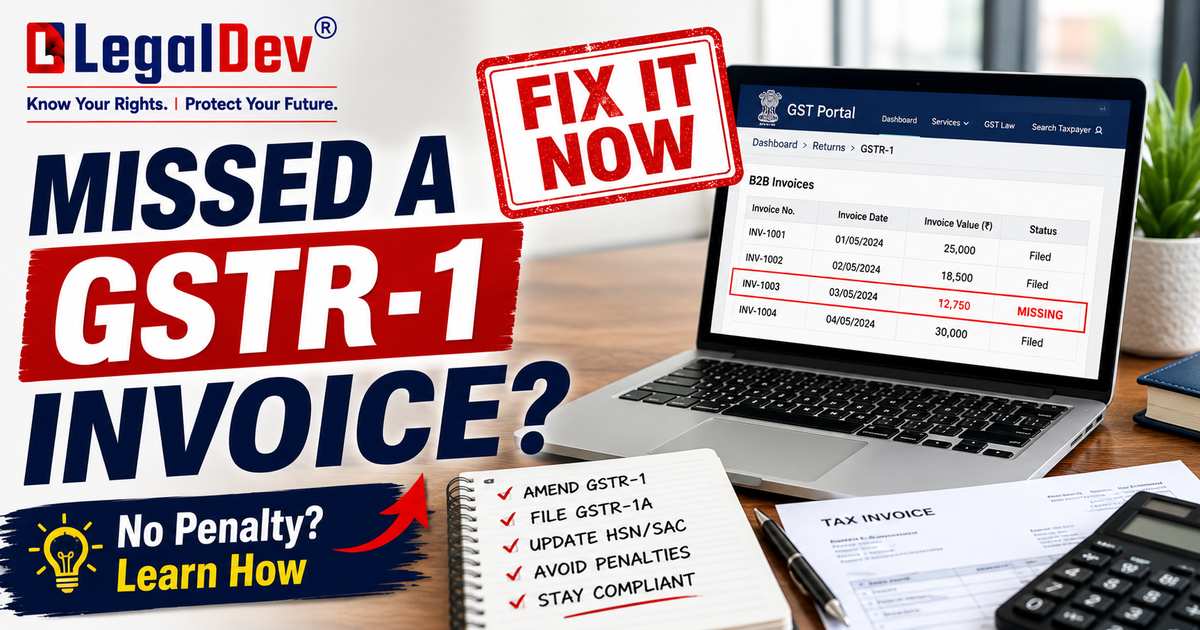
Missed an Invoice in GSTR-1? Here's How to Fix It the Right Way
Forgetting to report an invoice while filing GSTR-1 is one of the most common slip-ups GST-registered businesses run into. The good news? It's fixable. The bad news? There's a deadline, and missing it can create real headaches from blocked Input Tax Credit for your buyer to notices from the GST department.
This guide walks you through exactly how the correction process works, where each type of invoice needs to go, and how long you actually have before the window closes.
Quick Summary
-
A missed invoice cannot be edited directly inside an already-filed GSTR-1. it has to be added in a later filing.
-
Depending on the invoice type, it goes into Table 4 (B2B), Table 5 (large B2C), Table 6A (exports), or Table 7 (regular B2C).
-
The cut-off to add it is 30th November of the next financial year, or the date you file your annual return (GSTR-9) whichever comes first.
-
Leaving it unreported for too long can delay your buyer's ITC, trigger mismatches, and in some cases invite penalties.
Can You Actually Add a Missed Invoice After Filing GSTR-1?
Yes, but not by reopening the original return. Once GSTR-1 is filed for a tax period, that filing is locked. GST law doesn't permit a direct edit to a submitted return. Instead, you report the missing invoice in a later filing.
There are two routes, depending on timing:
Route 1: GSTR-1A (if you haven't filed GSTR-3B yet for that period) GSTR-1A lets you add or fix invoice details for the same tax period, but only before you file GSTR-3B for it. Once that window passes, GSTR-1A is no longer an option for that period.
Route 2: A subsequent GSTR-1 If GSTR-3B has already gone in, the missed invoice has to wait until your next GSTR-1 filing (the following month or quarter, depending on your filing frequency).
One important nuance: when you fix something through GSTR-1A, it flows into your own GSTR-3B for that period but your buyer won't see the credit retroactively in an already-generated GSTR-2B. They'll get it reflected in the next GSTR-2B cycle instead.
Why Invoices Go Missing in the First Place
Most slip-ups trace back to a handful of repeat offenders:
1. Wrong or missing GSTIN Type a digit wrong, or leave the field blank, and your buyer's ITC claim hits a wall often followed by a department query on your side too.
2. Incorrect HSN/SAC codes Wrong classification codes throw off your filings and make audits far more painful than they need to be.
3. Wrong tax rate Apply the wrong CGST/SGST/IGST split, and you've created a mismatch between GSTR-1 and GSTR-3B that someone will eventually have to reconcile.
4. Incomplete invoice data A valid GST invoice needs all of the following miss one and it can get flagged as invalid:
-
Invoice number and date
-
Supplier and recipient GSTIN
-
Place of supply
-
HSN/SAC code
-
Tax breakup and amount
5. Late invoicing Raising the invoice after the due date is a frequent issue in B2B dealings, where ITC timing for the buyer is tightly linked to when the invoice actually gets filed.
6. Duplicate invoice numbers Reusing a number creates conflicting records that surface during reconciliation or audit and can escalate into a formal notice.
7. Buyer/seller detail mismatches Wrong business name, address, or GSTIN on either side derails matching and puts ITC at risk.
Where Each Type of Missing Invoice Belongs in GSTR-1
The table you use depends entirely on who the invoice was issued to and its value.
|
Invoice Type
|
Table in GSTR-1
|
When It Applies
|
|
B2B (registered buyer)
|
Table 4 (4A, 4B, 4C, 6B, 6C)
|
Any sale to a GST-registered business
|
|
B2C Large
|
Table 5A / 5B
|
Unregistered buyer, invoice value above ₹1 lakh
|
|
B2C Others
|
Table 7
|
Regular B2C sales of ₹1 lakh or less, inter- or intra-state
|
|
Exports
|
Table 6A
|
Any export invoice, with or without tax payment
|
Getting this mapping right matters putting a large B2C invoice in Table 7 instead of Table 5, for instance, can throw off your reported tax liability and complicate any later reconciliation.
Step-by-Step: How to Actually Add the Missing Invoice
If You Haven't Filed GSTR-3B Yet Use GSTR-1A
-
Sign in at the GST portal.
-
Navigate to Services → Returns → Return Dashboard.
-
Pick the tax period you need to fix (say, October 2025).
-
Open GSTR-1A and select the relevant invoice table from the list above.
-
Enter the invoice details and save.
-
File GSTR-1A before you submit GSTR-3B for that same period this step is time-sensitive.
If GSTR-3B Is Already Filed, Add It in Your Next GSTR-1
-
Log into the portal and open the upcoming GSTR-1 filing period.
-
Choose the correct table B2B, B2C, or Export, based on the invoice.
-
Enter the invoice number and date exactly as per your original records.
-
Save the entry, then file the return using DSC or EVC.
-
Make sure this happens within the prescribed deadline (covered below).
A quick gotcha worth flagging: amendment tables in GSTR-1 are meant for correcting invoices you already reported not for adding ones you forgot entirely. For a missing invoice, you need the add record option in the relevant table, not the amendment section.
How Long Do You Have to Fix It?
The deadline is fixed: 30th November of the following financial year, or the date you file your GSTR-9 annual return whichever happens first.
So for FY 2025-26, the absolute cut-off to report a missed invoice is 30th November 2026, assuming you haven't already filed your annual return before that.
A few extra things worth knowing:
-
There's no separate cut-off for editing or deleting an invoice within the same tax period you can do that freely until you actually file that period's GSTR-1.
-
A recipient's GSTIN, once filed, cannot be changed through GSTR-1A that correction has to go through a later GSTR-1, within the same overall time limit.
What Happens If You Don't Fix It in Time
Letting a missing invoice slide has consequences that go well beyond a single return:
Cash flow gets squeezed. If your buyer's payment is tied to invoice processing, a missing entry can delay that payment and a chain of delayed payments puts pressure on your own ability to cover salaries, supplier dues, and operating costs.
You risk penalties and scrutiny. Mismatched sales and purchase data is exactly the kind of thing that draws attention during a GST audit, and persistent discrepancies can escalate into penalties.
Trust takes a hit. Clients and partners notice when invoicing is inconsistent. It's a small thing that compounds into a reputation problem over time.
ITC takes the biggest hit. This is usually the most expensive consequence your buyer can't claim Input Tax Credit on a purchase that never shows up in your GSTR-1, which directly increases their effective tax cost.
Frequently Asked Questions
Can I revise a GSTR-1 once it's filed?
No, a filed GSTR-1 can't be reopened. If you haven't filed GSTR-3B yet for that period, GSTR-1A is your option. After that, the invoice has to go into a later GSTR-1.
Which table should a missing invoice go into?
It depends on the invoice type B2B goes into Table 4, large B2C into Table 5, regular B2C into Table 7, and exports into Table 6A.
Can I use the amendment tables for a missed invoice?
No. Amendment tables are strictly for fixing invoices you've already reported. A missing invoice needs to go through the "add record" flow in the right table instead.
What's the actual deadline?
30th November of the following financial year, or your GSTR-9 filing date whichever is earlier.
Will I be charged a penalty just for adding a missed invoice?
Not directly for the addition itself, but if it increases your tax liability, interest can apply on that additional amount, separate from any late fee on the overall return.
The Bottom Line
A missed invoice in GSTR-1 isn't the end of the world, but it does need fixing through the correct process, in the correct table, within a fixed window. Catch it before you file GSTR-3B, and GSTR-1A makes it simple. Miss that window, and you're waiting for the next GSTR-1 cycle. Either way, the earlier you report it, the less disruption it causes to your ITC, your cash flow, and your relationship with whoever's on the other side of that invoice.