The Rupee Is Moving Again — But Is It Built to Last?
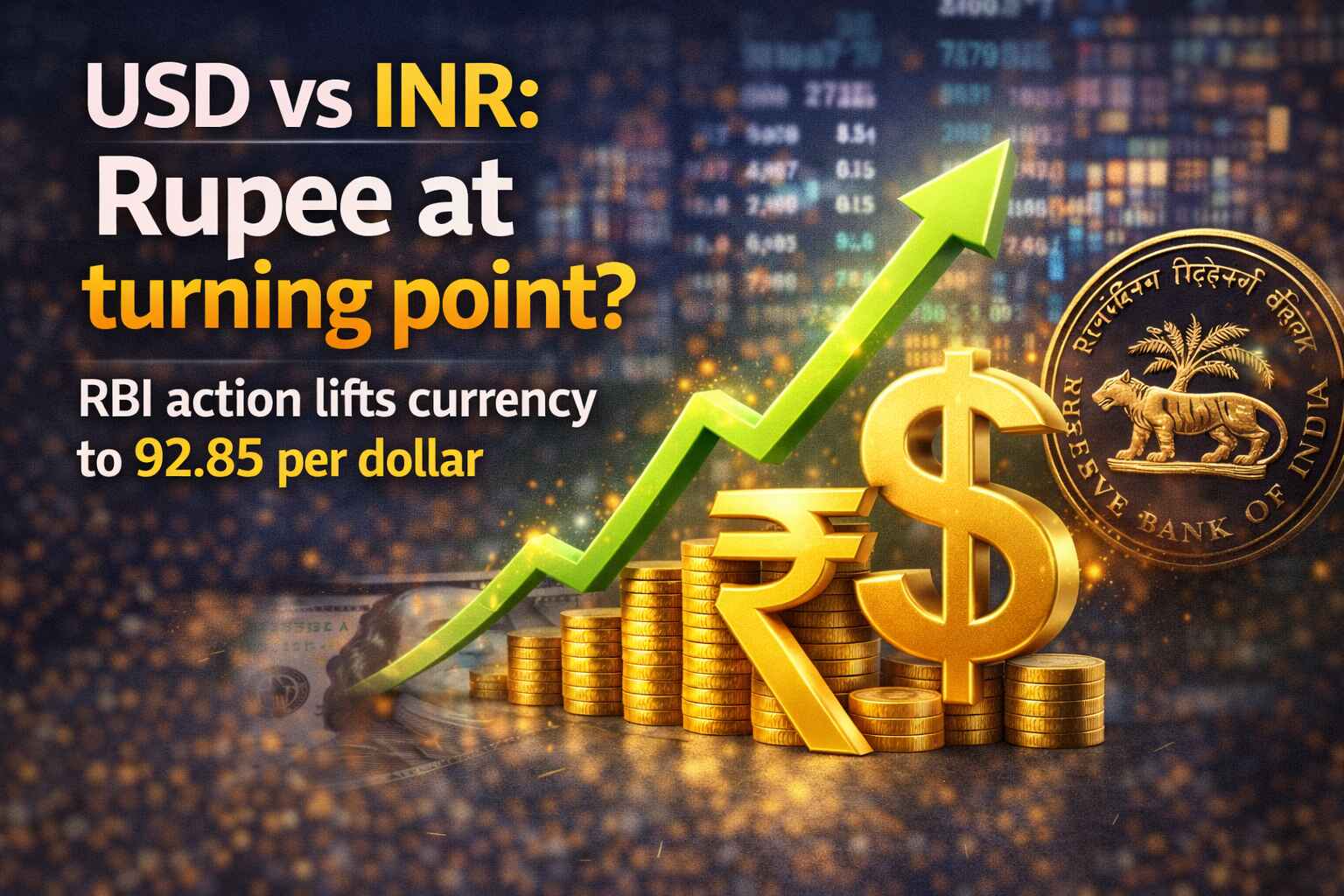
Monday morning. The rupee opened at 93.13 against the US dollar and almost immediately started climbing. By early trade it had risen 33 paise, touching 92.85. That might not sound dramatic, but in currency markets, 33 paise in a single session is a meaningful move.
This builds on something even bigger. Last Thursday, the rupee surged nearly 1.8% in a single day — one of its largest single-session gains in over 12 years. Two strong sessions back to back. Sentiment has clearly shifted.
The question worth asking right now: is this a genuine turning point, or just a relief rally that fades as quickly as it arrived?
What Actually Triggered This Rupee Recovery
It wasn't a surprise. The Reserve Bank of India moved deliberately, and the market responded.
The RBI tightened rules in the forex derivatives market and capped banks' net open positions at $100 million. That cap is significant — it directly limits how aggressively traders can bet against the rupee. The message the central bank was sending wasn't subtle: disorderly depreciation won't be tolerated, and speculative positioning will face consequences.
Market participants have read this clearly. The RBI's intervention forced traders who had built large bearish bets on the rupee to unwind those positions quickly. That unwinding — known as short covering — is what powered the sharp rally. It's the mechanism behind why the move was so fast.
India's forex reserves added confidence to the picture. The reserves are currently seen as adequate to cover roughly 12 months of imports — a buffer that gives the RBI room to keep intervening if the currency comes under pressure again.
The Bull Case — Why the Rupee Could Strengthen Further
Zee Business research points to several factors that could support further gains:
The RBI's proactive stance has reduced near-term downside risk. When a central bank shows willingness to act, speculative pressure tends to ease — at least temporarily. Strong forex reserves give the central bank meaningful firepower. Easing geopolitical tensions, if they materialize, could bring down crude oil premiums — which matters enormously for India's import bill. A potential trade deal with the UK could improve export competitiveness and bring in foreign exchange over the medium term. Lower currency volatility, if it persists, could also bring back carry trade interest — foreign investors borrowing in low-rate currencies to invest in higher-yielding Indian assets.
Global brokerages are also backing the rupee's trajectory. Bank of America expects the rupee to strengthen toward 86 per dollar. ING sees it heading toward 87 per dollar. Those are meaningfully stronger than where it's trading right now.
The Bear Case — What Could Reverse These Gains Fast
The optimism is real, but so are the risks.
The US dollar index is still holding firm above the 100 mark — a level that historically creates headwinds for emerging market currencies including the rupee. The RBI can intervene in the short run, but sustained intervention isn't indefinitely viable. At some point, the central bank has to weigh reserve depletion against currency defence.
Foreign institutional investors remain a structural concern. FIIs pulled out nearly ₹1.22 lakh crore in March 2026 — the ninth consecutive month of outflows. Nine straight months. That kind of persistent capital outflow doesn't reverse overnight, and it keeps structural pressure on the rupee regardless of short-term RBI action.
Oil prices are the other wildcard. For every $10 rise in crude oil prices, India's current account deficit widens by approximately 0.5% of GDP. If crude spikes — driven by geopolitical events in West Asia or a supply shock — much of the rupee's recent recovery could reverse quickly.
US trade and tariff policy uncertainty adds another layer of volatility that's difficult to predict or hedge against.
Some global firms aren't buying the rally narrative at all. UBS expects the rupee to weaken to 94 per dollar. Bernstein is even more bearish — they see levels as weak as 98 per dollar. That's a wide range of forecasts, which itself tells you how much genuine uncertainty exists here.
Where the Rupee Stands Right Now — and What to Watch Next
At around 12:57 PM on Monday, the rupee was trading at 93.14 against the US dollar — slightly off the session's early highs but still well within its recovery zone.
The short-term picture has clearly improved. The RBI has demonstrated willingness to act. Speculative shorts have been squeezed. Sentiment has shifted from bearish to cautiously constructive.
But the structural challenges — FII outflows, a firm dollar index, oil price sensitivity, and external uncertainties — haven't gone away. They've just been temporarily overshadowed by the RBI's policy action.
Honestly, whether this becomes a sustained recovery or just a technical relief rally depends on factors that are difficult to call right now. What happens with US tariffs, where crude goes, whether FII flows turn around — none of that is clear. The RBI has bought time and stabilised sentiment. What the market does with that time is the real question.
Frequently Asked Questions
Why did the rupee jump nearly 1.8% in a single day last Thursday — what caused that?
A move of 1.8% in a single session is unusual for the rupee — it was reportedly one of the largest single-day gains in over 12 years. The trigger was the RBI's combination of tightening forex derivative norms and capping banks' net open positions at $100 million. This forced traders who were positioned bearishly on the rupee to rapidly cover their short positions, creating a self-reinforcing rally. When short covering happens in a thin market, even moderate buying pressure creates outsized price moves. The Thursday surge was largely a technical reaction to forced position unwinding, not just organic demand for rupees.
What does the RBI's $100 million net open position cap actually mean for the rupee?
Banks actively trade currencies and take positions on where exchange rates will move. A "net open position" is essentially the difference between a bank's total long positions and total short positions in a currency — it's a measure of how much directional risk they're carrying. By capping this at $100 million, the RBI is preventing banks from making massive bets against the rupee. It reduces the scale of speculative selling that can occur in the market at any one time. This doesn't eliminate pressure on the rupee, but it does limit how fast or how far any speculative move can go in a single session.
How do FII outflows of ₹1.22 lakh crore affect the rupee over time?
When foreign institutional investors sell Indian stocks or bonds, they convert rupees back into dollars — that's direct dollar demand and rupee supply hitting the forex market simultaneously. ₹1.22 lakh crore in outflows over a single month (March 2026) represents an enormous amount of selling pressure. Nine consecutive months of FII outflows means this has been a structural headwind for the rupee throughout the past year, not a one-off event. The RBI can offset some of this through intervention, but it can't absorb every rupee of outflow indefinitely without depleting reserves. Until FII sentiment turns — driven by either India's growth outlook, valuation attractiveness, or global risk appetite shifting — this pressure doesn't fully disappear.
Is the rupee's recovery toward 86-87 per dollar realistic given the current environment?
Bank of America's 86 target and ING's 87 forecast are on the optimistic end of the spectrum — and they contrast sharply with UBS at 94 and Bernstein at 98. That ₹12 gap between the most bullish and most bearish forecasts tells you how much genuine disagreement exists among serious analysts right now. The bull case requires FII outflows to reverse, crude oil to stay contained, US tariff uncertainty to ease, and the RBI to stay proactive. That's a lot of things going right simultaneously. The bear case just needs one or two of those to go wrong. Both scenarios are possible, which is exactly why the range of forecasts is so wide.
How does India's 12-month import cover in forex reserves compare to other emerging markets — is it actually safe?
Having reserves that cover 12 months of imports is generally considered comfortable — the International Monetary Fund's typical benchmark for emerging markets is around 3 months of import cover. India's position at roughly 12 months is genuinely strong by that standard. However, the relevant risk isn't just import cover — it's also the pace of reserve depletion from RBI intervention. If the RBI is spending $5–10 billion per month defending the rupee, even a large reserve buffer can shrink faster than the monthly import cover number suggests. Tracking the RBI's weekly reserve data is the most direct way to gauge how much firepower is actually being used versus held in reserve.