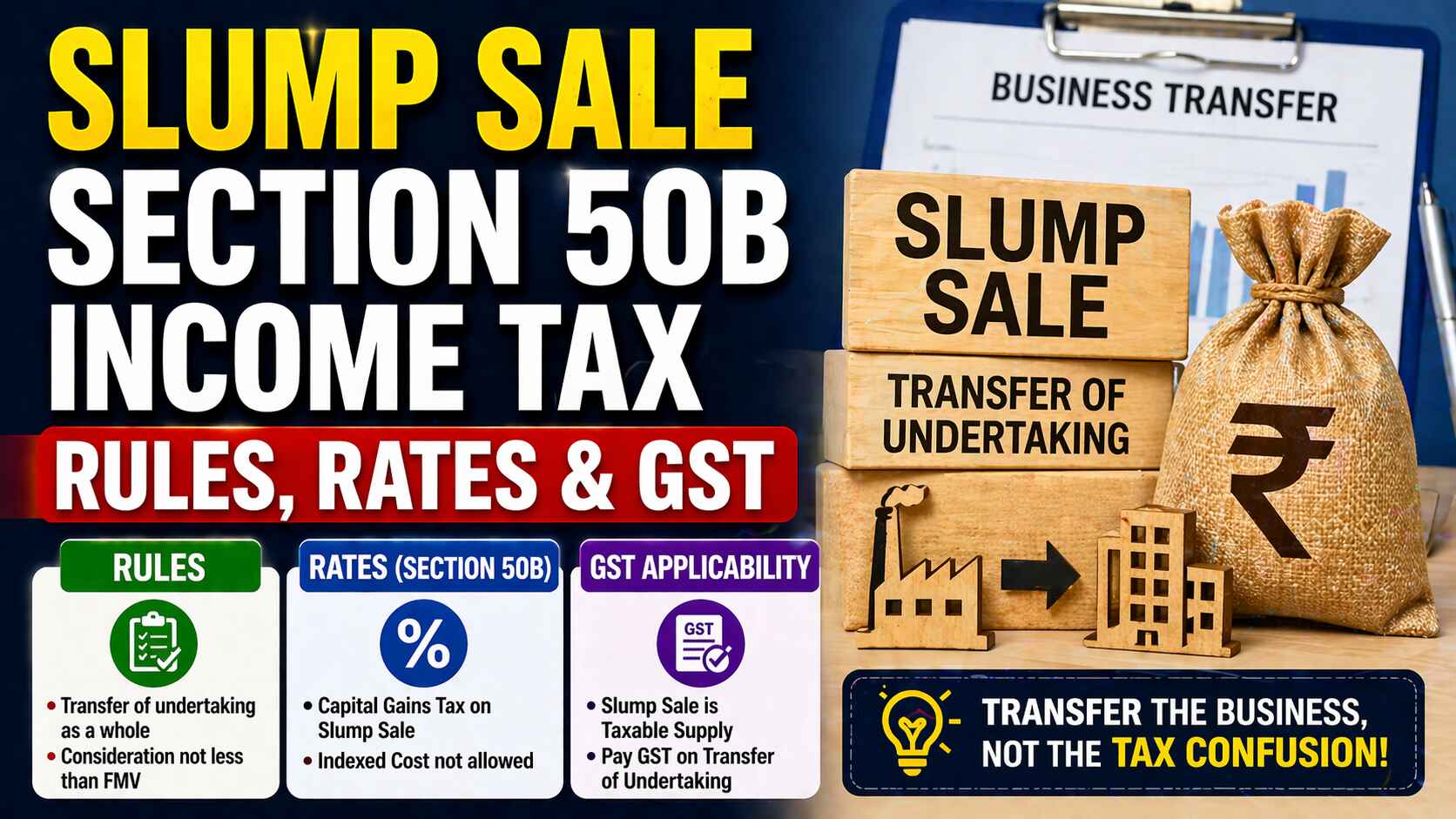
Slump Sale Under Section 50B: Capital Gains, GST & Tax Rules
Large and mid-sized companies rarely stay simple for long. Over time, they grow into multi-division structures where separate business units operate independently — each with its own assets, liabilities, and commercial focus. When one of those units needs to move to a different owner, the company has two choices: sell every asset one by one, or transfer the whole unit in a single deal. That second option is what Section 50B of the Income Tax Act governs, and it's called a slump sale.
In practice, I've seen companies spend weeks negotiating slump sale terms only to realize too late that the holding period flips their entire tax math. Getting the structure right from the start matters far more than most people think.
What Exactly Is a Slump Sale — And Why It Matters for Tax
A slump sale under income tax is a transaction where an entire business undertaking gets transferred to a buyer as a single package — without assigning individual values to each asset or liability inside it. The undertaking moves as a whole, not in parts.
Now, individual asset values aren't entirely irrelevant. They may still need to be worked out for stamp duty calculations or similar purposes. But for the core income tax computation, no separate pricing happens for each item in the deal.
How Slump Sale Capital Gains Are Actually Calculated
Any gain — or loss — arising from a slump sale gets taxed as a Capital Gain under the Income Tax Act. The computation follows a specific formula:
|
Particulars |
Amount |
|
Full Value of Consideration (higher of FMV1 or FMV2 under Rule 11UAE) |
Rs. XXX |
|
(–) Expenses directly related to the transfer |
Rs. XXX |
|
Net Consideration |
Rs. XXX |
|
(–) Net Worth of the Undertaking (cost of acquisition) |
Rs. XXX |
|
Capital Gain or (Loss) |
Rs. XXX |
Whether the resulting gain is long-term or short-term depends entirely on how long the undertaking has been held.
-
Held for more than 36 months → Long-Term Capital Gain (LTCG)
-
Held for 36 months or less → Short-Term Capital Gain (STCG)
One thing that catches many sellers off guard: there's no indexation benefit available here, even on long-term slump sales. The net worth figure gets used as-is, without any inflation adjustment.
Full Value of Consideration — FMV1 vs FMV2 under Rule 11UAE
The sale price you report to the tax department isn't simply what the buyer pays you. Rule 11UAE of the Income-tax Rules requires you to calculate two FMV figures and use whichever is higher:
-
FMV1 — Fair market value of the capital assets being transferred, as of the transfer date
-
FMV2 — Fair market value of the consideration actually received (cash, kind, or both combined)
The higher of these two becomes the full value of consideration. This prevents sellers from understating the deal value.
Net Worth Calculation for Slump Sale — What Gets Included and What Doesn't
The net worth of the undertaking functions as the cost of acquisition for capital gains purposes. Four rules govern how you calculate it:
-
Any revaluation of assets or liabilities is excluded — book values post-revaluation don't count
-
Depreciable assets are valued at their Written Down Value (WDV) as per the Income Tax Act
-
Assets where a full 100% deduction was already claimed under Section 35AD get a zero value
-
All other assets use the value shown in the books of accounts
And here's a detail that matters: if applying these rules produces a negative net worth, the cost of acquisition is treated as nil — not as the negative number itself. That means the entire consideration becomes taxable as capital gain.
Tax Rates That Apply — Short-Term vs Long-Term
-
Short-Term Capital Gain (STCG) — taxed at normal rates applicable to the company
-
Long-Term Capital Gain (LTCG) — taxed at 20%
Reporting Requirement: Form 3CEA
Before filing its tax return, the company must obtain and submit a report from a Chartered Accountant in Form 3CEA. This is mandatory — not optional.
GST on Slump Sale: Transfer as a Going Concern
GST is built around the concept of "supply." A slump sale qualifies as a supply, so it does fall within GST's scope. But it's a specific kind of supply — "transfer as a going concern" — and that classification attracts a nil rate of GST.
What does "going concern" mean in practice? It means the business being transferred can continue operating under new ownership without any fundamental restructuring. The buyer is essentially stepping into the seller's shoes and running the same business.
The nil-rate treatment is generally accepted, though the exact scope of "going concern" still generates some professional debate in grey-area cases. The AAR Karnataka confirmed this nil-rate classification in the Rajashri Foods matter, which provides useful precedent.
Accumulated Losses and Depreciation
The transferor company gets to carry forward any accumulated business losses and unabsorbed depreciation after the slump sale. These don't disappear with the deal.
Slump Sale vs Itemized Sale: The Tax Difference Nobody Tells You
To understand what makes a slump sale valuable, it helps to look hard at the alternative. In an itemized sale, every asset gets separately valued and sold, each with its own consideration. The tax treatment works out very differently.
Depreciable Assets: Why Short-Term Tax Hurts in an Itemized Sale
When all the assets within a particular block are sold together in an itemized deal, the gain is calculated as:
Net Sale Consideration – WDV of the Block = Capital Gain or (Loss)
Here's the problem — depreciable assets always generate short-term gains or losses, regardless of how long the company has owned them. Short-term gains get taxed at the normal company rate, which is often around 30%.
Sell those same assets as part of a slump sale where the undertaking has been held for more than 3 years, and the whole picture changes. Now you're looking at LTCG taxed at 20%. That gap — 30% vs 20% — is real money.
Other Assets: Business Profits vs Capital Gains
When non-depreciable assets transfer in a business sale (not a slump sale), the gain often gets treated as business profits under "Profits and Gains of Business or Profession." Business profits attract normal tax rates.
Under a slump sale, those same assets — if the undertaking has been held for over 3 years — qualify for 20% LTCG treatment instead. The structure of the deal changes the tax category entirely.
The Exception: Loss-Making Companies May Prefer Itemized Sales
There's one situation where an itemized sale can actually come out ahead. If the company has significant brought-forward business losses, an itemized sale that generates business profits lets you set those profits against those losses — potentially wiping out a big chunk of tax liability. A slump sale generating capital gains doesn't give you that set-off option.
Case Study: Supreme Court Ruling on Depreciable Assets in a Slump Sale
The assessee manufactured sheet metal components and had held that undertaking for over six years. It sold the entire business — all assets and liabilities included — to another company in one transaction and treated the gain as LTCG under slump sale rules.
The Assessing Officer disagreed. Because the deal involved depreciable assets, the officer argued Section 50(2) applied, which would mean STCG at normal rates.
The Supreme Court sided with the assessee. Section 50(2) covers situations where an assessee transfers one or more asset blocks used in business. But where an entire business is sold as a running concern — assets and liabilities together — that's a different transaction altogether. The gain can't be forced into short-term treatment just because depreciable assets are part of the bundle.
Separately, the AAR Karnataka confirmed in the Rajashri Foods case that slump sales constitute a supply under the CGST Act and that such supply carries a nil GST rate.
Three More Rules That Can Catch You Off Guard
Slump sales carry some less-discussed implications that are worth knowing before the deal closes.
First, there's a general income tax provision that taxes the difference between fair market value and actual consideration as "Income from Other Sources" when property is received below FMV. This doesn't apply when an entire undertaking transfers as a slump sale — the provision is specifically excluded.
Second, not every asset in the business needs to transfer to qualify as a slump sale. What matters is that the assets being transferred can operate as a functioning undertaking by themselves. Leaving one or two peripheral assets behind doesn't disqualify the deal — but stripping out core assets would.
Third, the consideration must be in cash. If the buyer pays with shares, bonds, debentures, or any other security, the transaction legally becomes an "exchange," not a sale. That changes the entire tax treatment.
Choosing Right: When a Slump Sale Under Section 50B Makes Sense
A slump sale under Section 50B gives businesses a clean, practical way to shift an entire undertaking to a new owner in one move — without the time and cost of valuing every single asset and liability separately. But clean doesn't mean simple. Capital gains computation, FMV determination under Rule 11UAE, net worth calculation, Form 3CEA reporting, and the going-concern test for GST all demand careful attention.
Against an itemized sale, a slump sale often comes out ahead on tax — particularly when the undertaking has been held for more than three years and LTCG rates apply across the board. Whether that advantage holds in your specific situation depends on the company's financial position, its loss carry-forwards, and what the long-term strategy looks like after the deal closes. Getting that analysis right before negotiating terms is the move that actually saves money.
Questions People Actually Search Before a Slump Sale
Is indexation available on long-term capital gains from a slump sale?
No — and this surprises a lot of people. Section 50B explicitly blocks indexation even for long-held undertakings. The net worth is used as the cost of acquisition exactly as calculated, with no inflation adjustment. The tax rate drops to 20% for LTCG, but your gain figure won't shrink the way it would with other capital assets. Factor this into your pricing expectations before the deal.
Can depreciable assets be part of a slump sale and still attract long-term capital gains tax?
Yes. The Supreme Court settled this. When an entire business is sold as a running concern — including all assets and liabilities — Section 50(2) doesn't apply. The holding period of the undertaking as a whole decides the STCG/LTCG classification. If the undertaking has been held for over 36 months, you get LTCG at 20%, regardless of depreciable assets in the mix.
How does Rule 11UAE determine the full value of consideration in a slump sale?
Rule 11UAE requires calculating two FMV figures. FMV1 is the market value of the capital assets being transferred on the date of sale. FMV2 is the market value of the consideration you actually receive — cash, kind, or a combination. Whichever is higher becomes the full value of consideration for tax purposes. This prevents sellers from under-reporting the deal value relative to what's actually changing hands.
Is GST payable on a slump sale and at what rate?
Yes, GST applies — but at a nil rate. A slump sale qualifies as "transfer of a going concern" under the CGST Act, and this specific category carries zero GST. The AAR Karnataka confirmed this in the Rajashri Foods case. The key condition: the transferred bundle must be capable of functioning as an independent business. A partial transfer that fails this test might not qualify for nil-rate treatment.
What happens when the net worth of the undertaking comes out negative in a slump sale?
If your net worth figure is negative after applying the Section 50B rules, the cost of acquisition is treated as nil — not as a negative number. This means the entire sale consideration gets taxed as capital gain. It's a genuine risk for businesses carrying heavy debt or assets fully depreciated under the Income Tax Act. Run the net worth calculation early in the deal process — before numbers get locked in.