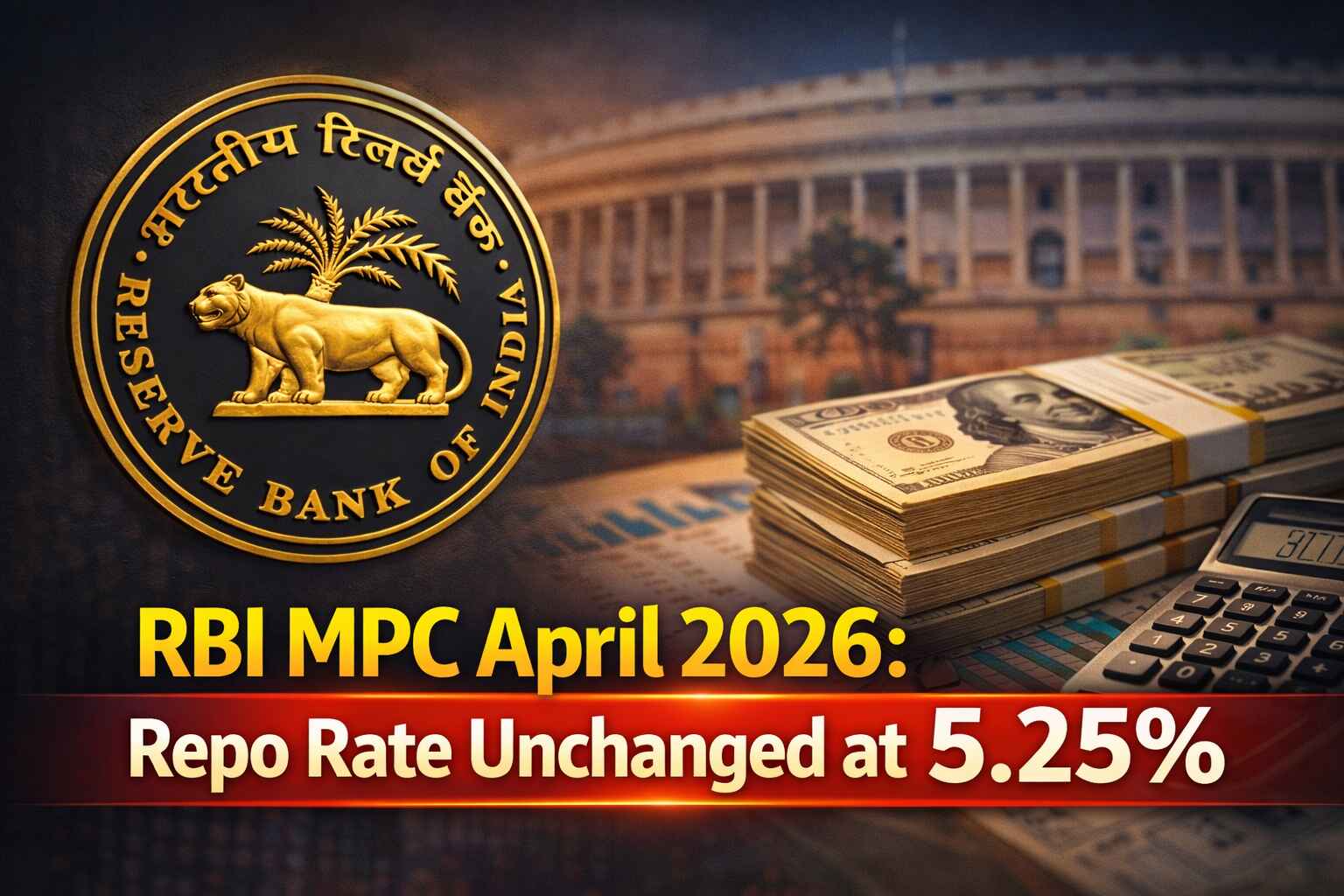
RBI MPC April 2026: Repo Rate Unchanged at 5.25%
8 April 2026 | Live Updates
The RBI's April 2026 monetary policy decision is out — and if you were hoping for an EMI cut this month, it didn't happen. The Monetary Policy Committee kept the repo rate steady at 5.25%, exactly where it's been since December 2025. No surprise there, honestly. Markets were already pricing in no change.
But here's the thing that actually moved markets today: Iran and the US-Israel bloc announced a ceasefire. That single piece of news sent crude oil prices down and Indian equities flying. Sensex crossed 77,000. Nifty hit 23,900. Not bad for a Wednesday morning.
RBI Repo Rate April 2026: No Cut — Stays Flat at 5.25%
10:04 AM
Confirmed. RBI has kept the repo rate unchanged at 5.25%. No revision, no surprise move — the rate stays exactly where it was after December's 25 basis point cut brought it down from 5.50%.
That's it. Short update, big impact for anyone with a floating-rate home loan.
RBI Governor: Hormuz Disruptions May Hurt India's GDP Growth in 2026
10:14 AM
RBI Governor Sanjay Malhotra said that India's real GDP growth last year is estimated at 7.6% under the new GDP series — a solid number. But he didn't stop there. He flagged that disruptions in the Strait of Hormuz could weigh on growth this year, given how much of India's oil supply moves through that corridor.
The government, he noted, has already been working proactively to secure input supplies across key sectors — so the supply chain risk isn't being ignored. Business sentiment, he added, remains positive. Whether that holds through a prolonged geopolitical standoff, nobody can say for certain.
Current RBI Repo Rate April 2026 — Last Changed December 2025
9:12 AM
For anyone who's lost track: the repo rate right now is 5.25%. The last time it moved was December 5, 2025, when the MPC cut it by 25 basis points from 5.50% to 5.25%. Before that, the RBI had been cutting rates through much of 2025 — a cumulative 125 bps reduction since February 2025.
If you hold floating-rate loans linked to the repo rate, here's what this means for you — your EMI stays the same for now. No increase, no decrease. Stability, but not relief.
Sensex Crosses 77,000, Nifty at 23,918 After Iran Ceasefire Rally
9:20 AM
Sensex opened at 77,290.63 — up sharply from yesterday's close of 74,616.58. Nifty opened at 23,855.15 against the previous close of 23,123.65 and was trading at 23,918.20 by 9:20 AM, up 794.55 points on the day.
What triggered it? Iran and the United States-Israel bloc announced a ceasefire. Strait of Hormuz opening back up means crude oil prices fell — and that's directly good news for India, which imports a massive share of its energy. Lower oil = lower inflation pressure = markets happy.
Sensex Nifty Pre-Opening Surge on Iran-US Ceasefire News
9:11 AM
Even before the official opening bell, Indian markets were showing serious strength. Sensex jumped 2,674 points to 77,290.63 in pre-opening trade. Nifty was up 731 points at 23,855.15.
You've probably been watching your portfolio for weeks wondering when the rally would come. Turns out, it took a geopolitical ceasefire — not a rate cut.
Reliance and HDFC Bank Jump 3.5% in Pre-Opening Trade
9:13 AM
Reliance Industries and HDFC Bank were among the biggest movers in pre-opening. Both stocks climbed roughly 3.5%, reflecting broad market confidence on the back of the ceasefire news and falling crude prices.
IndiGo Share Price Jumps 9.44% to ₹4,671 in Early Trade
9:35 AM
IndiGo had a particularly strong morning. The stock surged 9.44% to trade at ₹4,671.45 in early session. Airlines are direct beneficiaries of lower crude oil prices — aviation fuel is one of their biggest cost heads, so a ceasefire-driven oil price drop hits their bottom line in the best possible way.
Rupee Opens Strong at 92.64 vs Dollar — Gains 36 Paise
9:24 AM
The rupee opened with confidence on Wednesday. It came in at 92.64 per dollar, gaining 36 paise against the previous close of 93.00. A strengthening rupee alongside a falling crude price is about as good a combination as India can ask for on any given morning.
FAQ — RBI MPC April 2026
Will my home loan EMI go down after RBI's April 2026 decision?
Not right now, no. Since the repo rate hasn't moved — it's still sitting at 5.25% — banks have no reason to revise their lending rates downward. Even when the RBI does cut rates, banks typically take one to three months to pass on the benefit. Most home loans are linked to the repo rate as their base rate, but banks need time to deliver benefits to customers. Business Today So if you were waiting on an EMI drop this month, it's not coming yet.
Why didn't RBI cut the repo rate in April 2026?
Mostly caution. The RBI has already delivered around 125 basis points of rate cuts over the past year and is now assessing how those changes are transmitting through the financial system. Business Today Cutting again before the earlier cuts have fully worked through the economy would be like pressing the accelerator before checking if the last gear shift landed. Add global uncertainty — the Iran-Hormuz situation, oil price swings — and the MPC decided to wait and watch.
When was the repo rate last changed before April 2026?
December 5, 2025 — that was the last time RBI actually moved the rate. Between February and December 2025, the RBI cut the repo rate by a cumulative 125 basis points, bringing it down from 6.50% to 5.25% to support economic growth. Business Today Since then it's been held steady through February 2026 and now April 2026. Two consecutive holds after an aggressive cutting cycle.
How does the repo rate actually affect my home loan EMI?
It's pretty direct if your loan is repo-linked. All new floating-rate loans to retail and MSME borrowers must be linked to an External Benchmark Lending Rate — typically the repo rate — making policy rate changes directly visible in EMIs. Bankopedia So when the repo rate drops, your bank's lending rate drops, and your EMI follows — usually within the next quarterly reset. When it's held steady, your EMI doesn't move either way. Stable but not cheaper.
What happens to the stock market when there's a ceasefire announcement?
Today was a live example. Sensex jumped over 2,600 points in pre-opening alone after the Iran-US ceasefire news broke. The core logic: ceasefire → Strait of Hormuz reopens → crude oil prices fall → India's import bill shrinks → inflation pressure eases → stocks rally. It's not guaranteed every time — this depends heavily on how durable the ceasefire actually turns out to be — but markets react fast to anything that touches oil prices.