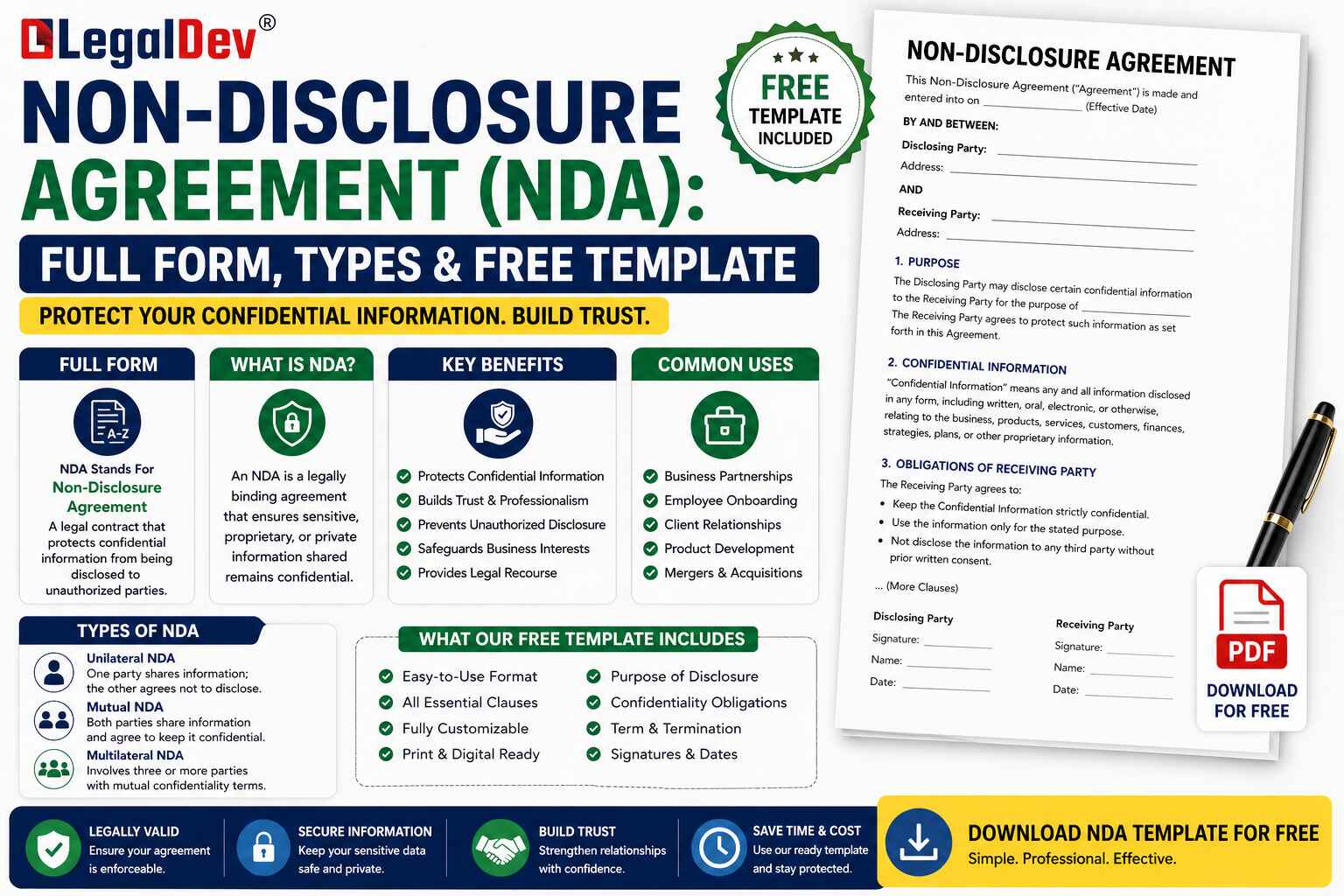
What Is a Non-Disclosure Agreement (NDA)? Full Form, Types, Template & India Laws
Sharing a business idea with a potential investor. Hiring a consultant who'll see your internal systems. Entering a joint venture where both sides bring something valuable to the table. Every one of these situations carries the same risk — confidential information walking out the door.
That's exactly what a non-disclosure agreement is designed to prevent. And if you're doing business in India without one where it matters, you're taking a risk that's entirely avoidable.
What Is a Non-Disclosure Agreement?
A non-disclosure agreement — NDA full form spelled out — is a legally binding confidentiality contract between two or more parties. It defines what information is considered confidential, establishes clear obligations on the receiving party not to disclose that information to unauthorised parties, and creates a confidential relationship that's enforceable under the Indian Contract Act, 1872.
The nda what is question comes up constantly in business settings — and the short answer is this: it's the legal mechanism that keeps sensitive information, trade secrets, and proprietary data from being shared without consent. An nda contract isn't just paperwork. It's protection.
When Can You Use a Non-Disclosure Agreement?
An nda agreement makes sense any time there's a real risk of confidential information being exposed during a business relationship. That covers more situations than most people initially think.
Common scenarios where disclosure agreements are essential:
-
Employment contracts — protecting company sensitive information, client lists, and trade secrets when bringing on new hires
-
Vendors and suppliers — keeping business plans and financial information away from competing businesses
-
Investors and business partners — sharing sensitive information while maintaining a competitive advantage
-
Freelancers and consultants — securing proprietary information during project engagements or marketing strategy discussions
-
IP protection — preventing public disclosure of intellectual property and valuable information before it's ready
If confidential information is changing hands, an nda non disclosure agreement belongs in that transaction.
Types of NDAs and When to Use Each
Non disclosure agreement parties don't always share the same relationship — and the type of NDA used should reflect that. There are three main types.
1. Unilateral NDA
A unilateral NDA is a non disclosure contract where only one party — the disclosing party — shares confidential information with the receiving party. The obligations flow in one direction only.
When to use it: When one party discloses sensitive information like marketing strategies or customer lists to vendors, contractors, or consultants who have no confidential information to share in return.
2. Mutual NDA
A mutual NDA — sometimes called a bilateral NDA — is signed when both parties share confidential and proprietary information with each other. Both sides take on confidentiality obligations.
When to use it: Business partnerships, joint ventures, merger negotiations, or any situation where both parties contribute trade secrets or business plans to the conversation.
3. Multilateral NDA
A multilateral NDA involves three or more parties agreeing to keep certain information confidential. Instead of signing separate bilateral agreements between each pair, one document covers everyone.
When to use it: Collaborations involving multiple companies, consortium projects, or any business relationship where more than two parties need to protect proprietary information and intellectual property simultaneously.
Benefits of a Non-Disclosure Agreement
Protects Business Secrets. A nda confidentiality agreement is one of the most reliable ways to protect trade secrets and other confidential information. Consultants, agencies, and external partners are routinely asked to sign one — and for good reason. Once confidential information is out, there's no putting it back.
Enhances Client Relationships. Businesses that handle third-party projects need their employees and contractors working under a non disclosure agree framework. Clients want assurance that their data is safe. A signed NDA provides that assurance — and builds trust in the working relationship.
Key Elements of a Non-Disclosure Agreement Format
Every legitimate nda non disclosure agreement should contain the following essential clauses. Missing any of these weakens the document significantly.
The Parties. This section identifies whether the agreement is unilateral, bilateral, or multilateral, and includes the full names and addresses of everyone involved.
Term of the Agreement. The non disclosure agreement form must state the execution date, the duration of the agreement, and whether confidentiality obligations continue after the agreement expires. This last point matters more than people realise.
Confidential Information. The nda disclosure section defines exactly what information falls under the 'confidential' category. Vague definitions here create loopholes.
Disclosure of Confidentiality. This section specifies the purpose for which the confidential information will be used, and identifies who else — if anyone — is permitted to access it.
Dispute Resolution. The agreement must state how disputes will be resolved — whether through arbitration, mediation, or litigation — and in which jurisdiction.
How to Write a Non-Disclosure Agreement
Drafting a non disclosure agreement doesn't have to be complicated if the structure is clear from the start. Here's what every nda agreement needs to include:
Title and Introduction — clearly state "Non-Disclosure Agreement" and identify the non disclosure agreement parties involved.
Definition of Confidential Information — specify what counts as confidential: marketing strategies, customer lists, financial information, proprietary information, source code, and so on.
Purpose Clause — explain why the confidential information is being shared. Is it for a potential business partnership? Evaluating a business plan? The purpose needs to be stated explicitly.
Obligations of the Receiving Party — detail the confidentiality obligations. The receiving party cannot disclose, copy, or share nda information with unauthorised parties.
Exclusions — clarify what falls outside the agreement. Public knowledge, independently obtained information, and legally compelled disclosures are typical exclusions.
Term and Termination — how long does the nda contract last, and what triggers its end?
Remedies for Breach — what happens if someone violates the agreement? Injunctive relief, monetary damages, and financial penalties should all be addressed here.
Governing Law — state that the agreement is governed by Indian law, specifically the Indian Contract Act, 1872.
Signatures — signature lines for all non disclosure agreement parties, whether it's two parties or more in a multilateral structure.
Is an NDA Legally Valid and Enforceable in India?
Yes — an nda agreement is a valid legal contract under the Indian Contract Act, 1872, provided it meets the conditions of a valid agreement. The nda required elements are present, the confidential information is clearly defined, and the obligations are lawful.
Indian courts can grant injunctive relief, award monetary damages, or provide other legal recourse if the receiving party breaches confidentiality obligations. This includes stopping further disclosure entirely, or compensating the disclosing party for loss of valuable information — whether that's marketing strategies, customer lists, or proprietary data.
One important caveat: NDAs cannot restrict disclosures that are required by law, or override statutory obligations. But for legitimate business protection, a properly drafted nda and confidentiality agreement holds up in Indian courts — across unilateral, mutual, and multilateral structures alike.
A non disclosure agreement in hindi is also valid if both parties agree to that language, though most formal NDAs used in commercial transactions are drafted in English for clarity and enforceability.
Exclusions to NDAs
Not everything qualifies as protected confidential information under a non confidentiality agreement framework. Standard exclusions include:
-
Information already available in the public domain
-
Information the receiving party already possessed before signing
-
Information the disclosing party explicitly consents to share publicly
-
Information disclosed under a legal obligation — such as a court order
These exclusions are standard across most disclosure nda formats and are worth reviewing carefully when defining what is — and isn't — covered.
Real-World Examples of NDA Agreements
Sometimes the best way to understand a non closure agreement is to see it in action.
A company developing a new product hires a consultant. Before any details are shared, the consultant signs an NDA. All information about the product development stays protected.
Two companies exploring a potential acquisition sign a mutual NDA before exchanging financial statements and customer lists. Both sides are protected.
A startup shares its business plans with a potential investor. The NDA ensures those plans — and any trade secrets discussed — cannot be disclosed or used for the investor's competing purposes.
Three real Indian examples worth noting: the Indian government signed an nda agreement with Google in 2018 for a cloud-based government data platform. Cipla entered into a non disclosure contract with Gilead Sciences in 2020 for generic drug development. And Unacademy signed an NDA with Tencent in 2021 to protect its business plans during investment discussions.
When Do You Need an NDA Agreement?
An nda required situation is any time confidential information is being shared outside of a standard employee-employer relationship. That includes:
-
Hiring consultants or external advisors
-
Entering joint ventures
-
Negotiating mergers or acquisitions
-
Sharing trade secrets or intellectual property
-
Discussing new product development with external parties
-
Seeking funding from investors
The rule is simple: if the information has value, and you're sharing it with someone outside your organisation, a disclosure nda belongs in that conversation.
Requirements for a Valid Non-Disclosure Agreement
For an NDA to be enforceable, it needs to cover these fundamentals:
-
Identification of the parties — who is bound by the agreement
-
Definition of confidential information — what specifically is being protected
-
Scope of the agreement — how long confidentiality obligations last
-
Exceptions to confidentiality — what falls outside the agreement's coverage
-
Obligations of the recipient — what the receiving party can and cannot do with the information
-
Remedies for breach — injunctive relief, monetary damages, or other legal recourse
-
Governing law and jurisdiction — which courts handle disputes
NDA Non-Disclosure Agreement Template
Use this non disclosure agreement template as a starting point. Every bracketed section should be replaced with actual details before signing.
NON-DISCLOSURE AGREEMENT (NDA)
This Nondisclosure Agreement (hereinafter referred to as the 'Agreement') is made and entered into on [Date] (the 'Effective Date') by and between [Name of Disclosing Party] (the 'Disclosing Party'), having its principal place of business at [Address], and [Name of Receiving Party] (the 'Receiving Party'), having its principal place of business at [Address].
1. Purpose:
The Disclosing Party is engaged in a business involving the creation, development, and marketing of [Product/Service/Information]. The Disclosing Party agrees to disclose certain information to the Receiving Party for the sole purpose of [Purpose of Disclosure]. This information is confidential and proprietary in nature.
2. Confidential Information
'Confidential Information' refers to all information designated as 'Confidential' or which the Receiving Party knows or has reason to believe is confidential, proprietary, or classified as a trade secret by the Disclosing Party — whether disclosed orally, in writing, or by inspection of physical objects.
3. Non-Disclosure and Non-Use
Without prior written consent of the Disclosing Party, the Receiving Party agrees to keep Confidential Information in strict confidence and not to disclose, copy, or use it for any purpose other than the one for which it was disclosed. Reasonable physical, electronic, and procedural safeguards must be maintained.
4. Term and Termination
This Agreement will remain in effect for [Term] unless terminated earlier by written notice. Upon termination, the Receiving Party must immediately return or destroy all Confidential Information and provide written certification confirming this.
5. Remedies
Both parties acknowledge that breach of this Agreement may cause irreparable harm that monetary compensation alone cannot address. The Disclosing Party may seek injunctive relief without posting a bond, in addition to any other available legal or equitable remedies.
6. Governing Law and Jurisdiction
This Agreement shall be governed by the laws of [State/Country]. All legal proceedings arising from this Agreement shall be conducted in the courts of [State/Country].
7. Entire Agreement
This Agreement constitutes the entire understanding between the parties regarding its subject matter and supersedes all prior agreements. Modifications require written consent from both parties.
IN WITNESS WHEREOF, the parties have executed this Agreement as of the Effective Date.
Disclosing Party: [Name] By: ___________________________ [Name], [Title]
Receiving Party: [Name] By: ___________________________ [Name], [Title]
What Happens If You Violate a Non-Disclosure Agreement?
Violating an nda non disclosure agreement carries real legal consequences. The specific outcome depends on the terms of the particular NDA and the nature of the breach — but the possibilities include monetary damages covering actual losses suffered by the disclosing party, disgorgement of any profits the breaching party made from using the confidential information, and injunctive relief — court orders stopping further disclosure immediately.
Indian courts take these breaches seriously. The disclosing party doesn't need to wait for the damage to compound before seeking legal action. An interim injunction can be filed while the full case proceeds.
Information Protected Under a Non-Disclosure Agreement
A non disclosure agreement can cover a wide range of confidential material, including:
-
Trade secrets — manufacturing processes, formulas, customer lists, proprietary methods
-
Business and financial information — sales figures, marketing plans, financial projections not in the public domain
-
Intellectual property — patents, trademarks, copyrights, proprietary software, algorithms
-
Personal information — individual identification data, health information, sensitive personal details
-
Proprietary software or technology — source code, system designs, technical inventions
-
Customer or supplier information — contact details, pricing agreements, sales history
The broader the definition in the nda information clause, the stronger the protection — provided the language is still specific enough to be enforceable.
Why Choose legaldev for Drafting Your NDA
A free nda template downloaded from a generic website might technically qualify as a legal document. Whether it actually protects you when it matters is a different question. Generic templates frequently miss specific confidentiality clauses, leave remedies vague, and fail to account for the nuances of Indian law.
legaldev's approach is different. The team includes NDA legal experts who understand Indian Contract Act requirements, have drafted over 50,000 agreements across employment contracts, business partnerships, startups, and investor negotiations, and operate through a secure, encrypted portal for all confidential drafting work.
The difference between a free template and a professionally drafted nda agreement isn't just language — it's enforceability. When confidential information is on the line, that gap matters.
FAQs
Q: What is a non-disclosure agreement and what does NDA stand for?
A: A non-disclosure agreement (NDA) is a legally binding contract between two or more parties that defines what information is confidential and prohibits the receiving party from disclosing it to unauthorised parties. NDA full form is Non-Disclosure Agreement. It is enforceable under the Indian Contract Act, 1872, and creates clear confidentiality obligations for everyone involved.
Q: What is the full form of NDA in a legal context?
A: The non disclosure agreement full form is Non-Disclosure Agreement — also referred to as a confidentiality agreement or nda confidentiality agreement. In legal settings in India, it functions as a formal contract that protects trade secrets, proprietary information, and sensitive business data from unauthorised disclosure during or after a business relationship.
Q: Is a non-disclosure agreement enforceable in India?
A: Yes — an nda agreement is generally enforceable under the Indian Contract Act, 1872, provided the confidential information is clearly defined, the obligations are lawful, and the agreement is properly signed. Indian courts can grant injunctive relief or award monetary damages in cases of breach. NDAs cannot, however, override statutory disclosure requirements or public interest obligations.
Q: What should a non-disclosure agreement template include?
A: A solid non disclosure agreement template should include identification of all parties, a precise definition of confidential information, the purpose of disclosure, obligations of the receiving party, exclusions from confidentiality, the term of the agreement, remedies for breach, and governing law. Missing any of these clauses weakens the document's enforceability significantly.
Q: Can I use a free NDA template instead of getting one professionally drafted?
A: A free nda template can serve as a starting point, but it often lacks the specific clauses needed to protect trade secrets and proprietary information effectively under Indian law. Missing or vague confidentiality obligations, undefined remedies, and incorrect governing law clauses are common problems. For any business relationship where valuable information is at stake, professional drafting significantly reduces the risk of disputes and enforcement failures.
Q: What happens if someone breaks an NDA in India?
A: Breaching a non disclosure agreement in India can result in injunctive relief — court orders stopping further disclosure — along with monetary damages covering actual losses and any profits gained through the breach. The disclosing party can seek interim relief while the full legal case proceeds. Courts treat confidentiality breaches seriously, especially where trade secrets or intellectual property are involved.
Q: What is the difference between a unilateral and mutual NDA?
A: A unilateral nda non disclosure agreement involves only one party sharing confidential information — the obligations flow in one direction. A mutual NDA applies when both parties share confidential information with each other, creating reciprocal obligations. The choice depends on the nature of the business relationship: consultant engagements typically use unilateral NDAs, while joint ventures and merger negotiations usually call for mutual ones.
Q: Does an NDA need to be notarised in India?
A: Notarisation is not mandatory for a non disclosure contract to be legally valid in India. A properly drafted and signed NDA is enforceable without notarisation. That said, a notarised document provides additional proof of authenticity, which can be useful in disputes about when or how the agreement was executed.
Q: Is a digitally signed NDA valid in India?
A: Yes — NDAs executed with a valid digital signature are recognised under the Information Technology Act in India. A digitally signed nda agreement carries the same legal weight as a traditionally signed document, making online execution both legally sound and practically convenient for business relationships across different locations.
Q: What information can an NDA protect?
A: A non-disclosure agreement can protect trade secrets, financial information, marketing strategies, customer lists, intellectual property, proprietary software, technical inventions, and personal data — essentially any nda information that has commercial value and is not already in the public domain. The protection is only as strong as the definition of confidential information written into the agreement itself.