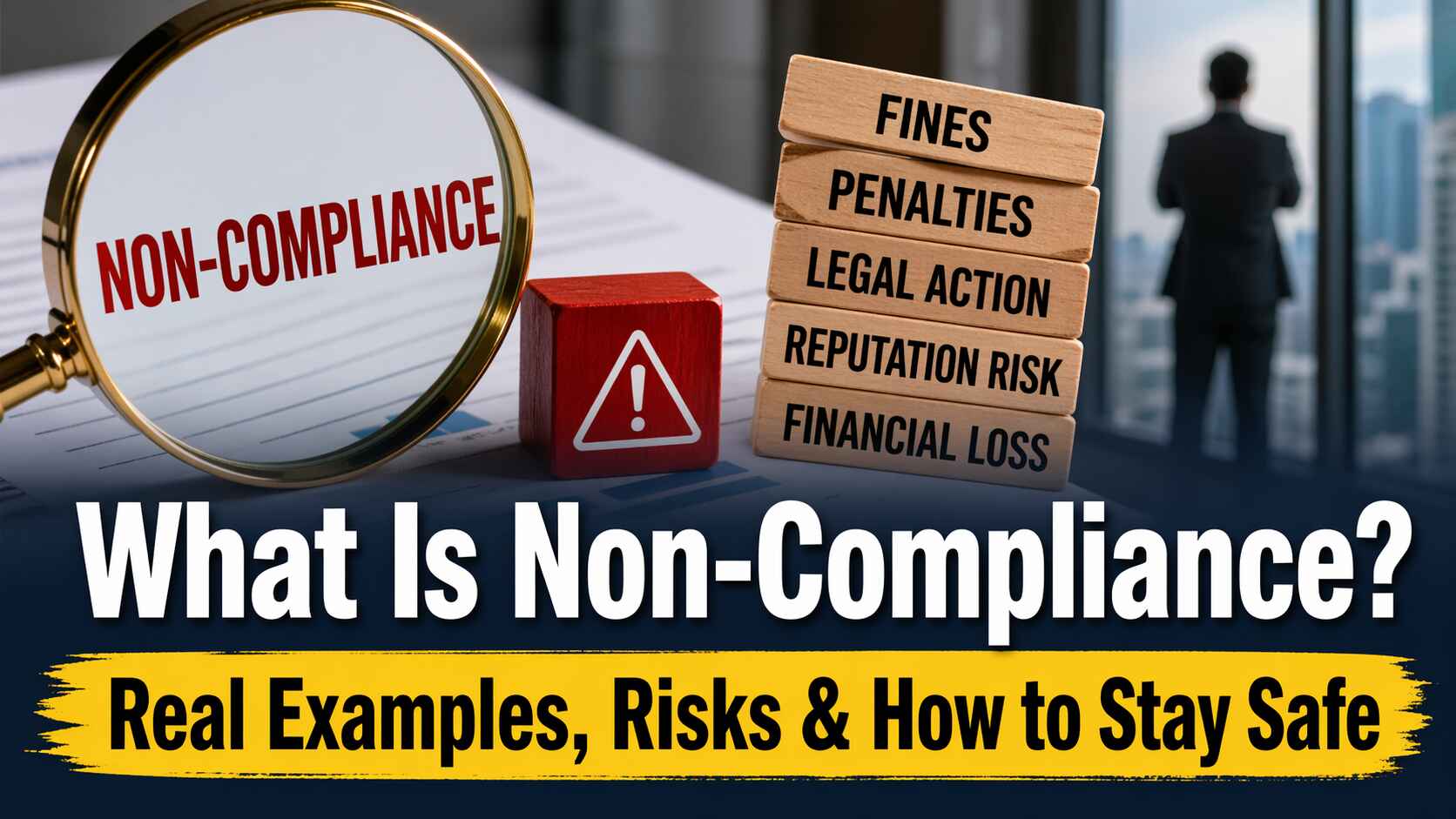
Non-Compliance in Business: Meaning, Types, Penalties & How to Avoid It
One missed filing. One overlooked notification. One team member who didn't know a rule had changed. That's all it takes — and suddenly your business is staring at blocked e-way bills, a GST number at risk, or a court notice with a director's name on it.
Non-compliance in business means failing to follow the laws, regulations, or internal and industry standards that apply to your company — whether that failure was intentional or just an honest oversight. And in India, where tax notifications drop almost weekly and regulatory frameworks keep evolving, even well-run companies slip up.
What Is Non-Compliance, Really?
The meaning of non compliance is straightforward: you were required to do something by law or regulation, and you didn't do it — or you did it wrong, or you did it late.
It isn't always wilful. Sometimes it's a system gap. Sometimes it's a team that didn't know a particular rule existed. Sometimes it's a notification that came and went without anyone noticing.
Take this scenario: a GST-registered company's tax team misses filing GSTR-3B for two consecutive months. The moment that happens, the GST portal automatically blocks their e-way bill generation. No manual warning. No grace period. Just — blocked. That's how quickly compliance and non compliance diverge in real business operations.
Compliance vs Non-Compliance
The gap between the two isn't complicated — it's discipline and documentation.
|
Comparison Point
|
Compliance
|
Non-Compliance
|
|
Meaning
|
Following applicable laws and regulations
|
Failure to follow required laws or rules
|
|
Risk Level
|
Low regulatory risk
|
High regulatory and financial risk
|
|
Business Impact
|
Builds credibility and trust
|
Leads to penalties and legal exposure
|
|
Example
|
Filing returns accurately and on time
|
Not filing, or filing with incorrect data
|
The difference sounds obvious on paper. But in practice, companies drift into non compliance slowly — one delayed filing here, one skipped audit there — until it becomes a pattern with real consequences.
Major Types of Non-Compliance in India
Non compliance doesn't come in one shape. There are three broad categories that Indian businesses most commonly run into.
Regulatory Non-Compliance
This is when a company fails to meet the standards set for its specific industry. A bank ignoring RBI lending norms. A pharma company skipping mandatory drug trial documentation. The rules are sector-specific, but the consequences are just as serious.
Tax Non-Compliance
This one hits hardest and most often. It covers everything — late TDS deposits, incorrect GST invoices, wrong ITC claims, missed advance tax payments. Tax non compliance has both financial and criminal dimensions in India, which makes it the highest-stakes category.
Labour Law Non-Compliance
Not depositing PF or ESI for employees within the deadline. Not maintaining proper wage registers. Not following the Shops and Establishments Act in your state. These seem administrative — until a labour inspector shows up, or an employee files a complaint.
Real-World Non-Compliance Examples (That Actually Happened)
These aren't hypothetical. These are the kinds of cases that play out across India regularly.
A factory unit cuts corners on waste disposal to save on costs. Authorities find out and lock the entire unit within 24 hours — production halted, contracts delayed, reputation gone.
A company stores customer data on an unsecured server. A breach happens. Under the Digital Personal Data Protection (DPDP) Act, the penalties run into crores — and the regulatory scrutiny doesn't stop at the fine.
A retail showroom forgets to display its GST registration certificate at the entrance. Looks minor. But that single missing document is enough for an inspector to levy a heavy fine on the spot.
The pattern is always the same: what seemed small enough to ignore became too expensive to recover from.
Why Does Non-Compliance Keep Happening?
Smart businesses still fall into this trap. Why?
Laws that change constantly. In India, tax circulars, amendments, and new notifications come out almost every week. Without proper tracking systems, even a diligent team simply cannot keep up manually.
No maker-checker system. When one person handles a compliance task with no review layer, their mistake becomes the company's liability. One wrong entry in a return, and the correction process is long and costly.
The team didn't know the rule existed. This is more common than most finance heads will admit. Especially with newer regulations — DPDP, amendments to the Companies Act, state-level labour rules — the information just doesn't always reach the right desk in time.
Chasing short-term savings. Some businesses skip a filing deliberately to hold onto cash for a month or two. It never works out. The interest and penalties for non compliance almost always exceed whatever was "saved."
Consequences of Non-Compliance: What's Actually at Stake
The risk of non compliance doesn't disappear if you ignore it. It compounds.
Fines and Interest: Authorities don't just charge a one-time fee. For continuous defaults, interest accrues daily. What starts as a manageable amount becomes a significant liability fast.
Personal Liability for Directors: This is the one that gets overlooked most. In cases of gross negligence or fraud, directors can be held personally liable — not just the company. Their personal assets are at risk.
Market Exclusion: Large corporates and PSUs now run vendor due diligence as standard practice. A history of non compliance gets you struck off their approved vendor lists. Once that reputation sticks, winning those contracts back is an uphill battle.
Licence Cancellation: The government can cancel your GSTIN, revoke your trade licence, or bar your business from operating in a particular sector. These aren't hypothetical threats — they show up in real enforcement actions.
How to Manage Non-Compliance Risk Before It Manages You
Run a Compliance Audit First
Before fixing anything, find out where you actually stand. Audit your current filings, internal processes, and documentation. Most businesses discover gaps they didn't know existed — and that's exactly the point.
Automate What Can Be Automated
Tax compliance software eliminates the category of errors that come from manual entry and missed reminders. If a due date exists, a system should be tracking it — not a person's memory.
Build a Compliance Calendar With Real Alerts
A calendar your team actually uses, with automated reminders built in, is non-negotiable. Not a shared spreadsheet that gets updated quarterly. A live system that tells someone three days before a deadline that something is due.
Bring In Someone Who Knows the Law
An internal compliance officer or external auditor who genuinely understands current regulations — not just the broad strokes — is worth every rupee. Quarterly checks catch what software doesn't flag.
Non-Compliance Meaning in Indian Languages
-
Hindi: गैर-अनुपालन (Gair-anupaalan)
-
Tamil: இணக்கமின்மை (Iṇakkamiṉmai)
-
Telugu: పాటించకపోవడం (Pāṭin̄cakapōvaḍaṁ)
-
Malayalam: പാലിക്കാത്തത് (Paalikkaatthu)
-
Marathi: नियमांचे उल्लंघन (Niyamān̄cē ullaṅghana)
-
Kannada: ಅನುಸರಣೆ ಮಾಡದಿರುವುದು (Anusaraṇe māḍadiruvudu)
-
Bengali: নিয়ম অমান্য করা (Niyam amanya kara)
-
Gujarati: બિન-પાલન (Bina-pālana)
-
Urdu: عدم تعمیل (Adam taumel)
FAQs
Q: What is the difference between compliance and non compliance in GST?
A: Compliance means filing your GSTR-1, GSTR-3B, and other returns accurately and on time, while paying the correct tax. Non compliance in GST is anything that deviates from that — late filing, incorrect ITC claims, wrong invoice data. The immediate consequence is usually interest and late fees; repeated defaults can get your GSTIN suspended or cancelled.
Q: Can a director go to jail for non compliance in India?
A: Yes, in certain cases. For serious tax fraud, violations under the Companies Act, or deliberate data protection breaches under the DPDP Act, directors can face criminal prosecution — not just company-level penalties. Personal liability is a real risk, especially when authorities can show the default was intentional or grossly negligent.
Q: What happens if a company has non compliance history during a vendor audit?
A: Large corporates and government entities run vendor compliance checks before signing contracts. A non compliance history — especially GST defaults, labour law violations, or pending litigation — can disqualify your business from their approved vendor list. Rebuilding that trust takes documented clean compliance records over multiple quarters.
Q: How does the DPDP Act create new non compliance risks for Indian businesses?
A: The Digital Personal Data Protection Act requires businesses to handle customer data with specific safeguards — consent-based collection, proper storage, breach notification obligations. Companies still storing data on unprotected servers or without documented consent frameworks are already in non compliance territory, even if no breach has occurred yet.
Q: Is non compliance always the company's fault, or can a CA or consultant be held responsible?
A: Ultimately, the legal responsibility sits with the business — but if a CA or compliance consultant made a filing error due to negligence, there can be professional liability on their end too. Most disputes of this kind are resolved through indemnity clauses in engagement letters. It's one more reason to work with professionals who carry proper documentation of what they filed and why.
|
🚀 Get GST Filing Help from legaldev.in!
|
|
Do you want an expert to file your GSTR-1 and GSTR-3B — correctly, on time, and completely hassle-free?
|
|
Visit legaldev.in — a team of expert CAs is available for monthly GST filing, GST registration, notice replies, and all GST-related services.
|
|
Pricing is transparent with no hidden charges. First consultation is FREE.
|
|
👉 Visit: www.legaldev.in | Call/WhatsApp: 8588808388
|