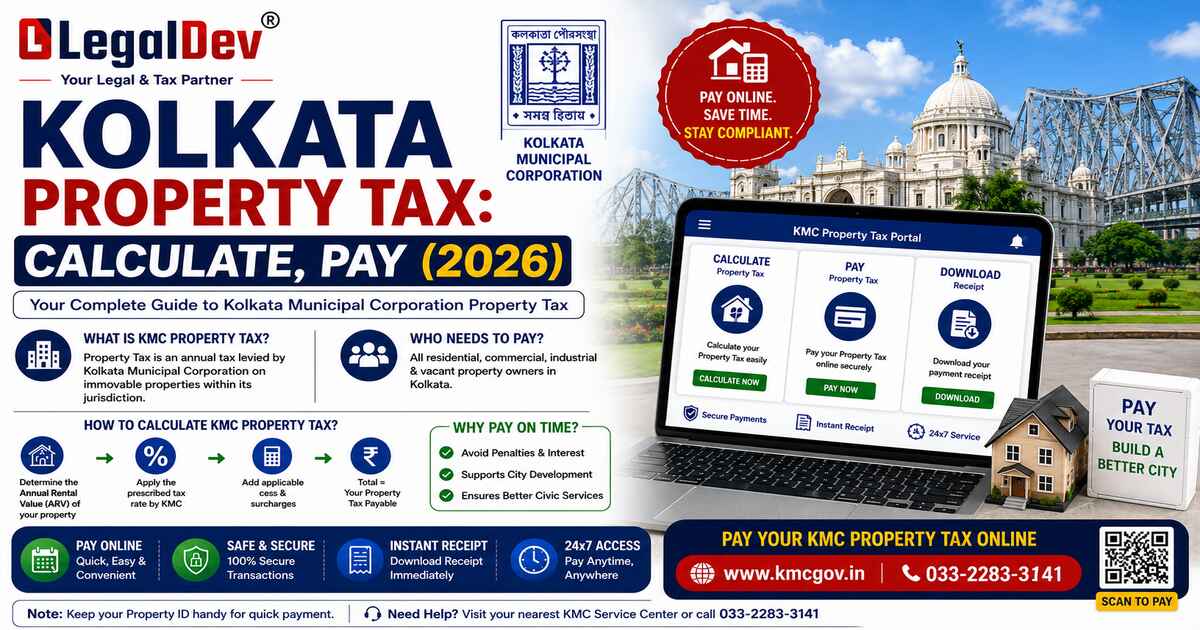
KMC Property Tax: How to Calculate It, How to Pay It, and What Most People Get Wrong
Owning property in Kolkata comes with one non-negotiable responsibility — paying your KMC property tax on time. Miss it, and you're not just looking at a penalty. You could end up with dues compounding for years, making a small oversight feel very expensive very fast.
The good news? The Kolkata Municipal Corporation has made the process reasonably straightforward — both online and offline. You just need to know what you're doing.
What Exactly Is KMC Property Tax?
KMC property tax is the charge levied by the Kolkata Municipal Corporation on all real estate within the city's jurisdiction. Residential homes, commercial spaces, industrial units, institutional properties, even vacant plots — everything falls under this.
This isn't just a fee. It's the primary revenue source that keeps Kolkata's basic civic machinery running — waste management, road repair, infrastructure projects, the works. So yes, skipping it has consequences beyond just your own wallet.
The tax amount isn't fixed across the board. It's calculated based on the Annual Valuation (AV) of your specific property, using a tiered structure that the KMC calls the Unit Area Assessment scheme.
How KMC Property Tax Is Calculated — The UAA Scheme Explained
Back in March 2017, the Kolkata Municipal Corporation introduced the Unit Area Assessment (UAA) scheme to replace the older, more opaque method of property valuation. The idea was simple — let property owners calculate their own tax rather than depending entirely on corporation assessors.
Here's how the system works.
Kolkata is divided into 293 blocks, which are further classified into 7 categories — A through G — based on market value, infrastructure quality, and available facilities. Each category carries a Base Unit Area Value, or BUAV, measured in rupees per square foot.
Base Unit Area Value (BUAV) by Category
|
Block Category
|
BUAV per sq.ft (₹)
|
|
A
|
74
|
|
B
|
56
|
|
C
|
42
|
|
D
|
32
|
|
E
|
24
|
|
F
|
18
|
|
G
|
13
|
Category A is your prime real estate — highest value, highest BUAV. Category G covers Kolkata's slum areas, keeping the tax burden minimal for economically weaker sections. Category E is reserved for Refugee Rehabilitation colonies and areas under government EWS and BSUP schemes.
Around 6 lakh property taxpayers across Kolkata are covered under this uniform scheme.
But here's where it gets a little more nuanced.
Multiplicative Factors — What Changes Your Final Tax
The BUAV alone doesn't determine your tax. The KMC uses Multiplicative Factors (MF) to adjust the base value depending on several variables — road width, building age, how the property is used, who occupies it, and what it's built with.
Two houses in the same block can end up with very different tax bills because of these factors.
By Property Location (Road Width)
|
Road Width
|
MF
|
|
≤ 2.5m
|
0.6
|
|
>2.5m but ≤ 3.5m
|
0.8
|
|
>3.5m but ≤ 12m
|
1
|
|
>12m
|
1.2
|
By Building Age
|
Building Age
|
MF
|
|
> 50 years
|
0.8
|
|
20 to 50 years
|
0.9
|
|
< 20 years
|
1
|
By Occupancy Status
|
Status of Occupancy
|
MF
|
|
Owner-occupied (family)
|
1
|
|
Tenant, tenancy > 50 years
|
1
|
|
Tenant, tenancy 20–50 years, protected under WB Premises Act
|
1
|
|
Tenant, tenancy 20–50 years, NOT protected under WB Premises Act
|
1.2
|
|
Tenant, tenancy ≤ 20 years, residential use
|
1.5
|
|
Tenant, tenancy ≤ 20 years, non-residential use
|
4
|
|
Garage/parking
|
4
|
By Building Usage
|
Building Usage
|
MF
|
|
Waterbody
|
0.5
|
|
Residential
|
1
|
|
Industrial/manufacturing, shop < 250 sq.ft., restaurant
|
2
|
|
Health, education, single-screen hall, hotel < 3-star, bar
|
3
|
|
3-star & 4-star hotels, ceremonial house
|
4
|
|
Office, bank, hotel 5-star+
|
5
|
|
Multiplex, mall, commercial shops
|
6
|
|
Night club, offsite ATM, tower, hoarding
|
7
|
|
Vacant land up to 5 katha (other categories)
|
2
|
|
Vacant land more than 5 katha
|
8
|
By Building Structure
|
Building Type
|
MF
|
|
Kutcha
|
0.5
|
|
Common area
|
0.5
|
|
Semi-pucca
|
0.6
|
|
Open/covered parking and garage
|
0.8
|
|
Pucca properties
|
1
|
|
Residential building, plot > 10 katha
|
1.5
|
|
Special IG projects, apartments > 2000 sq.ft. covered space
|
1.5
|
Tax Rate by Property Type
|
Property Type
|
Tax Rate (%)
|
|
Undeveloped slums
|
6
|
|
Developed slums
|
8
|
|
Government properties under KMC Act, 1980
|
10
|
|
Properties with annual value up to ₹30,000
|
15
|
|
Others
|
20
|
The Formula — How to Calculate KMC Property Tax
All those factors come together in one formula:
Annual Tax = BUAV × Covered Space or Land Area × Location MF × Usage MF × Age MF × Structure MF × Occupancy MF × Rate of Tax (including HB Tax)
The HB here stands for Howrah Bridge Tax — applicable only to properties in nearby wards.
Before you run the numbers, make sure your property records are updated and there are no outstanding dues sitting quietly against your account. If something looks off, report it to the KMC before it compounds.
How to Pay KMC Property Tax Online
KMC online tax payment is the faster, more convenient route — and honestly, the one most people should be using. Here's exactly how it works.
Step 1: Go to the official website of the Kolkata Municipal Corporation.
Step 2: On the right side, find the 'Quick Links' menu and click 'Make Online Payment'.
Step 3: Select 'Property Tax', then choose 'All Bill'.
Step 4: You'll land on a new page. Enter your email address, contact number, and your Assessee Number.
Step 5: Hit 'Search' to pull up your outstanding KMC property tax dues.
Step 6: Pay using credit card, debit card, UPI, or net banking — whichever you prefer.
Step 7: Once payment is done, download your e-receipt immediately. Store it somewhere you'll actually find it later.
Paying Offline — If You Prefer the Old-School Route
Not everyone trusts online portals for something this important. Fair enough.
Step 1: Visit the KMC office directly.
Step 2: Collect the application form from the officials there.
Step 3: Fill in all the required details — same information you'd enter online.
Step 4: Submit the completed form to the concerned authority.
Step 5: Pay the KMC tax amount and collect your physical receipt. Keep it safe.
How to Check Your KMC Property Tax Payment Status
Paid but not sure if it went through? Here's how to verify.
Step 1: Open the Kolkata Municipal Corporation's official portal.
Step 2: On the left-hand panel, go to 'Online Services' → 'Assessment Collection'.
Step 3: Click 'Check Payment Status' from the redirected page.
Step 4: Enter your Assessee Number and click 'Search'.
Step 5: Your KMC property tax payment status will appear on the screen.
KMC Property Tax Bill Download — How to Get Your Receipt
Whether you paid online or offline, getting a copy of your tax receipt is important. For the KMC property tax bill download, follow these steps.
Online:
-
Visit the KMC official website
-
Go to 'Online Services' → 'Assessment Collection'
-
Click on 'Reprint E-receipt'
-
The combined receipts page will load
-
Enter your start and end date along with your Assessee Number
-
Click 'Search Receipt' to pull up and download your receipts
Offline:
Walk into the corporation office, pay your due amount, and collect the receipt directly from the counter. Simple as that.
KMC Property Tax Waiver Scheme — This One's Worth Knowing
On 1st August 2024, the KMC rolled out a significant waiver policy for defaulters. If you've been putting off clearing old dues, this changes the math considerably.
Here's what the scheme offers:
-
Dues for 2 years or less — 99% waiver on fines + 50% waiver on interest
-
Dues between 2 and 5 years — 75% waiver on fines + 45% waiver on interest
-
Dues between 5 and 10 years — 50% waiver on fines + 40% waiver on interest
-
Dues older than 10 years — 25% waiver on fines + 35% waiver on interest
If you've been avoiding the kmc kolkata property tax office because the accumulated penalties felt unmanageable — this scheme is specifically designed for situations like yours.
KMC Contact Details
Having trouble with your KMC tax payment or assessment? Here's where to reach them.
Address: The Kolkata Municipal Corporation, 5, S.N. Banerjee Road, Kolkata – 700 013
Phone: +91 33 2286-1000
Call Centre: 155360 / 2226-9909 / 18003453375 (Available Monday to Friday, 10:00 AM to 6:00 PM)
FAQs
Q: How do I find my KMC Assessee Number for property tax payment?
A: Your Assessee Number is printed on your previous KMC property tax bill or receipt. If you don't have an old bill, you can visit the KMC office at 5, S.N. Banerjee Road with your property documents and request the number from the Assessment department. It's also sometimes retrievable through the KMC portal using your address details.
Q: Can I pay KMC property tax without an Assessee Number?
A: The KMC online tax payment portal requires your Assessee Number to search for dues. If you don't have it, you'll need to visit the ward office physically and request a fresh assessment or recover the number from records. It's advisable to keep this number saved — you'll need it every time.
Q: What is the last date to pay KMC property tax every year?
A: The Kolkata Municipal Corporation typically sets March 31st as the due date for annual property tax payment. However, KMC occasionally extends deadlines or announces special windows — especially when new waiver schemes are introduced. Check the KMC official portal or call 155360 for current deadline information.
Q: How do I download my KMC property tax bill if I lost the receipt?
A: Log in to the KMC official website, go to Online Services → Assessment Collection → Reprint E-receipt. Enter your Assessee Number and the date range of payment. Your KMC property tax bill will be available to download as a PDF. This works for all online payments made through the portal.
Q: Is there a penalty if I pay KMC property tax late?
A: Yes. If property tax remains unpaid, the KMC charges a penalty of up to 15% of the outstanding amount as a one-time fine, plus interest on the dues. However, the 2024 waiver scheme significantly reduces these charges for long-term defaulters — the longer the default period, the lower the percentage of fine waiver you receive.
Q: How is property tax calculated for a flat in Kolkata?
A: For a residential flat, the calcutta corporation tax is calculated using the UAA formula — BUAV multiplied by the flat's covered area, adjusted by multiplicative factors for location, building age, structure type, occupancy, and usage. For most standard residential flats under owner occupation, the usage MF is 1 and occupancy MF is also 1, making the calculation relatively straightforward.
Q: Can I pay KMC property tax through a mobile app or UPI?
A: Yes. The KMC bill payment portal accepts UPI payments during checkout. You can scan the QR code or enter your UPI ID on the payment page after entering your Assessee Number. There is currently no dedicated KMC mobile app — the payment is done through the web portal, which is mobile-browser compatible.
Q: What documents do I need to pay KMC property tax offline?
A: For offline payment at the KMC office, carry your previous tax receipt (if available), your Assessee Number, and a valid ID proof. If it's your first time paying or you've recently purchased the property, bring your property registration documents to help officials trace the account.
Q: How long does it take for KMC online tax payment to reflect?
A: In most cases, online KMC property tax payments reflect within 24 to 48 hours on the portal. If you pay via UPI or debit card, it usually processes faster. Always download the e-receipt immediately after payment — don't wait for the portal to update before you have proof.
Q: Is KMC property tax applicable on vacant land in Kolkata?
A: Yes. The KMC tax applies to vacant land as well. The usage multiplicative factor for vacant land up to 5 katha (not falling under other special categories) is 2, while vacant land above 5 katha carries a significantly higher MF of 8, making it one of the higher-taxed categories under the UAA scheme.