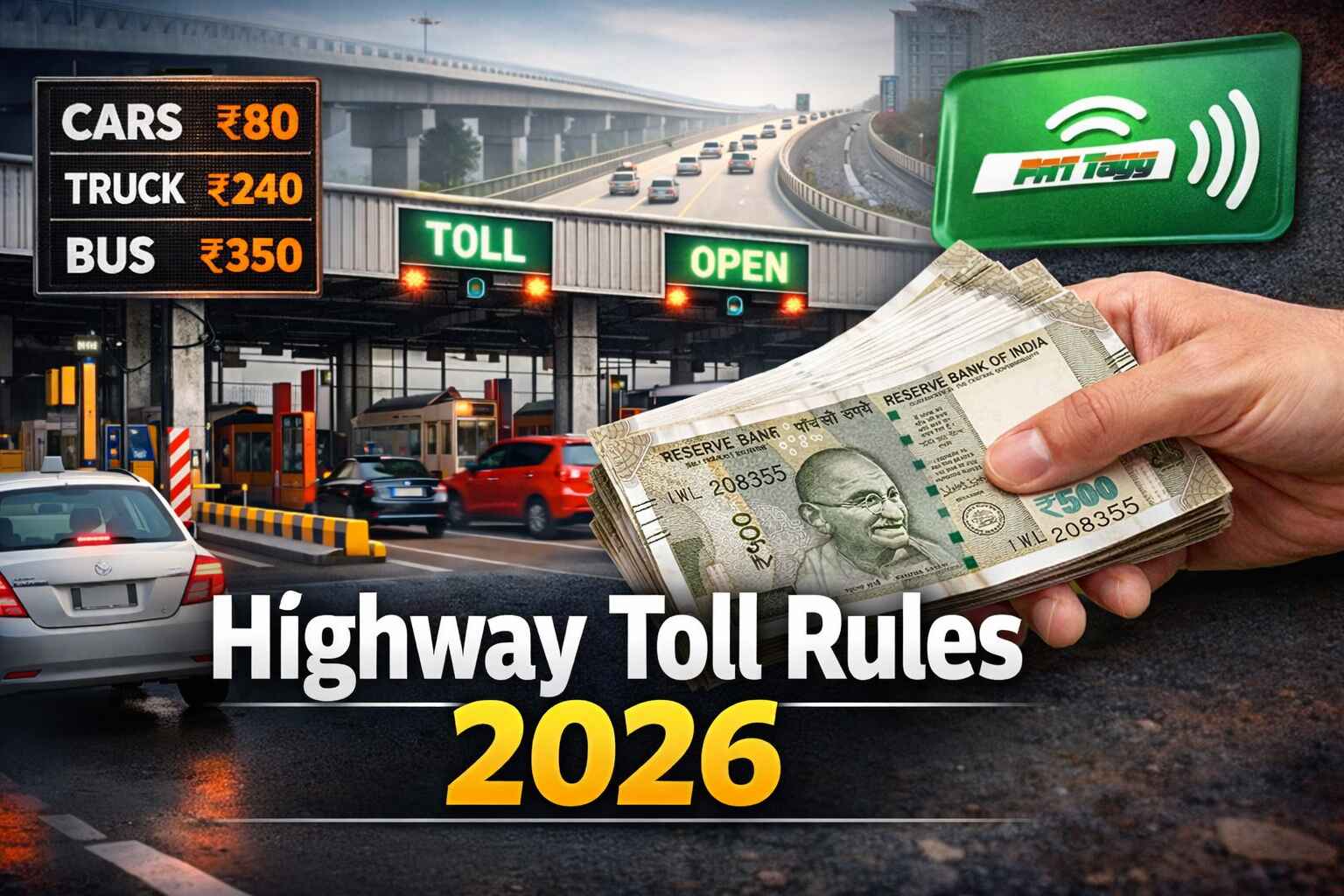
Highway toll plazas across India are going fully cashless on April 10 — no exceptions, no cash lanes, and no last-minute workarounds. The Ministry of Road Transport and Highways (MoRTH) issued a gazette notification making digital toll collection mandatory on all national highways and expressways. If your FASTag isn't active and topped up before that date, you're going to pay more — or get stopped entirely.
This change affects everyone who drives on national highways regularly. Here's what's actually different, what it costs, and what you need to do before the deadline.
What Changes at the Toll Plaza — And What It Costs You Now
For private vehicle owners and regular highway users, the new rules have three direct consequences:
FASTag is now mandatory. Vehicles without a valid FASTag can no longer pay cash at any national highway toll plaza. The cash option is gone entirely.
UPI without FASTag costs 25% more. If you don't have FASTag, you can still pay via UPI — but you'll be charged 1.25 times the standard toll rate. That surcharge is built into the notification deliberately; it's designed to push everyone toward FASTag adoption rather than let UPI become a permanent cash substitute.
Non-payment has real consequences. If digital payment is refused or fails, the vehicle can be stopped or removed from the lane. An automated e-notice gets issued to the registered owner. If that goes unpaid for three days, the charge doubles. The system doesn't need a human to follow up — it's automated.
The entire design discourages anything except FASTag. Everything else either costs more or creates friction.
How Toll Exemptions Work Under the New National Highway Rules
The notification also closes a common workaround: officials using personal vehicles during private travel and claiming a toll waiver by showing their ID at the booth.
Going forward, toll exemptions are tied to the vehicle and its authorised purpose — not to the individual travelling in it. If you previously qualified for an exemption, you'll now need to apply for an Exempted FASTag through the proper channel. Alternatively, you can use a FASTag annual pass. This should reduce the arguments and manual identity checks at toll booths that were causing unnecessary delays, which is a win for everyone stuck behind those queues.
FASTag Annual Pass 2025: Is ₹3,075 Worth It for Your Commute?
The government has introduced a FASTag annual pass specifically for frequent travellers.
-
Price: ₹3,075 per year
-
Coverage: Up to 200 toll crossings for private cars
For daily commuters or anyone crossing a toll three or more times a week, the per-crossing cost works out to around ₹15 — which is likely cheaper than standard per-trip charges at many plazas. But if you're an occasional highway user, it probably doesn't make sense. There's no universal answer here; it genuinely depends on your route and how often you travel. Check your last three months of FASTag transaction history and do the math before buying.
India's Shift to Multi-Lane Free-Flow Tolling — The Next Phase
This cashless mandate isn't the final destination — it's a step toward a system where toll collection happens without vehicles stopping at all.
The government is actively working on multi-lane free-flow (MLFF) tolling, where scanners read your FASTag or use automatic number plate recognition (ANPR) and GNSS-based vehicle tracking to deduct the fee automatically as you pass through at full speed. No booths, no barriers, no queuing. By removing cash first and standardising digital payments now, the infrastructure is being set up for that next phase. The transition to fully barrier-free highways will likely happen in stages over the next few years — nobody has locked in a hard national rollout date yet.
FASTag Checklist: What Every Vehicle Owner Must Do Before April 10
The deadline is close. Here's what to check right now:
-
Keep your FASTag active and maintain a positive balance before any highway trip
-
Update your KYC details — an incomplete KYC can cause scan failures even with a funded FASTag
-
Apply for an Exempted FASTag if your vehicle category qualifies
-
Evaluate the annual pass — if you commute on national highways regularly, ₹3,075 may save you money over the year
The cashless highway system isn't new — India has been moving this way for years. April 10 is just the point where the last remaining fallback disappears. Getting your FASTag sorted now takes maybe 20 minutes. Getting stopped at a toll plaza because you didn't will take considerably longer.
FAQ
If I don't have FASTag, can I still pay cash at the toll?
No — cash lanes are completely closed from April 10. If your vehicle doesn't have a valid FASTag, UPI is the only fallback, but you'll be charged 1.25 times the standard toll rate for using it. That surcharge adds up fast if you're a daily commuter. The simplest fix is to get a FASTag from any bank or NHAI-authorised point, which usually takes under 24 hours to activate.
What happens if I just refuse to pay at the toll plaza?
The vehicle can be physically stopped and removed from the lane. Beyond that, the system generates an e-notice automatically, and if you don't settle within three days, the penalty doubles. It's not something you can quietly ignore — the notice links to your registered vehicle number and goes directly to the owner on record.
How do I apply for an Exempted FASTag if I qualify?
Eligible categories — certain government officials, defence personnel, and specific vehicle types — now need to go through a formal application process rather than just showing an ID at the booth. You apply through NHAI's official portal or your department's nodal officer. Honestly, the documentation requirements vary by category, so check your department's internal circular before assuming you qualify. Once approved, the Exempted FASTag works like a standard one at any scanner — no manual checks, no holdups.
Is the FASTag annual pass worth buying if I travel on highways occasionally?
At ₹3,075 per year, it covers up to 200 toll crossings on private cars — working out to roughly ₹15 per crossing. If you cross a toll more than three or four times a week, the math favours the pass quickly. If you use a highway once a month or less, you'd likely pay less through standard per-crossing charges. Run the numbers against your actual travel pattern before buying — there's no mid-year refund.
Will FASTag work on all national highways and expressways, or just some?
FASTag works across all NHAI-operated national highways and most expressways — the network covers well over 850 toll plazas. State highways are a different story; some have adopted it, others haven't fully yet. For long-distance travel on national corridors, you're covered. Keep your balance topped up before any highway trip, because a failed scan at a plaza with no cash fallback can cause a real holdup now.