5 Heads of Income Tax in India: What Every Taxpayer Must Know
Most people fill their ITR without really understanding why their income gets split into different buckets. And that's where mistakes happen — wrong head, missed deductions, unnecessary penalties.
India's Income Tax Act classifies every rupee you earn into one of five heads of income tax. Each head has its own rules, its own deductions, and its own way of calculating what you actually owe. Get the classification right, and tax filing becomes a lot less painful.
Here's a complete breakdown.
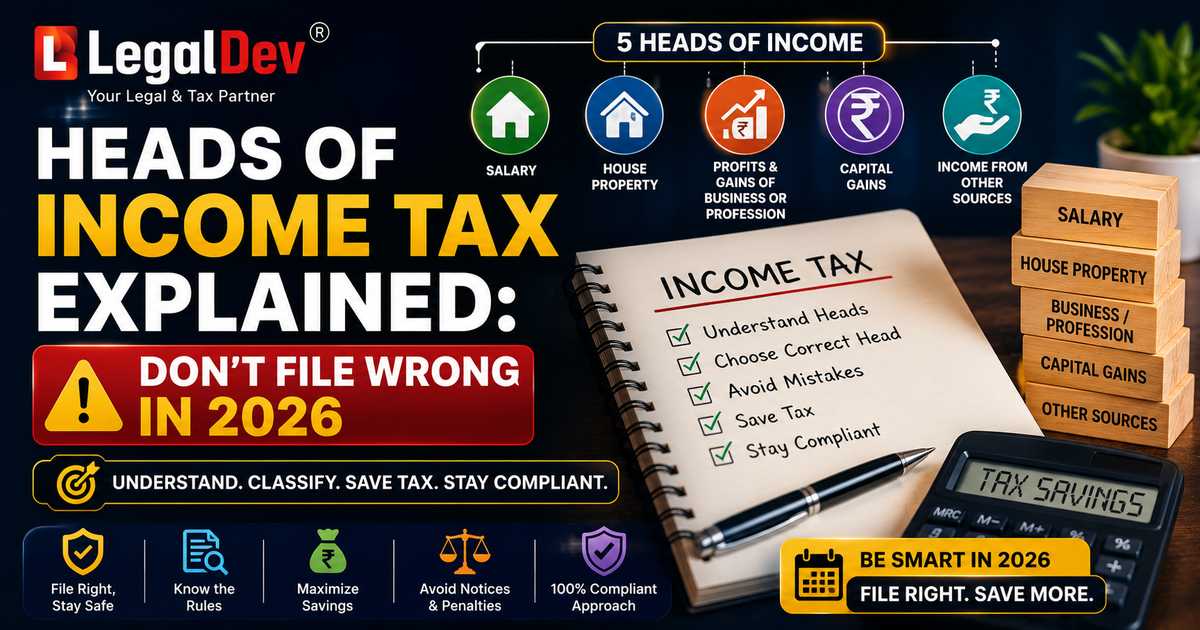
What Are the 5 Heads of Income?
The five heads of income under the Income Tax Act are:
-
Income from Salary
-
Income from House Property
-
Income from Profits and Gains from Business or Profession
-
Income from Capital Gains
-
Income from Other Sources
Each head of income is governed by separate provisions of the Act. You can't mix rules across heads — what's deductible under one may not be under another.
Income from Salary
If you earn money through an employer-employee relationship — whether it's a monthly salary, a bonus, advance salary, commission, gratuity, perquisites, or pension — it falls under this head.
The key sections governing this head are:
-
Section 15 — defines what's taxable as salary income
-
Section 16 — lists available deductions
-
Section 17 — explains components like monetary compensation and perquisites
Two common exemptions under this head that many salaried employees miss:
House Rent Allowance (HRA): If you live in a rented home, you can claim partial or full tax exemption on the HRA component of your salary. The actual exemption depends on your salary, rent paid, and city of residence.
Transport Allowance: Employees who are blind, deaf and dumb, or orthopedically handicapped can claim ₹1,600 per month as a transport allowance exemption.
Salary income details go into Schedule S of your ITR form.
Income from House Property
Own a house, flat, or land? Any income flowing from that property — rental income, deemed rental value — comes under this head.
The head of income from house property is broadly divided into three types:
-
Self-Occupied Property — the one you live in yourself
-
Let Out Property — rented out to a tenant
-
Deemed Let Out Property — if you own more than two self-occupied properties, the additional ones are treated as "deemed let out," even if no rent is actually received
Both commercial and residential properties are taxed here. A significant deduction available under this head is for interest paid on a home loan — something that reduces taxable income considerably for many property owners.
This information is declared in Schedule HP of your ITR.
Income from Profits and Gains from Business or Profession
Running a business? Working as a freelancer, consultant, or self-employed professional? Your income lands here.
Under this head, you can deduct business expenses from your total revenue — what remains is the taxable profit. Some types of income specifically chargeable under this head include:
-
Profits from the sale of a specific license
-
Business gains during an assessment year
-
Cash received from government export incentive schemes
-
Salary or bonus earned through a partnership firm
-
Gains from Future & Options trading, intraday trading
-
Presumptive taxation under Sections 44AD, 44ADA, and 44AE — designed to simplify tax for small businesses and professionals
Individuals or HUFs earning from business and profession must file ITR-3 or ITR-4, depending on whether they opt for presumptive taxation.
Income from Capital Gains
Sold a property, mutual fund, stock, or gold? The profit from selling a capital asset is taxed as capital gains.
Assets like real estate, equity shares, bonds, mutual funds, and gold all qualify as capital assets. Capital gains are split into two types based on the holding period:
-
Short-Term Capital Gains (STCG) — asset sold before the required holding period
-
Long-Term Capital Gains (LTCG) — asset held beyond that period
Here's how the tax rates and holding periods work (applicable for sales on or after 23rd July 2024):
|
Nature of Asset
|
Holding Period for LTCG
|
STCG Tax Rate
|
LTCG Tax Rate
|
|
Immovable Property
|
24 months
|
Slab rates
|
12.5% (no indexation)*
|
|
Unlisted equity shares
|
24 months
|
Slab rates
|
12.5% (no indexation)
|
|
Listed equity shares / equity mutual funds
|
12 months
|
20%
|
12.5% (no indexation)
|
|
Other capital assets
|
36 months
|
Slab rates
|
12.5% (no indexation)
|
|
Non-equity mutual funds (debt funds) purchased after 1 April 2023
|
Not applicable
|
Slab rates
|
Slab rates
|
*Individuals and HUFs still have the option to claim indexation and pay 20% on immovable property.
Capital gains details are disclosed in Schedule CG. If you're an individual, you'll need ITR-2 or ITR-3.
Income from Other Sources
Think of this as the catch-all head. Any income that doesn't fit neatly into the other four heads of income comes here.
This includes:
-
Dividends from shares or mutual funds
-
Interest from savings accounts, fixed deposits, or bonds
-
Lottery winnings, gambling income, card game prizes
-
Sports rewards and achievements
-
Rent from plant and machinery
-
Any other income not specifically classified elsewhere
Dividend income, in particular, is now taxable in the hands of shareholders in India under this head — since the dividend distribution tax was abolished in 2020.
Heads of Income vs Sources of Income
These two terms get confused often. They're not the same thing.
Heads of income are the classification buckets defined by the Income Tax Act — there are exactly five, and every taxpayer must categorise their earnings into these heads for filing purposes.
Sources of income are the actual origins of money — salary from a job, returns on investment, business profits, government grants, commission earned, and so on. One source of income can generate earnings that fall under a specific head. A salaried person's "source" is their employer; the "head" is Income from Salary.
Getting this distinction clear helps avoid misclassification errors in ITR filing.
Can Income Be Taxed Under More Than One Head?
Yes — and this is where things get interesting.
Rental income, for example, is typically classified under Income from House Property. But if someone's primary business is letting out properties for commercial rent, tax authorities may classify it under Profits and Gains from Business or Profession instead. Context and the nature of the taxpayer's activity matter.
When in doubt, consult a tax professional. The difference in classification can meaningfully change your tax liability.
Who Is Liable to Pay Income Tax in India?
It's not just individuals. The following are all liable:
-
Individual taxpayers
-
Hindu Undivided Families (HUFs)
-
Partnership firms and LLPs
-
Companies
-
Body of Individuals (BOIs) and Association of Persons (AOPs)
-
Any other artificial judicial person
And no — agricultural income is not taxable under Section 10(1) of the Income Tax Act, and it doesn't form part of total income for basic threshold calculation. Income from animal husbandry, on the other hand, does not qualify as agricultural income.
FAQs
Q: What are the 5 heads of income tax in India?
A: The five heads of income tax in India are: Income from Salary, Income from House Property, Income from Profits and Gains from Business or Profession, Income from Capital Gains, and Income from Other Sources. Every taxpayer must classify their earnings under the appropriate head before filing their ITR.
Q: Which ITR form is used for capital gains income?
A: For individuals with capital gains income, you need to file ITR-2 (if no business income) or ITR-3 (if you also have business or professional income). ITR-1 cannot be used if you have capital gains.
Q: Is salary income and professional income the same head?
A: No. Salary income falls under the "Income from Salary" head and requires an employer-employee relationship governed by a contract of service. Professional or freelance income falls under "Profits and Gains from Business or Profession," which has a completely different set of deductions and ITR forms.
Q: How is dividend income taxed in India after 2020?
A: Since the dividend distribution tax was abolished in FY 2020-21, dividends are now taxed in the hands of the investor under "Income from Other Sources." They are added to your total income and taxed at your applicable slab rate.
Q: What is deemed let out property in income tax?
A: If you own more than two self-occupied properties, the additional ones are treated as "deemed let out" under the house property head, even if no actual rent is received. Tax is calculated on the notional rental income that the property could have earned.
Q: What is the LTCG tax rate on equity mutual funds in India?
A: For equity mutual funds held for more than 12 months, long-term capital gains exceeding ₹1.25 lakh in a financial year are taxed at 12.5% without indexation (applicable for sales on or after 23rd July 2024).
Q: Can income from F&O trading be shown under capital gains?
A: No. Income from Futures & Options (F&O) trading is classified under "Profits and Gains from Business or Profession," not capital gains. This means you need to file ITR-3 and maintain books of accounts if your turnover exceeds the specified threshold.
Q: What deductions are available under the salary head of income?
A: Under Section 16 of the Income Tax Act, salaried individuals can claim a standard deduction of ₹50,000 (under the old regime), deduction for entertainment allowance (for government employees), and professional tax paid. HRA and transport allowances are available as separate exemptions under Section 10.
Q: Is rental income always taxed under house property?
A: Usually yes — rental income from property is taxed under the house property head. However, if letting out properties is your primary business activity, tax authorities may classify it under business income. The distinction matters because the applicable deductions and tax rules differ significantly.
Q: How does the government collect income tax from salaried employees?
A: For salaried employees, income tax is primarily collected through Tax Deducted at Source (TDS) by the employer. Additionally, if your tax liability exceeds ₹10,000 after TDS, you're required to pay Advance Tax in quarterly instalments. Any remaining liability is settled through Self-Assessment Tax at the time of filing.