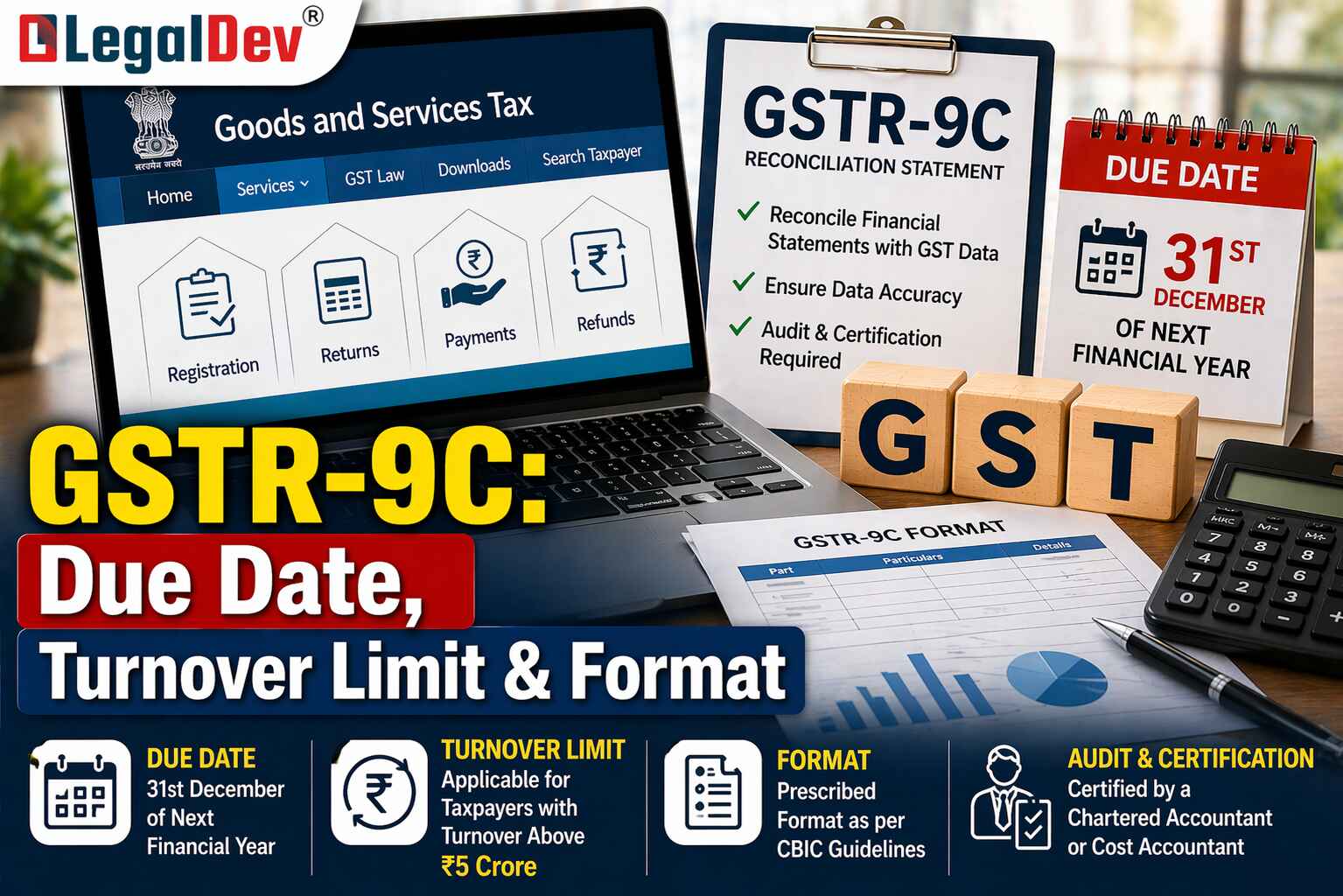
Businesses crossing ₹5 crore in annual turnover have one extra obligation beyond GSTR-9 — and that's GSTR-9C.
GSTR-9C is a reconciliation statement that sits on top of your annual GST return. It compares what your audited financial statements show against what you've declared in GSTR-9 — and any gap between the two has to be explained, reported, and if necessary, paid for. The form is self-certified by the taxpayer and filed per GSTIN on the GST portal.
This article covers GSTR-9C applicability, turnover limit, due date, format, recent changes, and the questions taxpayers actually ask.
Key Takeaways
-
GSTR-9C applies to registered persons with aggregate turnover above ₹5 crore for a financial year
-
It reconciles audited financials at PAN level against GSTR-9 figures per GSTIN
-
Self-certification by the taxpayer replaced CA certification from FY 2020-21 onwards
-
Any unreconciled tax or ITC shortfall gets reported in Part V and paid via DRC-03
-
Due date is 31st December of the year following the relevant financial year
-
Foreign airlines and OIDAR providers serving unregistered persons are exempt
What the GSTR-9C Reconciliation Statement Does
At its core, GSTR-9C bridges two sets of numbers that often don't match perfectly.
On one side — your audited annual financial statements, which represent PAN-level data. On the other — your GSTR-9 annual return, which is filed per GSTIN. The reconciliation statement identifies where these two diverge, requires reasons for each difference, and gets certified by the taxpayer before submission.
One GSTIN means one GSTR-9C. So a business with multiple GSTINs under the same PAN has to file a separate GSTR-9C for each registration. That adds up quickly for businesses with operations across multiple states.
Any discrepancy left unreconciled doesn't just sit there. It gets disclosed in the statement and, where tax is owed, paid through DRC-03 before filing. Getting ahead of these gaps proactively — rather than waiting for a notice — is exactly what this form is designed for.
Why GSTR-9C Matters More Than Most Taxpayers Realise
GSTR-9C does more than satisfy a compliance checkbox.
It verifies that what you've declared in your GST returns actually matches your books. Tax authorities use it to spot inconsistencies between reported turnover, tax paid, and ITC claimed. When the reconciliation is clean, the risk of receiving a scrutiny notice drops significantly.
There's also a liquidity angle. Identifying ITC mismatches or turnover differences early — through the reconciliation process — lets you manage the DRC-03 payment before the filing deadline rather than being caught off guard. Most experienced GST practitioners will tell you: the pain of reconciling early is nothing compared to the pain of a notice later.
Who Needs to File GSTR-9C — Turnover Limit Explained
The GSTR-9C turnover limit is ₹5 crore aggregate turnover in a financial year.
Any registered taxpayer crossing this threshold is required to file GSTR-9C. This applies regardless of the nature of goods or services supplied.
Two categories of taxpayers are exempt:
Foreign airline companies that comply with the relevant provisions of the Companies Act 2013 are not required to file GSTR-9C, as per CBIC notification no. 09/2020 dated 16th March 2020.
Non-resident OIDAR service providers supplying digital services to unregistered persons in India are exempt from both GSTR-9 and GSTR-9C, as per CBIC notification no. 30/2019 dated 28th June 2019.
Everyone else who crosses ₹5 crore — files.
GSTR-9C Due Date — and What Happens if You Miss It
The GSTR-9C due date matches the GSTR-9 deadline exactly: 31st December of the year following the relevant financial year.
So for FY 2024-25, the deadline was 31st December 2025. For FY 2025-26, it's 31st December 2026. The government can extend this if needed, and extensions have happened in past years — but planning around the original deadline is always the safer approach.
Miss the deadline and a general penalty of ₹25,000 applies. There's no specific late fee provision for GSTR-9C the way there is for monthly returns, but that doesn't mean non-filing goes unnoticed. Authorities do track it.
GSTR-9C Format: What Each Part Covers
The GSTR-9C form has two main sections: Part A — the Reconciliation Statement, and the Verification/Self-Certification by the taxpayer.
Part A — Reconciliation Statement
Part A is divided into five sub-parts:
Part I — Basic Details GSTIN, legal name, financial year, and ARN of the filed GSTR-9.
Part II — Turnover Reconciliation This is where gross and taxable turnover as per audited accounts gets compared to what was declared in GSTR-9. Reasons must be given for every difference — whether it's timing, adjustments, or treatment of certain transactions.
Part III — Tax Paid Reconciliation Tax liability as per the reconciled turnover from Part II is compared against the actual tax paid. Any shortfall identified here gets carried to Part V.
Part IV — ITC Reconciliation Input Tax Credit claimed in GSTR-9 is reconciled against ITC as per audited books. This part catches the cases where ITC was claimed in returns but wasn't fully reflected — or vice versa — in the financial statements.
Part V — Additional Liability Any unreconciled amount — whether tax or ITC — lands here. This isn't just a disclosure field. The liability reported in Part V has to be paid via DRC-03. Leaving it here without payment creates a compliance gap that authorities will follow up on.
Verification and Self-Certification
From FY 2020-21 onwards, CA certification is no longer required. The taxpayer — through an authorised signatory — self-certifies the statement. This shift placed more responsibility on the business, but it also removed a practical bottleneck that used to delay filings significantly.
Recent Changes to GSTR-9C Format You Should Know About
Two additions to the format are worth paying close attention to:
Table 7D1 — E-Commerce Operator Supplies (New)
This table captures supplies where tax is paid by the e-commerce operator under Section 9(5) of the CGST Act. Before this table existed, these transactions were harder to track and reconcile cleanly. Now, suppliers using e-commerce platforms need to report these separately — ensuring alignment between what the supplier declares and what the operator has paid.
Table 17 — Auto-Calculated Late Fee (New)
GSTR-9C now includes an auto-populated Table 17 that calculates late fees at ₹100 per day for delayed filings — covering both GSTR-9 and GSTR-9C. Payment goes through DRC-03. The automation removes the manual calculation step, but it also removes any room to argue the amount. What the system calculates is what gets paid.
FAQs
Q: Is GSTR-9C still mandatory after the GST audit requirement was removed?
A: Yes — GSTR-9C is still required for taxpayers with aggregate turnover above ₹5 crore. What changed from FY 2020-21 is that CA certification is no longer needed. The taxpayer now self-certifies the reconciliation statement. The filing obligation itself didn't change — just who signs off on it.
Q: What's the penalty for not filing GSTR-9C by the due date?
A: There's no specific late fee structure for GSTR-9C the way GSTR-1 or GSTR-3B have one. A general penalty of ₹25,000 applies to taxpayers who miss the 31st December deadline. That said, enforcement isn't always uniform — but waiting to find out isn't worth the risk.
Q: Can GSTR-9C be filed before GSTR-9 is submitted?
A: No. GSTR-9C reconciles against GSTR-9, so the annual return must be filed first. Both share the same due date — 31st December following the financial year — so in practice, they're filed together or in quick succession.
Q: Which tables in GSTR-9C are mandatory to fill?
A: Tables 5, 7, 9, and 12 are always mandatory. Tables 6, 8, 10, and 13 only need entries if there are unreconciled amounts identified in the mandatory tables — otherwise they stay blank. This is one of the more common points of confusion during filing, so it's worth checking before submission.
Q: How do you pay the additional liability found during GSTR-9C reconciliation?
A: Any tax shortfall or unreconciled ITC difference identified in Part V of GSTR-9C gets paid through Form DRC-03 — not directly within the GSTR-9C itself. Clearing this before the filing deadline significantly reduces the chance of a follow-up notice from the department.