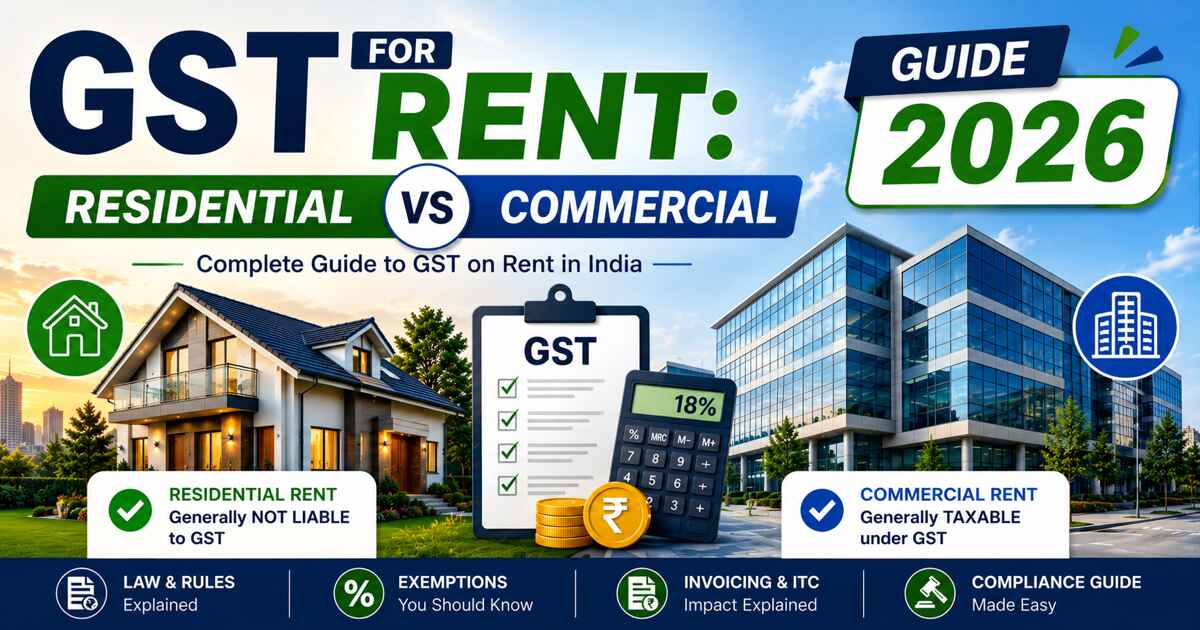
GST on rent confuses thousands of landlords, tenants, and business owners every single year — and honestly, that's understandable. The rules aren't the same for everyone. Where you live, what the property is used for, and who the tenant is can completely change the tax picture. This guide breaks it all down in plain language, for the Indian context, without the usual jargon overload.
At Legaldev, we've helped people navigate tax and compliance for years. The same questions keep coming up. So here's the clarity most people are still looking for.
What Is GST and How Does It Apply to Rent?
GST — Goods and Services Tax — came into effect on July 1, 2017, replacing a whole range of indirect taxes that had been layered on top of each other for decades. Under GST, renting a property is treated as a service in many situations, which means gst for rent can apply depending on a few key factors.
Those factors? Whether the property is residential or commercial, how it's actually being used, and who the tenant is.
In simple terms:
-
Renting a home to a family for living purposes — generally no GST.
-
Renting a shop or office for business — GST applies.
-
A business renting a residential flat for commercial use — a special case, often covered under RCM.
Let's go through each one.
GST on Residential Properties
Residential property means homes, flats, apartments — places where people actually live.
Standard Rule: No GST
If a residential property is rented out purely for someone to live in, gst on rent does not apply. No extra tax is added to the monthly rent. That's been the rule since GST was introduced, and it's good news for most ordinary landlords and tenants across Delhi, Pune, Chennai, or anywhere else.
What If a Business Is the Tenant?
Here's where it gets a bit more specific. If a registered business rents a residential property — even a flat — and uses it for business purposes like a small office or a guest house, gst for rental income can apply. And in this situation, it usually falls under the Reverse Charge Mechanism (RCM).
Under RCM, the tenant (the business) pays the GST directly to the government. The landlord doesn't have to be GST-registered for this to kick in. The tax obligation shifts entirely to the business using the property.
This is exactly why the RCM provision exists — to make sure taxes are collected fairly when a company benefits commercially from a technically residential space.
Example: RCM in Action
Say you've leased your flat to a software startup that's using it as a small working space. The property is residential by nature, but the use is commercial. In this case, the startup pays 18% GST under RCM directly to the government. You, as the landlord, don't collect or remit anything — but the business cannot skip this step.
Many landlords are relieved to hear they don't need to handle the GST in this scenario. But businesses must get it right and file their returns accordingly.
GST on Commercial Property
Commercial property — shops, showrooms, offices, warehouses, any space used for trade or business — is taxed differently. Here, rent gst rate is clear and consistent.
GST Applies at 18%
When commercial property is rented out, the rent is a taxable service. The gst rate on rent for commercial spaces is 18% — the standard rate for most services under GST.
So if a shop owner rents a retail space for ₹50,000 a month, the landlord adds ₹9,000 as GST, making the total outflow ₹59,000 per month. The landlord collects this and remits it to the government through regular GST returns.
Who Actually Pays It?
In most cases, the tenant pays the GST along with the rent. The landlord collects it and files returns.
Tenants who are GST-registered can claim Input Tax Credit (ITC) on the GST paid — as long as the space is being used for taxable business activities. That makes the effective cost lower for registered businesses, which is worth knowing.
When the landlord is unregistered but the tenant is registered, the rent and gst obligation can flip under RCM — the tenant covers the GST directly and claims ITC where applicable.
GST Registration Threshold — When Does It Become Mandatory?
Not every landlord needs to register for GST. The threshold matters.
If your annual rental income and gst liability from commercial property crosses ₹20 lakh, GST registration becomes mandatory. In certain special category states, that limit drops to ₹10 lakh.
If you're only renting residential property to individuals for personal living, and your income stays below the threshold, registration generally isn't required.
The exception — as discussed — is when a registered business rents your residential property for commercial use. RCM applies there regardless of your income level.
What Registration Means in Practice
Once you're registered, the obligations are straightforward but must be followed:
-
Charge GST on rent wherever applicable
-
Issue GST-compliant invoices to tenants
-
File GST returns on time — monthly or quarterly
-
Deposit the collected GST with the government
Miss these steps and penalties start adding up. This is exactly the area where Legaldev works closely with clients — making compliance manageable rather than stressful.
GST on Mixed-Use Properties
Some properties serve dual purposes — partly residential, partly for business. In these cases, gst for rent is calculated only on the commercial portion.
If 30% of a property is used as an office and the rest is residential, GST applies only to that 30% of the rent. The residential portion stays exempt. Keeping clear documentation of this split is important — it prevents disputes if things are ever questioned later.
Security Deposits and GST
Security deposits are a common point of confusion when it comes to rent and gst.
Refundable security deposits are generally not taxable — they're not a payment for a service, they're a security against damage or default. As long as they're returned at the end of the lease, no GST applies.
Advance rent payments are a different story. Since they represent payment for actual rental services, they can attract GST. Proper documentation and a well-drafted lease agreement go a long way in keeping things clean here.
Common Scenarios — How GST Applies in Real Life
Sometimes it helps to just see the scenarios laid out plainly.
Scenario 1: Home rented to a family Monthly Rent: ₹15,000 | GST: None
Scenario 2: Office space rented to a startup Monthly Rent: ₹80,000 | GST: 18% charged by the landlord — total ₹94,400
Scenario 3: Flat rented to a business as a guest house Monthly Rent: ₹40,000 | GST: 18% under RCM — paid by the business tenant
Scenario 4: Shop rented by an unregistered landlord to a registered business Monthly Rent: ₹60,000 | GST: Tenant pays under RCM
Each of these has a different compliance path. Treating them the same is where most mistakes happen.
Why Getting GST on Rent Right Matters
The gst rate on rent isn't just a number to memorise — it affects pricing decisions, monthly cash flows, and tax filing for both sides of a rental agreement. Landlords who miss their GST obligations face penalties and back-interest. Businesses that handle it incorrectly lose out on ITC they could have legitimately claimed.
Rental income and gst compliance, when handled correctly, is far less complicated than it looks. The confusion usually comes from not knowing which rule applies to which situation — which is exactly what this guide is meant to fix.
If you need help assessing your specific situation, handling registration, or filing returns, the team at Legaldev.
FAQs
Q1: Is GST applicable on rent for a residential flat in India?
A: If a residential flat is rented purely for someone to live in, gst on rent does not apply. However, if a registered business rents the same flat for office or guest house use, 18% GST applies under the Reverse Charge Mechanism — paid directly by the business tenant, not the landlord.
Q2: What is the GST rate on rent for commercial property?
A: The gst rate on rent for commercial properties — shops, offices, warehouses, showrooms — is 18%. This is the standard rate under GST for most services. The landlord collects it from the tenant and remits it through GST returns.
Q3: Who pays GST on rent under RCM — landlord or tenant?
A: Under the Reverse Charge Mechanism, the registered business tenant pays the gst for rent directly to the government. The landlord doesn't collect or deposit anything in this case. RCM typically applies when a business uses a residential property for commercial purposes, or when the landlord is unregistered but the tenant is registered.
Q4: Does GST apply to rental income below ₹20 lakh?
A: For rental income and gst on commercial property, registration becomes mandatory only when annual taxable rental income exceeds ₹20 lakh (₹10 lakh in special category states). Below the threshold, registration is generally not required — unless RCM applies due to a registered business tenant.
Q5: Can a business claim ITC on GST paid for office rent?
A: Yes. Registered businesses paying rent and gst on commercial office space can claim Input Tax Credit on the 18% GST paid — as long as the space is used for taxable business activities. This effectively reduces the net cost of renting for most businesses.
Q6: Is GST applicable on security deposits for rented property?
A: Refundable security deposits are generally not taxable under gst for rental income rules, since they're not a payment for services rendered. However, advance rent paid upfront can attract GST, as it constitutes payment for actual rental services. Clear documentation in the lease agreement matters here.
Q7: Does a small landlord with one rented shop need GST registration?
A: It depends on the annual rent gst rate exposure and total taxable income. If the annual rent from commercial property stays below ₹20 lakh, registration is usually not required. Cross that threshold and registration becomes mandatory — along with invoicing, return filing, and deposit obligations.
Q8: What happens if a landlord doesn't collect GST on commercial rent?
A: If a landlord is GST-registered and fails to charge or deposit gst on rent for commercial property, penalties and interest apply. In some cases, the tax department can demand the uncollected GST directly from the landlord. Staying compliant from the start is far easier than dealing with a notice later.
Q9: How is GST calculated on a mixed-use property — partly residential, partly commercial?
A: Gst for rent is calculated only on the commercial portion of the property. If 40% of the space is used for business, GST at 18% applies to 40% of the total rent. The remaining residential portion stays exempt. Documenting the usage split clearly — in the lease agreement and your records — is the safest approach.
Q10: Is rental income from a warehouse or godown taxable under GST?
A: Yes. Warehouses and godowns fall under commercial property, so the standard rent gst rate of 18% applies. The landlord charges GST on the monthly rent, and a registered business tenant can claim ITC on it — making it a cost-neutral transaction for most businesses in the supply chain.