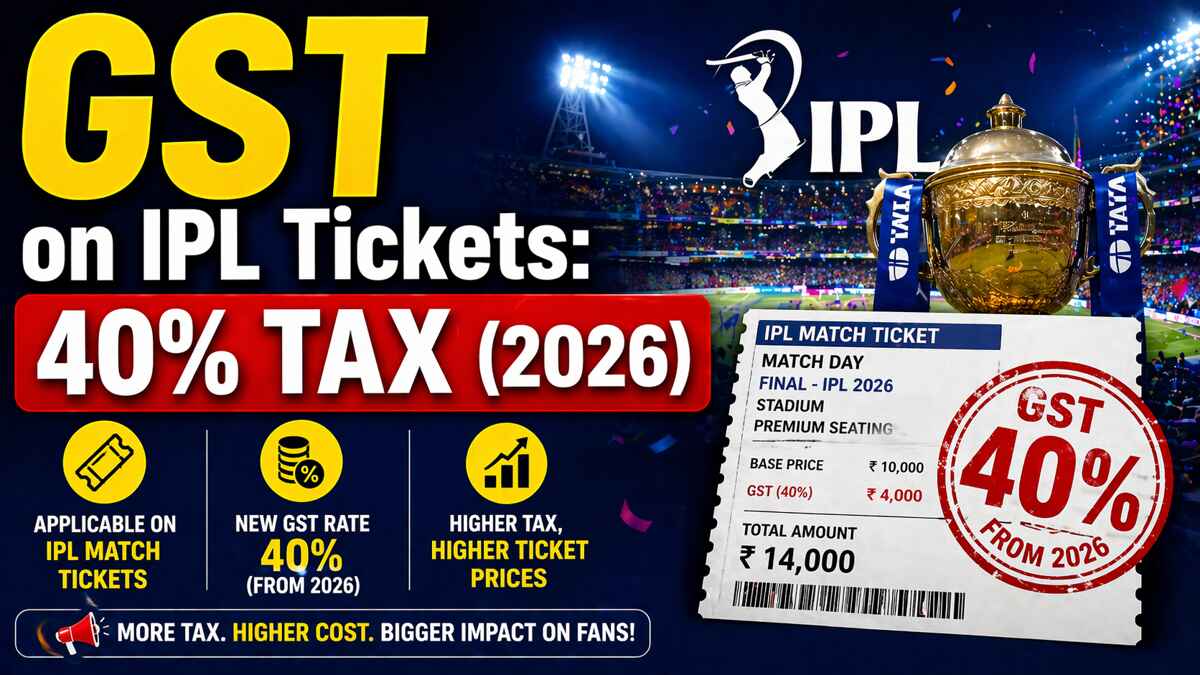
GST on IPL Tickets: Why Fans Pay 40% and Teams Want It Halved
Watching an IPL match live just got more expensive than booking a business-class flight. Every IPL ticket you buy carries a 40% GST — and cricket fans are quietly absorbing that cost without realizing it. Now, IPL franchises have had enough. They've taken their case straight to the Finance Ministry, demanding that the GST on IPL tickets be slashed from 40% to 18%. Whether the government listens could decide whether stadium cricket stays a middle-class experience or slowly becomes a luxury.
How the GST Slab Change Put IPL in the Wrong Category
The current 40% rate didn't come out of nowhere. When the central government overhauled the GST structure last year, it introduced what's called the "sin goods" slab — a special high-tax bracket reserved for products and activities considered socially harmful.
That bracket covers things like pan masala, tobacco, gambling, and casinos. IPL tickets got pulled into the same category.
Bipin Sapra, Partner at EY, put it plainly: taxing sports events under the cricket ecosystem at 40% does real damage to the game's growth. It also sends the wrong signal about how India views sports as part of its economy.
Before that GST restructuring, IPL tickets attracted a 28% tax rate. The jump to 40% happened quietly — and most fans didn't notice until ticket prices climbed.
Comparing Cricket to Casinos: IPL Teams Say That's Plain Wrong
Here's where the franchises get genuinely frustrated. A casino or a gambling den has a measurable social cost — addiction, financial harm, family breakdown. An IPL match is families watching cricket together on a Sunday.
Lumping the two together under the same tax slab makes no logical sense, according to the teams.
The franchises also point to a comparison that's hard to argue with: a hotel room priced above ₹7,500 per night attracts 18% GST. A business-class or first-class flight ticket? Also 18%. A BCCI-organized international cricket match? 18%.
An IPL match? 40%.
To put that in rupee terms — if a ticket has a face value of ₹1,000, you're actually paying ₹1,400 after GST. Cut the rate to 18%, and that same ticket costs ₹1,180. That's ₹220 back in every fan's pocket, per match.
The Case IPL Franchises Are Making — And It's Hard to Argue With
IPL teams aren't just making a financial argument. They're making a cultural one.
Cricket is the one sport that cuts across every class, language, and region in India. Families in Nagpur watch the same match as families in Kolkata. The IPL, whatever its flaws, is one of the few sporting events where a factory worker and a CEO can sit in the same stadium.
Prateek Jain, Partner at PriceWaterhouse & Company, flagged something that deserves more attention: international cricket markets are expanding fast. The US hosted T20 World Cup matches in 2024. Saudi Arabia is now investing in sports seriously. If India's domestic tax structure makes live cricket unaffordable at home, it pushes fans toward screens instead of stadiums — and that hollows out the live-sports ecosystem over time.
The teams' core argument is also simple: reclassify IPL matches as sporting events rather than entertainment. That one change in category would drop the applicable GST rate to 18% automatically, without needing a new slab or special exemption.
IPL Update for GST: What the GST Council Decides Next
A government official confirmed that the Finance Ministry has received the franchises' representation and it'll be sent to the GST Council for review. The Council is the body that decides all GST rate changes — states and the Centre both have a say.
Whether this makes it onto the agenda at the next GST Council meeting isn't confirmed yet. No formal date for a decision has been announced, and GST Council meetings don't always move at the speed that industry lobbying would prefer.
If the rate does come down to 18%, the impact is immediate and direct — cheaper tickets, fuller stadiums, and a stronger case for cricket as a mainstream sport rather than a premium experience. Fans who've been watching from home because stadium tickets feel too expensive could actually come back.
That's the real upside here. Not just for IPL teams' bottom lines — but for cricket culture itself.
Real Questions About GST on IPL Tickets — Answered
How much GST do you actually pay on an IPL ticket right now?
Every IPL ticket carries a 40% GST on top of its face value. So a ₹500 ticket becomes ₹700 at the counter. A ₹2,000 ticket costs ₹2,800. That 40% isn't shown separately in most booking flows — it's baked into the "all-inclusive" price you see, which is why most fans don't realize how much of their payment is tax.
Why do BCCI international match tickets attract lower GST than IPL matches?
BCCI-run international matches — Tests, ODIs, T20Is — sit in a different tax category and attract 18% GST. IPL matches, being a private league rather than a national board event, fall under a different classification. That's the exact reclassification IPL franchises are now fighting for: move IPL from "entertainment" to "sporting event" and bring it in line with BCCI matches. A 22-percentage-point gap for matches played in the same stadiums between some of the same players is genuinely hard to justify.
Is the 40% IPL ticket tax actually higher than what casinos pay?
Yes — and that's precisely why IPL teams are upset. Casinos attract 28% GST on their gross gaming revenue in most states. IPL tickets at 40% are taxed at a higher rate than gambling. Whether that was a deliberate policy choice or a classification error when the sin goods slab was introduced isn't fully clear. Either way, the franchises argue it's an anomaly that needs fixing.
Will GST on IPL tickets actually come down in 2026?
Possibly — but don't hold your breath for a quick decision. The Finance Ministry has confirmed it's been referred to the GST Council, where all rate change decisions are made. The Council meets periodically and has a full agenda; sports event taxation isn't the only item on the table. A decision could come in the next meeting or get pushed further. If it does pass, the 18% rate would likely apply to future seasons, not retrospectively to 2026 tickets already sold.
What would IPL ticket prices look like at 18% GST instead of 40%?
The savings are real and direct. On a ₹1,000 base ticket: you currently pay ₹1,400 total — cut to ₹1,180 at 18%. On a ₹5,000 premium seat: you go from ₹7,000 down to ₹5,900. At the upper end — ₹20,000 hospitality tickets — the difference is ₹4,400 per seat. For families buying multiple tickets, that gap becomes significant. If you're planning to watch a match this season, keep an eye on GST Council announcements — a rate cut, if it happens, would make stadium tickets meaningfully more affordable.
Fans have been absorbing 40% GST on IPL tickets without a real fight — mostly because the tax gets buried in the final price. The push to cut that rate to 18% by reclassifying IPL as a sporting event makes sense on policy grounds, economic grounds, and frankly on common-sense grounds. Whether the GST Council agrees is another question. But the conversation has started — and for cricket fans who want to watch their team live without paying casino-level taxes for the privilege, it's the right one to be having.