GST on Cement 2026: New 18% Rate, HSN Code & Real Impact on Construction Costs
The GST rate on cement just came down — and for anyone in construction, real estate, or infrastructure, that's worth paying attention to.
India is the world's second largest cement producer, sitting just behind China. With the government's sustained push on infrastructure development, affordable housing, and road construction, the cement industry was already on a growth path. The big question has always been: does the GST structure help or hurt that momentum?
Here's where things stand right now.
What Is the Current GST on Cement?
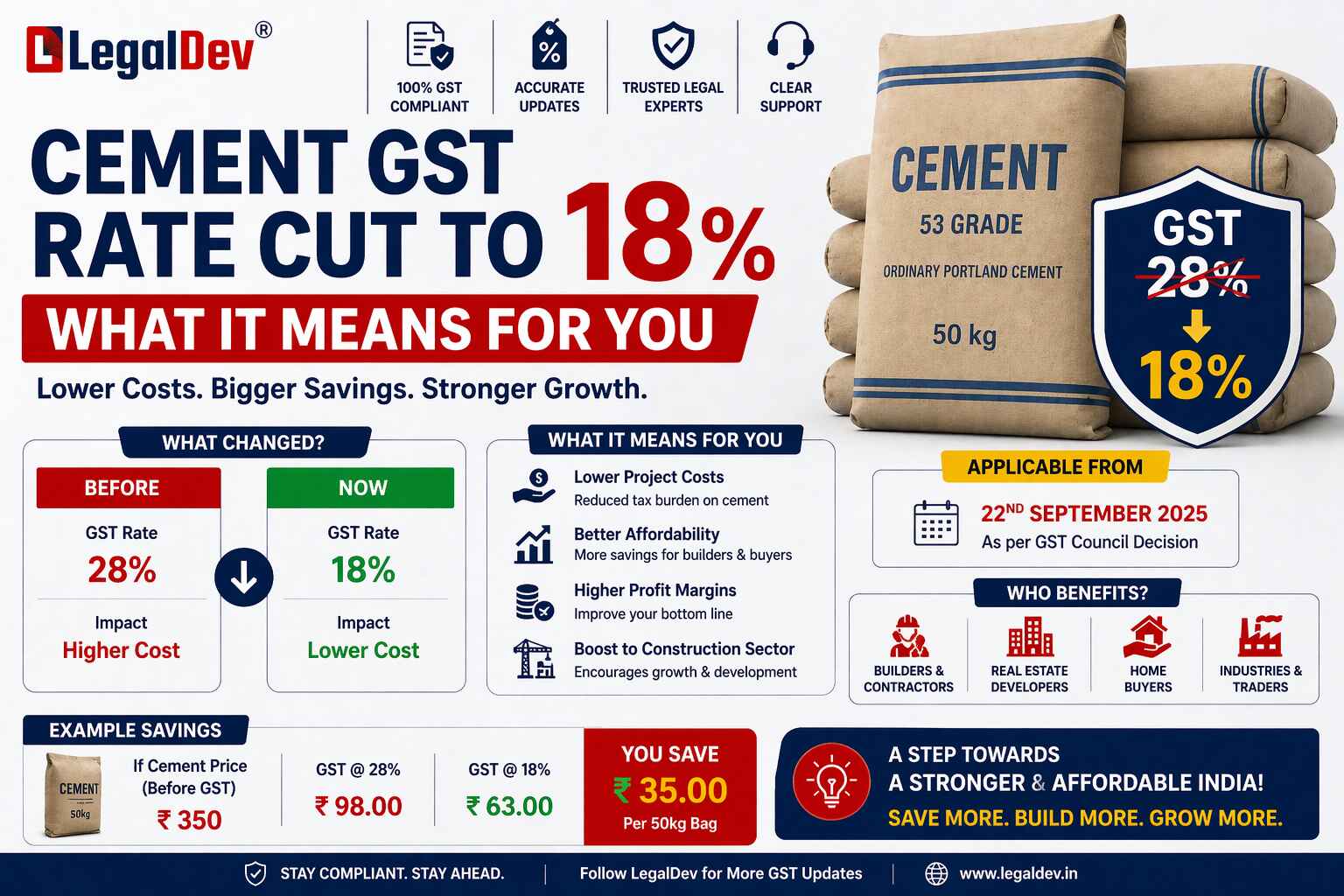
Effective 22nd September 2025, the cement GST rate is 18%. This covers Portland cement, aluminous cement, slag cement, super sulphate cement, and similar hydraulic cements. The CBIC officially notified this reduction on 17th September 2025 — bringing it down from the earlier 28%.
That's a meaningful shift. For a sector as cost-sensitive as construction, a 10-percentage-point reduction in cement GST is not a small thing.
Before this change, gst on cement sat at 28% — one of the higher slabs — which added real pressure on infrastructure project costs and housing prices alike.
Cement HSN Code and GST Rate
For businesses filing returns or raising invoices, here's a quick reference:
|
Cement Type
|
HSN Code
|
GST Rate
|
|
Portland, aluminous, slag, hydraulic cements
|
2523
|
18%
|
|
Refractory cement, mortars, concretes
|
3816
|
18%
|
|
Cement Bonded Particle Board
|
6808
|
12%
|
The cement HSN code and GST rate for standard cement — the kind used in most residential and commercial construction — falls under HSN 2523 at 18%. Refractory cement (used in industrial furnaces and large kilns) also attracts 18%. Cement Bonded Particle Board sits at a lower 12% slab.
What Was the Tax on Cement Before GST?
Under the earlier VAT regime, cement taxation was anything but simple. Excise duties varied based on the type of cement, the form of packaging, and who the buyer was — industrial, institutional, or trade. The effective rate, including excise duty and VAT combined, typically worked out to around 24–25%.
Here's a rough picture of how that excise structure looked:
|
Customer Type
|
Packaging
|
Ad-Valorem Duty
|
Specific Duty
|
|
All
|
Bulk
|
12% on transaction value + cess
|
Nil
|
|
Industrial/Institutional
|
Packaged
|
12% on transaction value + cess
|
Nil
|
|
Trade
|
Packaged (MRP mandatory)
|
12% on MRP with 30% abatement
|
₹120/MT
|
Multiple rates, multiple conditions, separate calculations for each supply type. GST replaced all of this with a single fixed rate — which alone reduces compliance burden considerably.
Raw Material Taxes Under GST — The Full Picture
The gst for cement doesn't tell the whole story. Cement production depends heavily on three key inputs: limestone, coal, and electricity. Each has its own tax treatment.
Limestone is taxed at 5% under GST. Coal is capped at 5% — down from the earlier effective rate of around 11.69%, which is a genuine relief for manufacturers. Electricity, however, sits outside GST's purview entirely and continues to be taxed under state electricity laws.
Two costs that remain outside GST's reach are worth flagging. First, the royalty that cement companies pay state governments for limestone quarrying is not addressed under GST — it remains an unsubsumed cost. Second, the clean energy cess on coal cannot be claimed as input credit since it isn't subsumed into GST. Both of these continue to flow into the cost of cement production, same as before.
So while the headline cement GST percentage has improved, manufacturers still carry these legacy costs. That context matters when evaluating how much of the rate cut actually reaches the end consumer.
Positive Impact of GST on the Cement Industry
Warehousing Gets Leaner
Before GST, cement manufacturers maintained warehouses in multiple states primarily to avoid Central Sales Tax and state entry levies. Most of these facilities ran well below capacity — an obvious operational inefficiency.
With GST removing those inter-state tax frictions, companies can now consolidate. Warehouses can be positioned based on logistics logic rather than tax geography. Cities like Nagpur — historically a natural distribution hub — become more attractive for centralized storage. Fewer, better-utilized warehouses means lower overhead and less waste in the supply chain.
Transport Costs Should Come Down
Cement plants are typically built close to limestone quarries. Demand, however, is spread across the country. That gap between production location and consumption point has always translated into high freight costs.
Under GST, the logistics industry itself has been significantly streamlined. Vehicles spend less time at state border checkpoints. Transit times drop. And when transit times drop, so does the per-unit transport cost — which feeds directly into the gst on cement bag pricing that buyers eventually see.
One Rate Replaces Many
The earlier excise structure — with its mix of ad-valorem duties, specific duties, and differentiated rates based on packaging type and buyer category — created enormous compliance complexity. All of that is gone. A single cement GST rate now applies, which simplifies filing, reduces scope for disputes, and cuts administrative overhead across the board.
For smaller cement dealers and distributors, this matters just as much as it does for the large manufacturers.
Will Cement Prices Actually Fall?
That's the right question, and the honest answer is: it depends on whether manufacturers pass the savings on.
The rate cut on gst cement from 28% to 18% creates room for prices to ease. But input costs — particularly electricity and royalties — remain unchanged. Margins in the cement industry have historically been tight. Whether the gst of cement savings translate into lower prices for buyers depends on competitive dynamics in local markets.
Historically, cost savings in commodity industries don't always flow downstream immediately. Construction companies and individual buyers building homes should watch pricing trends over the next few quarters rather than assuming an immediate drop.
What is clear: for infrastructure projects with long timelines and bulk cement procurement, the cement bricks GST rate and related material cost reductions will add up meaningfully over a full project lifecycle.
GST on Cement Bag — What Retail Buyers Should Know
For retail purchases, gst on cement bag is the most directly relevant figure. At 18% GST, a 50 kg bag of standard OPC cement now carries a lower tax burden than it did before September 2025.
The actual market price also depends on freight, dealer margins, and brand. But the tax component — which at 28% was a significant portion of the final price — has now reduced. For someone building or renovating a home, this is a tangible positive, even if the full benefit takes time to filter through.
FAQs
Q: What is the current GST rate on cement in India?
A: The current GST on cement is 18%, effective from 22nd September 2025. This applies to Portland cement, aluminous cement, slag cement, and other hydraulic cements covered under HSN code 2523. The rate was reduced from 28% by the CBIC.
Q: What is the HSN code for cement and its GST rate?
A: The cement HSN code and GST rate is HSN 2523 at 18% for standard hydraulic cements including Portland and slag cement. Refractory cement and concretes fall under HSN 3816 at 18%, while Cement Bonded Particle Board (HSN 6808) attracts 12% GST.
Q: How much GST is charged on a cement bag?
A: GST on cement bag is 18% on the taxable value. For a standard 50 kg bag of OPC cement, this means the GST component is calculated at 18% on the base price before dealer margins and freight are added.
Q: Did the cement GST rate change in 2025?
A: Yes. The cement GST rate was reduced from 28% to 18% with effect from 22nd September 2025. The CBIC officially notified this rate change on 17th September 2025, making it one of the more significant GST revisions for the construction materials sector.
Q: What is the GST rate on cement bricks?
A: Cement bricks GST rate is 12% under GST. This is lower than the 18% applicable on standard cement, which can make a difference in material cost calculations for construction projects using brick-based building systems.
Q: Will the GST reduction on cement actually reduce housing costs?
A: The GST cement rate cut from 28% to 18% creates room for prices to fall, but the full benefit depends on manufacturers and dealers passing on the savings. Raw material costs like electricity and limestone royalties remain outside GST, so the reduction in cement GST percentage doesn't eliminate all input cost pressures.
Q: Is electricity used in cement manufacturing covered under GST?
A: No. Electricity falls outside the GST framework entirely and is taxed under state electricity laws. This means cement manufacturers cannot claim input tax credit on electricity costs, and this continues to be absorbed into production costs regardless of the cement GST rate.
Q: What was the effective tax rate on cement before GST?
A: Before GST, the effective tax rate on cement — including excise duty and VAT — worked out to approximately 24–25%. The structure was complex, with different rates depending on whether cement was supplied in bulk or packaged form and whether the buyer was industrial, institutional, or a trade customer.
Q: Does GST on cement apply the same way for all states in India?
A: Yes. One of the core benefits of gst for cement is that it replaced the state-by-state VAT and entry tax structure with a uniform national rate. All states now apply the same 18% cement GST, eliminating the earlier interstate tax complications that manufacturers and distributors had to navigate.
Q: Can cement dealers claim input tax credit under GST?
A: Yes. GST-registered cement dealers, distributors, and contractors can claim input tax credit on cement purchases, as long as they hold a valid tax invoice and the purchase is used for business purposes. This was one of the structural improvements GST brought over the earlier VAT regime.