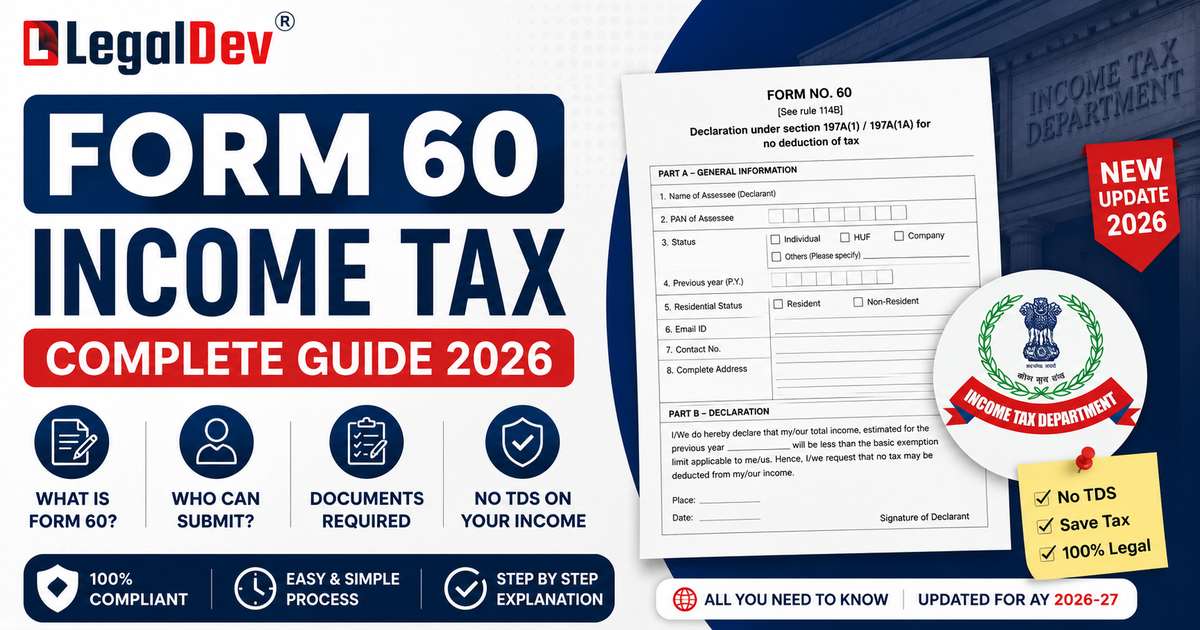
Form 60 Income Tax: What It Is, Who Needs It, and How to Use It Right
No PAN card — but you need to open a bank account, buy a property, or put money in a fixed deposit? Most people hit a wall here. What they don't know is that there's a legal way out. It's called Form 60, and the Income Tax Department created it specifically for situations like this.
Here's everything you need to know — who qualifies, when to use it, what to fill in, and what to avoid.
What Is Form 60?
Form 60 is a written declaration submitted by an individual who doesn't hold a PAN card but needs to carry out a financial transaction that normally requires one. It acts as an alternative to quoting a PAN, helping the income tax department keep such transactions transparent and compliant.
The form sits under Rule 114B of the Income Tax Rules, 1962 — a rule that makes PAN compulsory for certain high-value dealings. The government put this rule in place to track large cash movements and reduce black money circulation. For those who genuinely don't have a PAN yet, Form 60 is the substitute.
One important boundary: companies and firms cannot use Form 60. Under Rule 114B, companies or firms involved in specified transactions cannot submit Form 60 as an alternative — they must provide their PAN. This form is strictly for individuals, HUFs, trusts, and in limited cases, foreign companies.
Who Can File Form 60 And Who Cannot?
You can file Form 60 if:
-
You haven't applied for a PAN card yet — but your total income (excluding agricultural income) must be below the basic exemption limit. If it's above that, you cannot use Form 60 without a pending PAN application.
-
You have applied for a PAN, but the allotment is still pending. In this case, you can submit Form 60 regardless of your income — just include the application date and acknowledgement number in Column 22 of the form.
You cannot file Form 60 if:
-
You are a company or a registered firm
-
Your income is above the basic exemption limit and you haven't even applied for PAN yet — first apply for PAN, then you can use Form 60 in the meantime
When Does Form 60 Apply? Full List of Rule 114B Transactions
The following transactions require PAN to be quoted. If you don't have one, Form 60 must be submitted instead:
|
Transaction
|
Threshold
|
|
Purchase or sale of any motor vehicle (excluding two-wheelers)
|
Any value
|
|
Opening a Demat account
|
Any value
|
|
Opening a bank account (other than basic savings deposit account)
|
Any value
|
|
Applying for a debit or credit card
|
Any value
|
|
Purchase or sale of immovable property
|
₹10 lakh or above (as per Stamp Valuation Authority)
|
|
Fixed deposit with bank / post office / Nidhi / NBFC
|
More than ₹50,000 or aggregate more than ₹5 lakh in a financial year
|
|
Cash payment to hotels or restaurants
|
Exceeding ₹50,000 at one time
|
|
Payment for foreign travel or foreign currency purchase in cash
|
Exceeding ₹50,000 at one time
|
|
Life insurance premium payment
|
Exceeding ₹50,000 in a year
|
|
Purchase or sale of company shares or securities contract
|
Exceeding ₹1 lakh per transaction
|
|
Purchase of Mutual Fund units
|
Exceeding ₹50,000
|
|
Payment to company/institution for debentures or bonds
|
Exceeding ₹50,000
|
|
Payment to RBI for bonds
|
Exceeding ₹50,000
|
|
Cash deposit with bank or post office
|
Exceeding ₹50,000 in one day OR aggregating more than ₹2.5 lakh during 9 Nov–30 Dec 2016
|
|
Purchase of bank drafts / pay orders / banker's cheques in cash
|
Exceeding ₹50,000 at one time
|
|
Time deposit with bank / NBFC / Nidhi
|
Exceeding ₹50,000 or aggregate more than ₹5 lakh in a financial year
|
|
Pre-paid payment instruments via cash / draft
|
Aggregating more than ₹50,000 in a financial year
|
|
Sale or purchase of other goods and services
|
Exceeding ₹2 lakh per transaction
|
Special Cases Worth Knowing
Minors: If a minor enters into any transaction mentioned in Rule 114B and does not have income chargeable to income tax, they will need to quote the PAN of their father, mother, or guardian. If no PAN is available in the family either, Form 60 can be submitted in the parent's or guardian's name on the minor's behalf.
Non-residents: Non-residents are not fully exempt. As per Rule 114B, non-residents are required to quote PAN or file Form 60 only for a limited number of transactions. For remaining transactions like hotel and restaurant payments, getting a debit or credit card, and travel expenses — non-residents are not required to furnish PAN or Form 60.
HUF: Any document in the name of the Karta of the HUF is accepted as identity and address proof.
Joint transactions: If the transaction involves two or more people, the total number of persons involved and the combined transaction amount must be mentioned clearly in the form.
How to Download Form 60 PDF
Getting the form is straightforward:
-
Go to the official Income Tax Department website — incometax.gov.in
-
Click on 'Forms/Downloads' in the top navigation menu
-
Select 'Income Tax Forms' from the dropdown
-
You'll land on a page listing all tax forms
-
Search for 'Form No. 60' and click on it
-
The PDF will download to your device automatically
Many banks and financial institutions also keep printed copies of Form 60 at their branches — you can pick one up when you're there for the transaction itself.
How to Fill Form 60 — What Goes Where
The form asks for some specific details. Here's what you'll need to fill in:
-
Full name and complete address of the person making the declaration
-
Details of the transaction — what kind of transaction it is, the institution's name, and the amount involved. If something doesn't apply, write N.A.
-
Income tax assessment details — if you've ever filed an income tax return, mention the ward, circle, or range where you filed it
-
Reason for not having PAN — be honest and specific here. If you've applied and it's pending, say so and include the acknowledgement number and application date in Column 22
One thing to double-check before signing: every detail you fill in must match the supporting documents exactly. A mismatch between the form and your documents will get the form rejected and you'll have to resubmit.
Documents to Submit Along With Form 60
What you need to attach depends on your situation:
If your PAN application is pending — the acknowledgement receipt of your PAN application is enough. No other documents needed.
If you haven't applied for PAN yet — attach any one identity and address proof from this list:
-
Aadhaar card
-
Passport
-
Driving licence
-
Ration card
-
Electricity bill or telephone bill
-
ID proof issued by a recognised institution
-
Any document from Central or State Government or local bodies
For Trusts: Copy of trust deed or registration certificate from the Charity Commissioner.
For Association of Persons / Body of Individuals / Local Authority: Copy of registration certificate from Charity Commissioner, Registrar of Cooperative Societies, or any other competent authority.
For HUF: Any document in the Karta's name.
If the transaction is in a minor's name, the parent's or guardian's identity and address proof serves as the minor's proof — and the form must be signed by the parent or guardian.
How to Submit Form 60
Form 60 goes to whoever you're doing the transaction with — the bank, insurance company, broker, or registrar. Not to the Income Tax Department directly.
You can submit it either offline (in person, printed and signed) or online, depending on whether the institution accepts digital submissions. Many banks now allow online Form 60 submission through their portals or mobile apps.
Before signing the declaration, the declarant should satisfy themselves that all information furnished in the form is true, correct, and complete in all respects.
How Long Is Form 60 Valid?
Form 60 is valid for six years from the end of the financial year in which the transaction took place. After that, a fresh declaration would be needed for any new transaction.
Also worth noting: if you do not have a PAN and the transaction falls under Rule 114B, a fresh Form 60 may be required each time unless the institution specifies otherwise.
What Happens If You Make a Wrong Declaration?
This is the part people don't take seriously enough — and they should.
Filing false information in Form 60 is a punishable offence under the Income Tax Act:
-
Transaction amount below ₹25 lakh: Imprisonment between 3 months and 2 years, plus a fine
-
Transaction amount above ₹25 lakh: Imprisonment between 6 months and 7 years, plus a fine
The penalties are steep. And the income tax department does cross-check declarations. So fill in exactly what's true — nothing more, nothing less.
Who Does NOT Need to Submit Form 60?
Some categories are exempt from the PAN/Form 60 requirement for certain Rule 114B transactions:
-
Central Government, State Governments, and Consular Offices — fully exempt
-
Non-residents — exempt for specific transactions like hotel bills, travel expenses, and credit/debit card applications
-
Anyone who already has a PAN — just quote your PAN; Form 60 is irrelevant for you
Related PAN Forms You Should Know About
If Form 60 has prompted you to finally apply for a PAN, here are the right forms:
-
Form 49A — PAN application form for individuals who are residents of India
-
Form 49AA — PAN application form for non-residents and bodies incorporated outside India
FAQs
Q: Can I use Form 60 if my income is above the basic exemption limit and I don't have a PAN?
A: No. If your total income (other than agricultural income) exceeds the basic exemption limit and you haven't applied for PAN yet, you must apply for PAN first. Only after applying can you use Form 60 for the specified transaction — and you'll need to mention your acknowledgement number and application date in Column 22.
Q: Does Form 60 need to be submitted every time I do a high-value transaction?
A: Generally yes — if the transaction falls under Rule 114B and you still don't have a PAN, a fresh Form 60 is usually required each time. Some institutions may have their own procedures, so check with them directly.
Q: How long is Form 60 valid after submission?
A: Form 60 stays valid for six years from the end of the financial year in which the transaction was carried out. After that period, a new declaration must be submitted for any further qualifying transaction.
Q: Can a Company or LLP submit Form 60 instead of a PAN?
A: No. Companies and LLPs are allotted PAN at the time of incorporation itself, so they are not eligible to use Form 60. The form is strictly for individuals, HUFs, trusts, and in limited cases, foreign companies.
Q: What is the punishment for filling incorrect information in Form 60?
A: Filing false details is taken seriously. If the transaction is below ₹25 lakh, imprisonment of 3 months to 2 years and a fine can be imposed. For transactions above ₹25 lakh, the punishment goes up to 6 months to 7 years imprisonment along with a fine.
Q: Do NRIs need to submit Form 60 for all Rule 114B transactions?
A: No. Non-residents only need to quote PAN or submit Form 60 for a limited set of Rule 114B transactions. They are exempt for things like hotel bill payments, foreign travel, and debit/credit card applications.
Q: Where exactly do I submit Form 60 — to the Income Tax Department?
A: Form 60 is submitted to the person or institution you're transacting with — the bank, broker, insurance company, or registrar. It does not go to the Income Tax Department directly. The receiving institution is responsible for forwarding it.
Q: Can a minor submit Form 60 independently?
A: No. If a minor is involved in a transaction requiring PAN, either the PAN of the parent or guardian is quoted, or Form 60 is submitted in the parent's/guardian's name. The parent or guardian must sign the form on the minor's behalf.
Q: Is Form 60 accepted for opening a savings account?
A: Yes, most banks accept Form 60 for account opening when the applicant does not have a PAN, provided the required identity and address proof documents are also submitted along with it.
Q: What documents do I need if my PAN application is pending and I need to submit Form 60?
A: If your PAN application is already submitted and allotment is pending, just attach the acknowledgement receipt of your PAN application along with Form 60. You don't need any separate identity or address proof in that case.