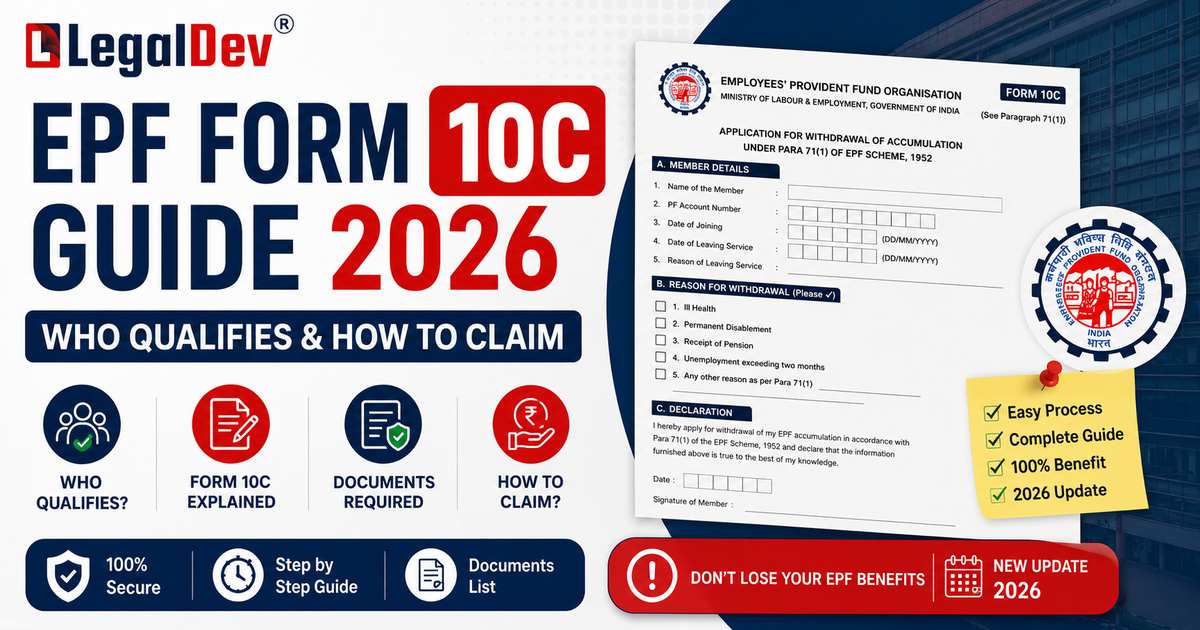
Form 10C EPF: How to Withdraw Your Pension or Get a Scheme Certificate (2026 Guide)
Every month, 8.33% of your employer's contribution quietly flows into your EPS account — that's your pension fund. Most people don't think about it until they leave a job. And when they do, the first question is usually: can I get that money back?
The answer depends on how long you've worked. But the form you need in most cases is Form 10C. Here's everything about it — who qualifies, what's changed in 2026, and how to file it without making mistakes.
What Is Form 10C and Why Does It Exist?
Out of the total 12% EPF contribution deducted from your salary, 8.33% goes into the Employees' Pension Scheme (EPS) — not into your regular PF account. This pension portion is handled separately by EPFO and has its own withdrawal rules.
Form 10C is the application you file to either:
-
Withdraw your accumulated pension amount (if you're eligible), or
-
Get a Scheme Certificate that preserves your pension membership for future use
You cannot use Form 19 for this. The EPS portion needs Form 10C specifically.
2026 Update: What's Changed
Two important things have changed that affect how and when you can file Form 10C:
1. Waiting period extended to 36 months Earlier, you had to wait just 2 months after becoming unemployed before filing for pension withdrawal. That waiting period has now been extended to 36 months. EPFO's official guidance also clarifies: if you don't find new employment within 36 months of leaving your last job, apply for settlement before that window closes — because after 36 months, no interest is paid and the account becomes inoperative.
2. Service under 6 months — proportionate refund now allowed This is the bigger update. Previously, if you had worked for less than 6 months, your EPS contribution was simply forfeited to the government pool. No refund. Nothing.
That rule has changed. As per the latest amendment to Table D:
|
Service Duration
|
Old Rule
|
New Rule (2026)
|
|
Less than 6 months (with at least 1 month contribution)
|
₹0 refund
|
Proportionate refund allowed
|
|
6 months to 9.5 years
|
Full EPS withdrawal via Form 10C
|
Unchanged
|
|
9.5 years or more
|
Scheme Certificate / Monthly Pension
|
Unchanged
|
So even if you worked for just 2 or 3 months, your EPS money isn't gone anymore — you can claim it back.
Who Is Eligible to File Form 10C?
Eligibility falls into three categories depending on your situation:
Category 1 — Withdrawal Benefit
-
Left the job before completing 10 years of service, OR
-
Turned 58 years old before completing 10 years of service
These members can apply for a direct pension withdrawal.
Category 2 — Scheme Certificate Only
-
Completed 10 or more years of service at the time of leaving, but haven't turned 50 yet, OR
-
Aged between 50 and 58 and not willing to accept a reduced pension
These members cannot withdraw the pension amount directly. They get a Scheme Certificate instead, which preserves their EPS membership and service record.
Exception: If a member aged 50–58 is willing to accept a reduced pension, they can apply directly for pension in Form 10D instead.
Category 3 — Family Members / Legal Heirs
-
Family members, nominees, or legal heirs of a deceased member who died after reaching 58 years but before completing 10 years of service
In this case, a withdrawal benefit is available to the family.
What Can You Actually Get?
|
Who You Are
|
What You Get
|
Form to Use
|
|
Category 1 (left before 10 yrs service)
|
Withdrawal benefit (pension amount)
|
Form 10C
|
|
Category 2 (completed 10 yrs, below 50)
|
Scheme Certificate
|
Form 10C
|
|
Category 2 (50–58, reduced pension acceptable)
|
Reduced monthly pension
|
Form 10D
|
|
Permanent disablement (any service duration)
|
Disablement pension
|
Form 10D
|
|
Category 3 (deceased member's family)
|
Withdrawal benefit
|
Form 10C
|
What Is a Scheme Certificate and Why Would You Want One?
If you're not eligible for a direct withdrawal, the Scheme Certificate isn't a consolation prize. It's genuinely useful.
Here's what it does:
-
Your previous service period gets counted when you join a new employer — so you're not starting from zero on your pension eligibility clock
-
If you don't take up new employment and die before age 58, your family still receives a family pension
-
If you survive without a new job, you get withdrawal benefits when you reach 58
Think of it as keeping your pension membership alive even when you're between jobs. For anyone who plans to continue working in the formal sector, opting for the Scheme Certificate over a cash withdrawal is often the smarter long-term call.
Documents Required for Form 10C
Keep these ready before you start the claim:
-
Cancelled cheque or blank cheque — for bank account verification
-
Date of birth certificate of children — only if applying for a Scheme Certificate
-
Death certificate of the member — required if the claim is being filed by family members
-
Succession certificate — required if the applicant is a legal heir (not a nominee)
-
Revenue stamp of ₹1 — to be attached with the physical form
For online claims, most of this is verified automatically through your UAN-linked KYC. Physical copies are only required for offline or manual submissions.
How to File Form 10C Online — Step by Step
Before you begin, check these boxes:
-
You have left your current employment
-
Your employer has updated your Date of Exit in the EPF database
-
Your UAN is active and KYC (Aadhaar, PAN, bank details) is fully verified
Steps:
-
Go to the EPFO Unified Member Portal at unifiedportal-mem.epfindia.gov.in
-
Log in using your UAN and password
-
Under 'Online Services', click on 'Claim (Form-31, 19, 10C & 10D)'
-
The screen will show your member details pre-filled — name, father's name, date of birth, bank account details. Enter the last 4 digits of your bank account to verify
-
Click 'Yes' on the Certificate of Undertaking pop-up
-
Select 'Proceed for Online Claim'
-
In the claims section, choose 'Only Pension Withdrawal (Form 10C)' under "I want to apply for"
-
Fill in your complete address and tick the disclaimer
-
Click 'Get Aadhaar OTP' — an OTP will be sent to your Aadhaar-linked mobile number
-
Enter the OTP and click 'Validate OTP and Submit Claim Form'
Once submitted, you'll get an SMS confirmation. The pension amount typically gets credited to your bank account within 7 to 15 working days after EPFO processes the claim.
You can also file the claim through the UMANG app — search for EPFO services, tap 'Raise Claim', verify your UAN with OTP, and follow the same steps above.
How to Fill Form 10C - Information Required
Whether you're filling online or offline, you'll need:
-
Full name of the member
-
UAN and/or Pension Number
-
Aadhaar number
-
Father's name or husband's name
-
Date of birth
-
Date of joining and date of leaving
-
PAN and reason for leaving
-
Bank account details (account number, IFSC)
-
Complete postal address
One rule that trips people up: no overwriting or corrections allowed. If you make a mistake, every correction must be attested separately. Cleaner to start fresh on a new form if possible.
Offline Submission and Attestation
If you're submitting Form 10C in physical form — either downloaded online or collected from an EPFO centre — it needs attestation from your employer.
If your employer or establishment is closed and the authorised signatory is unavailable, any of the following officials can attest the form with their office seal:
-
Magistrate or Gazetted Officer
-
Post Master or Sub-Post Master
-
President of Village Union or Village Panchayat
-
Chairman, Secretary, or Member of Municipal / District Local Board
-
Member of Parliament or Member of Legislative Assembly
-
Member of the Central Board of Trustees / Regional Committee of EPFO
-
Manager of the bank where you hold your savings account
-
Head of a recognised educational institution
For closed companies specifically, a First Class Judicial Magistrate affidavit or Bank Manager certification can substitute for employer verification — along with bank statements and salary slips submitted to EPFO.
What If Your Claim Gets Rejected?
The most common reasons for Form 10C rejection:
-
Name mismatch between Aadhaar and EPF records
-
Service period gaps or incorrect Date of Exit not updated by employer
-
Missing Annexure K in certain job-change cases
-
KYC not fully verified on UAN
Fix these data errors through the EPFO correction process before reapplying. After employer approval, standard corrections take 30 to 90 days. Older records from before 2014 may take longer due to manual verification.
Form 10C vs Form 19 vs Form 10D — Quick Reference
|
Form
|
Purpose
|
|
Form 10C
|
Withdraw EPS pension amount OR get Scheme Certificate
|
|
Form 19
|
Withdraw EPF (provident fund) balance — the main PF portion
|
|
Form 10D
|
Apply for monthly pension — reduced pension (50–58 yrs) or disablement pension
|
|
Form 31
|
Partial / advance withdrawal for specific needs (medical, marriage, housing)
|
Form 10C and Form 19 are often filed together as a Composite Claim when leaving employment — but they cover different funds entirely. Don't mix them up.
FAQs
Q: Can I withdraw my EPS pension if I have completed 10 years of service?
A: No — once you cross 10 years of qualifying service, you are no longer eligible for a cash withdrawal of your pension. You become eligible for a monthly pension after age 58. In the meantime, you can only get a Scheme Certificate through Form 10C, which preserves your EPS membership and service record.
Q: What is the waiting period before I can file Form 10C after leaving a job?
A: As per the updated EPFO rules, the waiting period for pension withdrawal has been extended to 36 months from the date of leaving your last job. EPFO also advises filing before 36 months — after that, no interest is paid and the account can become inoperative.
Q: I worked for only 4 months. can I still get my EPS money back using Form 10C?
A: Yes, as per the 2026 amendment to Table D, if you have contributed to EPS for at least 1 month, you are now eligible for a proportionate refund — even if your service was under 6 months. Earlier, this money was forfeited entirely.
Q: What is the difference between Form 10C withdrawal benefit and a Scheme Certificate?
A: A withdrawal benefit means you receive your EPS money as a lump sum cash amount. A Scheme Certificate, on the other hand, keeps your pension membership active — your previous service gets counted when you join a new employer, and your family remains eligible for a family pension if something happens to you before age 58. The right choice depends on whether you plan to continue working in the organised sector.
Q: Do I need to visit the EPFO office to file Form 10C?
A: No. The entire Form 10C claim can be submitted online through the EPFO Unified Member Portal or the UMANG app without visiting any office. As long as your UAN is active and KYC is verified, the process is fully digital from start to finish.
Q: How long does EPFO take to process a Form 10C claim?
A: After successful online submission, the pension amount is typically credited to your bank account within 7 to 15 working days, subject to EPFO verification. Complex cases involving service mismatches or pre-2014 records may take longer.
Q: My previous company is closed and there's no one to attest Form 10C. what do I do?
A: If the employer or authorised signatory of a closed establishment is unavailable, you can get the form attested by a Gazetted Officer, Magistrate, Bank Manager, or other authorised officials listed under EPFO guidelines. A First Class Judicial Magistrate affidavit also works as a substitute for employer verification.
Q: Can I file Form 10C and Form 19 together?
A: Yes. Form 10C (for EPS pension) and Form 19 (for EPF balance) can be filed together as a Composite Claim when leaving employment. They cover different funds — EPS and EPF respectively — so both are needed if you want to withdraw everything from your account.
Q: What happens to my Scheme Certificate if I join a new employer?
A: You submit the Scheme Certificate to EPFO through your new employer along with Form 11. Your previous service period then gets added to your fresh EPS membership, helping you reach the qualifying 10-year threshold for a monthly pension at retirement.
Q: Will TDS be deducted on my EPS pension withdrawal through Form 10C?
A: TDS rules on EPF withdrawals apply when the withdrawal amount exceeds ₹50,000 and your service period is less than 5 years. Submitting Form 15G (or Form 15H for senior citizens) at the time of the claim can help you avoid TDS deduction if your total income is below the taxable limit.