Data is only as valuable as your ability to actually use it. Most organisations sit on enormous amounts of raw data spread across dozens of systems — and that data is useless until someone builds a reliable process to collect, clean, and structure it. That's exactly what the ETL process does.
ETL is the foundational method behind data warehousing, business intelligence, and modern data engineering. Whether you're building a real-time analytics dashboard or a machine learning pipeline, understanding how extract, transform, and load works — and where it breaks — is non-negotiable for anyone working with data at scale.
ETL Full Form and What It Means in Data Engineering
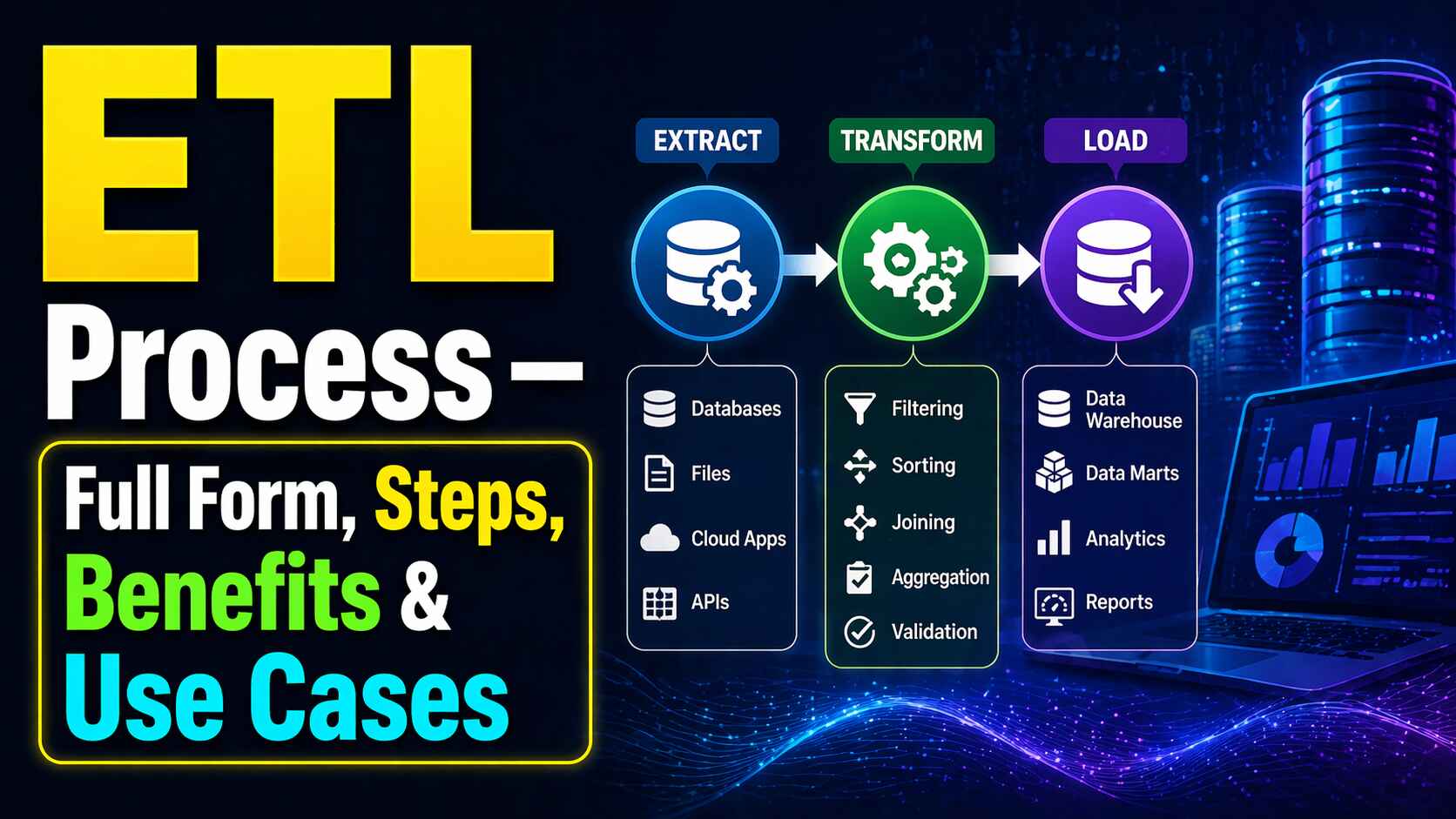
The ETL full form is Extract, Transform, and Load. It describes a three-stage process used in data mining, extraction, and warehousing — particularly when raw data is coming in from multiple sources with incompatible structures.
The rules behind any given ETL design depend entirely on what the data will be used for. A pipeline built for predictive analytics follows different logic than one optimised for storage efficiency. Both are ETL — but the transformation rules, validation criteria, and loading strategies are different in each.
Three stages make up the ETL process:
Extract — Raw data gets pulled from sources like IoT sensors, APIs, point-of-sale systems, ERP platforms, and flat files. These sources deliver data in structured, semi-structured, and unstructured formats, so extraction techniques vary by source. Depending on the source database, extraction is either full (the entire database every time) or partial (only what's changed since the last run).
Transform — Once extraction is done, the raw data needs cleaning, validation, data type conversion, and restructuring into the target format. This stage enforces uniformity, data integrity, and quality across everything pulled from different sources. If data doesn't meet the benchmark criteria set for the ETL process, the transform stage can initiate a rollback — which means it carries real compliance and diagnostic weight in warehouse management.
Load — Cleaned, structured data gets pushed to a data warehouse, either populating a new database or updating an existing one. This is where the data finally becomes usable for analytics, reporting, or ML models.
Why the ETL Process — And What Breaks Without It
A poorly designed ETL pipeline doesn't just slow things down — it corrupts the data that business decisions get made on. The 2012 Knight Capital trading loss, caused partly by a failed software deployment in a data pipeline, resulted in a $440 million loss in under an hour. That's an extreme case, but it illustrates what happens when data processes go wrong at scale.
Beyond catastrophic failures, here's what a solid ETL process protects against day to day:
Fragmented, incompatible data. Business data lives in dozens of systems — CRMs, ERPs, logistics platforms, finance tools — each with its own format. ETL extracts all of it and integrates it into a coherent structure before it hits the warehouse.
Silent data corruption. The transform stage is where duplicate entries, type mismatches, and anomalies get caught and either corrected or rolled back. Without this, bad data flows straight into analytics models and produces bad outputs — often without anyone noticing for weeks.
Compliance exposure. Data processing regulations aren't getting lighter. The design of an ETL pipeline has direct legal implications: how data is collected, where it's stored, and how long it's retained are all compliance questions. Getting ETL design wrong isn't just a technical problem; it's a legal one.
Wasted analytics capacity. Not all raw data is analysis-ready. ETL's transformation layer converts messy, inconsistent inputs into structured formats that analytics and machine learning models can actually work with. It also makes database management techniques like sharding, partitioning, and indexing possible — which directly affects storage costs and query performance.
How ETL Works Step by Step — The Full 5-Stage Workflow
The ETL process runs as a sequential 5-step workflow:
-
Extract — Collect raw data from all designated sources
-
Clean — Remove anomalies, duplicates, and bad entries from unstructured or inconsistent data
-
Transform — Integrate cleaned data from multiple sources and convert it into the target data types and formats
-
Load — Push the integrated, standardised data into an existing or new database in the data warehouse
-
Analyse — Stored data goes through analytics tools or machine learning models to produce business intelligence or other outputs
Each stage depends on the one before it. A failure at the cleaning stage means corrupted data reaches transformation — and corrupted data in transformation means unreliable outputs at the analytics stage. The ETL process is only as strong as its weakest step.
ETL Testing in Database Management: What Gets Checked and Why
ETL testing verifies that a specific pipeline delivers data that meets its intended quality and functional benchmarks. It's not an optional step — running a pipeline without testing it first is how production databases end up with silent errors that take months to trace.
An ETL testing process typically involves: defining the business data requirements clearly, building a test plan, identifying specific test cases, collecting representative test data, running the tests, and documenting the results.
The four test types that matter most:
Metadata testing — Compares data types, schema structures, length constraints, and other metadata attributes between source systems and the target database. Mismatches here cause downstream type errors.
Data accuracy testing — Checks for inaccurate values, duplicates, and anomalies in the data after extraction and transformation. Catches what the transform stage missed.
Data completeness testing — Cross-references what was in the source against what actually landed in the target. If rows disappeared somewhere in the pipeline, this is where you find out.
Data integration testing — Looks for breakdowns in how different database components interact with each other. Particularly important in pipelines that pull from multiple sources with different schemas.
The ETL Pipeline Explained: How Automation Keeps Data Fresh
An ETL data pipeline is the automated infrastructure that runs the extract, transform, and load process continuously. Rather than manually triggering ETL runs, a pipeline monitors source data for any changes or additions and automatically processes and loads updates into the target database.
That automation is what makes ETL practical at scale. A retailer with 500 stores can't manually update a central warehouse every time inventory data changes at a location. The ETL pipeline handles that continuously, keeping the warehouse current without human intervention at each step.
A Real-World ETL Example — And Why Getting It Wrong Is Costly
The clearest example of ETL in practice is a large organisation consolidating data from across its entire operation into a central warehouse.
Picture a company with separate systems for sales, inventory, CRM, logistics, and finance — each potentially running on different platforms, in different locations, with different data structures. Raw data from all of these gets extracted, cleaned, transformed into a common format, and loaded into a central database. That's where analytics teams, finance departments, and executive dashboards pull their numbers from.
Get the ETL design right, and that central database is a reliable source of truth. Get it wrong — a bad transformation rule, an unchecked duplicate, an unvalidated data type — and the decisions being made from that database are based on fiction. Scale matters here: errors that are harmless in small datasets become compounding problems in pipelines handling millions of records daily.
What You Gain From a Well-Built ETL Process
Data standardisation. Raw data from incompatible sources gets converted into uniform formats that analytics tools can actually read and compare.
Bulk data movement. Large volumes of data move from multiple dissimilar systems quickly and at lower cost than manual or ad-hoc extraction methods.
Complex data type handling. ETL tools are built to manage sophisticated type conversion and integration tasks that manual processing can't scale to.
Data cleansing built in. Accuracy and integrity checks happen inside the pipeline — not as an afterthought after bad data has already spread.
Pipeline automation. Once built, the ETL pipeline runs the full extraction, transformation, and loading cycle without manual triggers for each update cycle.
Lower storage and management costs. Cleaner data, automated pipelines, and standardised formats reduce the overhead of running a data warehouse at scale.
The Hardest Parts of ETL Implementation Nobody Warns You About
Raw data quality. This is the biggest one. Inconsistent entries, duplicates, and structural anomalies in source data are the most common reason ETL pipelines fail or produce unreliable outputs. You can't transform your way out of genuinely bad source data.
Unconventional data sources. New sensor technologies, IoT devices, and non-traditional data streams produce raw data that doesn't fit neatly into existing ETL schemas. Cleaning it and maintaining consistency with other sources gets complicated fast.
Scalability. Even a well-designed ETL pipeline needs adjustments when data volume grows or new sources get added. Scaling isn't automatic — it requires deliberate re-engineering, which adds cost.
Transformation complexity. As source data gets more varied and less structured, transformation logic becomes harder to maintain. Rules that worked for structured data don't apply cleanly to images, documents, or freeform text.
Data governance and legal compliance. Privacy regulations, data residency requirements, and processing restrictions differ by jurisdiction and industry. ETL pipeline design has to account for all of them — not just at build time, but as regulations change.
When the ETL Process Is the Right Call — And When It Isn't
The ETL process fits when you need to extract data from multiple sources, clean and structure it into a specific format, and then load it into a target database for analytics or reporting. If your data pipeline needs to enforce quality standards before data reaches storage — ETL is the right architecture.
It's less suited to scenarios where transformation can happen inside a powerful data warehouse or cloud platform, or where you're dealing with massive volumes of unstructured data where loading first and transforming later is faster. That's where ELT becomes relevant.
ETL Use Cases Across Industries: Where It Shows Up Most
ETL pipelines appear wherever large, complex datasets need to be consolidated and made usable. The most common industry applications:
-
Retail — Consolidating supply chain, inventory, and sales data from store systems across hundreds of locations into a central warehouse
-
Healthcare — Centralising patient records, lab results, and clinical data across hospital networks and care facilities
-
Banking and finance — Aggregating risk management data, transaction records, and compliance information across products, regions, and entities
-
Logistics — Building situational awareness from GPS, shipment tracking, and operational data across fleets and routes
-
Power utilities — Collecting and harmonising grid performance data from thousands of distributed sensors
Within any of these industries, the specific ETL design varies based on what the data will actually be used for — real-time reporting, predictive modelling, regulatory filing, or operational dashboards all call for different pipeline architectures.
Best Practices for ETL Implementation — In the Right Order
The sequence matters. Skipping ahead creates problems that are expensive to fix later.
-
Define the objectives and requirements for the target database clearly before writing a line of pipeline code
-
Review all applicable regulatory and data governance requirements for your industry and jurisdiction
-
Identify the tools needed to build the pipeline — don't default to what's familiar; match the tool to the use case
-
Design the full ETL implementation workflow, including error handling and rollback logic
-
Establish ETL test criteria before implementation begins, not after
-
Build and implement the ETL processes
-
Run ETL testing across all four test types and validate against your benchmarks
-
Monitor pipeline performance against pre-defined thresholds once live
-
Maintain a performance log and compliance documentation trail
-
Conduct regular database performance audits — pipelines degrade as source data evolves
ETL vs ELT: Which Actually Fits Your Stack?
Both ETL and ELT handle data extraction, integration, and transformation — but the order of operations matters, and so does where the heavy processing happens.
ETL (Extract-Transform-Load) runs transformation before loading. It's the better fit when source data is structured or semi-structured, when transformation rules are complex, or when you need strict quality control before data reaches the warehouse.
ELT (Extract-Load-Transform) loads raw data into the warehouse first, then transforms it using the warehouse's own compute resources. It's better suited to large-scale pipelines handling bulk unstructured data — images, documents, freeform text — especially when the warehouse platform (like BigQuery or Snowflake) has the processing power to handle transformation efficiently at scale.
Honestly? There's no universal answer here, even among experienced data engineers. The right choice depends on your source data types, your warehouse infrastructure, your team's expertise, and your latency requirements. Teams with mature cloud data warehouse setups often find ELT more practical. Teams dealing with regulatory constraints on raw data storage frequently find ETL is the only workable approach.
Frequently Asked Questions
What is the ETL process in data warehousing?
ETL stands for Extract, Transform, and Load — a three-stage process that pulls raw data from multiple sources, cleans and restructures it, then loads it into a target data warehouse for analytics or machine learning. It's the backbone of most business intelligence infrastructure. Without a functioning ETL process, data from different systems sits in incompatible formats that analytics tools can't work with. Think of it as the plumbing that makes data actually usable.
How does the ETL process work step by step?
The full ETL workflow runs in five stages: Extract (pull raw data from sources like APIs, sensors, ERPs, or flat files), Clean (remove duplicates, anomalies, and bad entries), Transform (convert data into the target format and structure), Load (push the cleaned data into a data warehouse), and Analyse (run the stored data through analytics or ML models). A failure at any stage contaminates everything downstream — which is why ETL testing before going live isn't optional.
What's the difference between ETL and ELT in data engineering?
ETL transforms data before it reaches the warehouse — cleaning and restructuring happen in a staging environment. ELT loads raw data into the warehouse first, then transforms it using the warehouse's compute power. ETL fits better when source data is structured and transformation rules are strict. ELT suits large-scale pipelines with heavy unstructured data. The right choice genuinely depends on your infrastructure — there's no universal winner even among experienced engineers.
Which industries use ETL pipelines most heavily?
Retail, banking, healthcare, logistics, and utilities are the heaviest users. Retail chains consolidate supply chain and sales data from dozens of systems into one warehouse. Banks aggregate risk and compliance data across products. Hospital networks centralise patient records across facilities. Logistics firms build operational awareness from fleet and shipment data. Power utilities collect grid performance readings from thousands of sensors and use ETL to make that data coherent for operations teams.
What tools are commonly used to build ETL pipelines?
The most widely used ETL tools include Microsoft SQL Server Integration Services (SSIS), Pentaho Data Integration (also called Kettle), IBM DataStage, Oracle Data Integrator (ODI), and AWS Glue. The right tool depends on your existing infrastructure, data volumes, and whether you need cloud-native, on-premise, or hybrid pipeline support. AWS Glue is the go-to for teams already running on AWS. SSIS suits organisations deep in the Microsoft stack. IBM DataStage and ODI are common in large enterprise environments with legacy systems.