Documents Required for GST Registration Clarification — Complete Checklist
Received a notice on the GST portal asking for clarification? Don't panic. This happens more often than you'd think — and sorting it out is straightforward if you know exactly which documents are needed and how to submit them.
The official notice you receive is called Form REG-03, and you typically have 7 working days from the date of receipt to respond. Miss that window, and your application can get rejected. So let's get this done right.
What Are the Commonly Required GST Documents for Clarification?
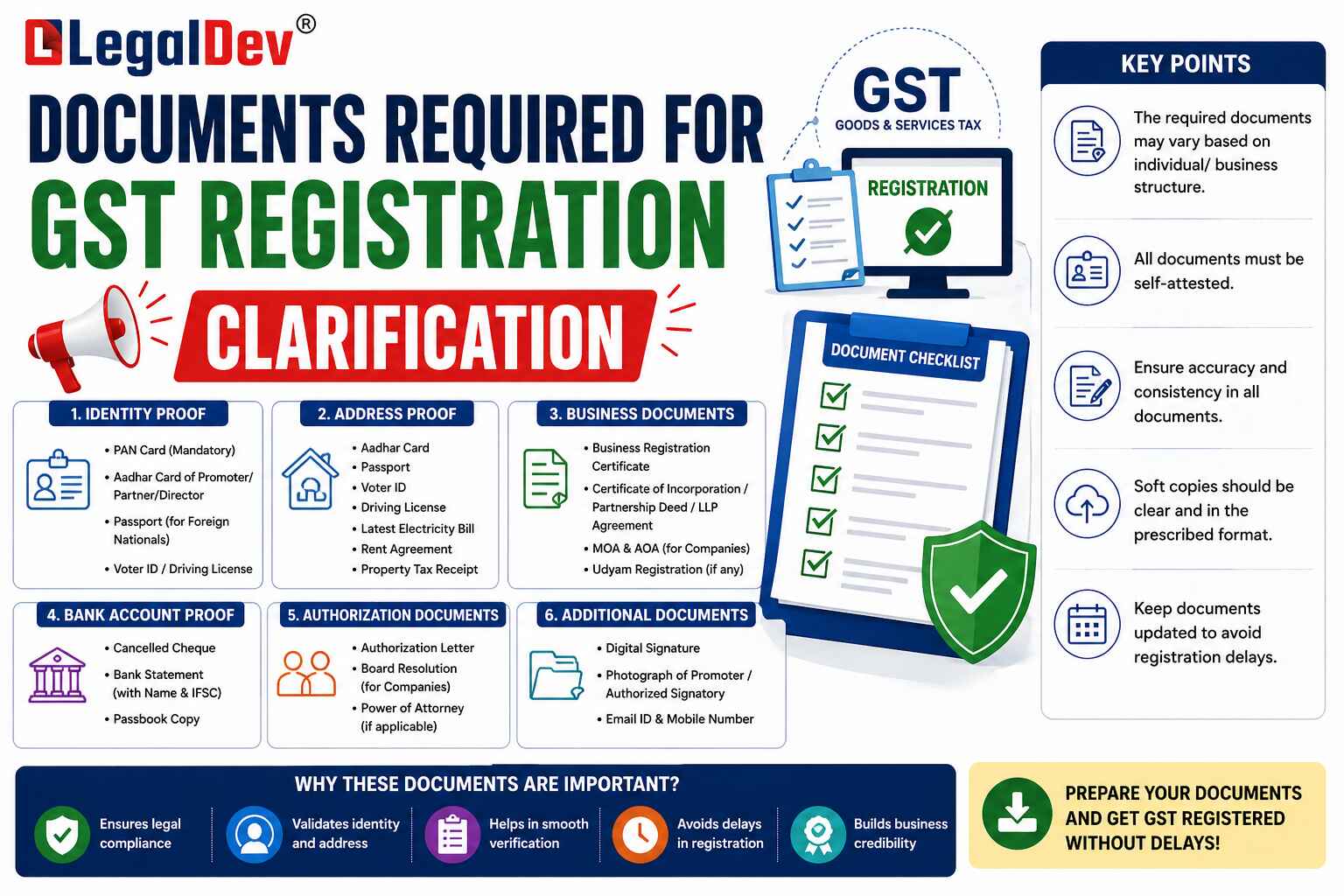
The specific docs required for GST registration clarification depend on what the officer flagged. But most notices ask for a combination of the following:
Identity & Address Proof
-
PAN card of the owner, directors, or partners
-
Aadhaar card of the same individuals
These need to match the details you originally submitted. Even a minor spelling mismatch between your PAN and Aadhaar records can trigger a notice — so double-check before uploading.
Business Address Proof
This is the most common reason for clarification requests. What you need depends on your occupancy type:
If the premises is owned:
-
Property tax receipt, or
-
Municipal khata copy
If the premises is rented:
-
Rent agreement
-
NOC (No Objection Certificate) from the property owner
-
The owner's electricity bill
If it's a shared or virtual office:
-
Service agreement with the provider
-
NOC from the service provider
One important thing — the electricity bill cannot be older than two months. Officers do check this. If yours is older, get a fresh copy before you file the clarification.
Bank Account Proof
Submit any one of the following:
-
Cancelled cheque
-
Bank statement (recent)
-
First page of the passbook — showing the account holder name, account number, and IFSC
The name on the bank document must match the name on your new GST registration application exactly.
Authorization Proof
You'll need a letter of authorization or a board resolution that names an authorized signatory for your business. This is mandatory if someone other than the proprietor is handling the GST registration.
Discrepancy-Specific Documents
Sometimes the notice asks for something very specific — photographs of your business premises, a revised partnership deed, or updated incorporation documents. Read your REG-03 notice carefully. Whatever it specifically asks for — that goes in too.
The process runs entirely through the GST portal. Here's how it works:
Step 1: Visit the official GST portal. If you have a Temporary Reference Number (TRN), select 'Register Now' and enter it. If you're already registered, simply log in.
Step 2: Go to Services → Registration → Application for Filing Clarifications.
Step 3: Enter the Reference Number from your REG-03 notice.
Step 4: Upload all the relevant GST documents. Files should be in PDF or JPEG format and clearly legible.
Step 5: Submit your response using either a DSC (Digital Signature Certificate) or E-Sign via Aadhaar OTP.
That's it. No office visits required.
Tips That Actually Matter When Submitting GST Documents
A few things people get wrong — and then wonder why their clarification got rejected:
Document recency: Electricity bills and rent agreements must be recent — not more than two months old. This catches a lot of people off guard.
Scan quality: If your uploaded documents come back as rejected, rescan them at 200 DPI or higher. Blurry or low-resolution files are a surprisingly common reason for delays.
Name matching: Every detail — spelling, middle name, punctuation — must match your PAN and Aadhaar records exactly. Even a single character off can cause a mismatch.
No fees involved: Filing a clarification response on the GST portal is completely free. If someone is charging you for it, that's a red flag.
Getting your GST registration certificate issued quickly really does come down to having the right docs in order before you hit submit.
FAQs
Q: What documents are required for GST registration clarification in response to Form REG-03?
A: You typically need PAN and Aadhaar of the owner or directors, business address proof (electricity bill, rent agreement with NOC, or property tax receipt), bank account proof, and a letter of authorization or board resolution. If the notice asks for anything specific — like premises photos or revised deed documents — include those too.
Q: How many days do I have to reply to a GST clarification notice?
A: You have 7 working days from the date you received Form REG-03 to file your clarification on the GST portal. Missing this deadline can result in your GST registration application being rejected outright, so act quickly.
Q: Is there any fee for filing GST registration clarification?
A: No, filing a clarification response on the GST portal is completely free of cost. There are no government fees involved in this step of the new GST registration process.
Q: My electricity bill is older than 2 months — will it be accepted as address proof for GST?
A: No. The GST department requires that electricity bills used as address proof be recent — not older than two months. If yours is outdated, get the latest bill from your electricity provider before uploading your docs required for GST registration.
Q: Can I submit GST registration documents using E-Sign instead of a DSC?
A: Yes, absolutely. The GST portal accepts responses signed via E-Sign, which uses an Aadhaar OTP for verification. This is the more convenient option for most individual proprietors and small business owners who don't have a DSC set up.
Q: What happens if the names on my PAN and Aadhaar don't match during GST registration?
A: A mismatch between PAN and Aadhaar details is one of the most common reasons officers raise a clarification notice. You'll need to get the discrepancy corrected at the source — either update your Aadhaar or PAN — before resubmitting your GST documents.
Q: What format should I use to upload documents on the GST portal?
A: The GST portal accepts documents in PDF or JPEG format. Make sure files are clearly scanned at 200 DPI or higher. Blurry or oversized files are frequently rejected, which delays your GST registration certificate.
Q: For a rented office, what address proof documents are needed for GST registration?
A: For a rented premises, you need the rent agreement, an NOC (No Objection Certificate) from the landlord, and the landlord's electricity bill. All three together serve as valid business address proof for new GST registration.
Q: What is an authorized signatory in GST registration and what documents prove it?
A: An authorized signatory is the person designated to act on behalf of the business in GST matters. To prove this, you need to submit a letter of authorization or a board resolution — whichever is applicable based on your business structure.
Q: What happens after I submit the GST clarification documents?
A: After submission, the GST officer reviews your response. If satisfied, your application moves forward and your GST registration certificate is issued. If the officer still has concerns, another notice may be raised — or the application may be rejected, in which case you'd need to reapply.