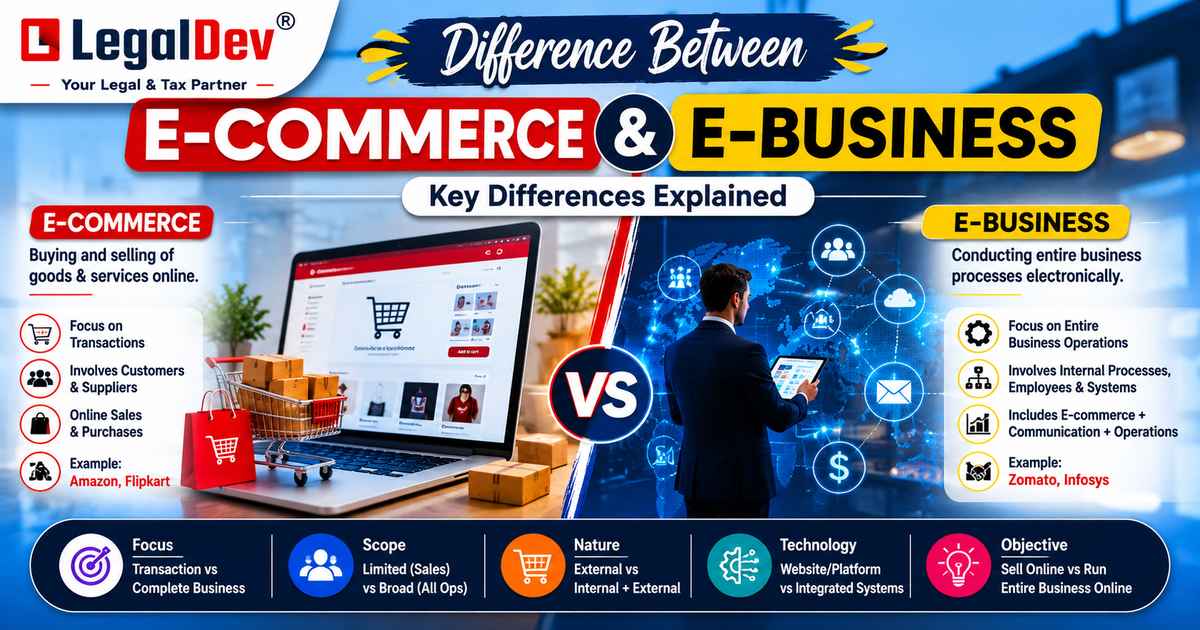
Difference Between E-Commerce and E-Business
Here's something that trips up a lot of people — e-commerce and e-business get thrown around like they mean the same thing. They don't. E-commerce is specifically about online transactions: buying, selling, money moving. E-business is the bigger picture — every business activity that runs through the internet, not just the checkout page.
What Is E-Commerce?
E-commerce is buying and selling over the internet — that's the core of it. Any time money changes hands online, or a product moves from seller to buyer through a digital platform, that's e-commerce in action. You need a website or an App to run it.
What falls under e-commerce?
-
Products sold or purchased online
-
Online payments and money transfers
-
Internet-based ticketing
-
Paying taxes online
-
Online accounting software
Think Flipkart, Amazon, Paytm Mall, Myntra. Or sellers pushing digital products — ebooks, online courses, subscriptions. All of that sits under the e-commerce umbrella.
What Is E-Business?
E-business stretches well beyond the transaction. It takes every piece of a business operation — procurement, supply chains, customer communication, internal management — and runs it through the internet. A business can be doing e-business without ever directly selling anything to a consumer.
The tools are different too. Where e-commerce needs a website, e-business often runs on multiple platforms — websites, Apps, ERP systems, CRM tools — all talking to each other across different departments.
What does e-business actually include?
-
Supply chain management
-
Setting up and running online stores
-
Customer education and support
-
Email marketing
-
Business-to-business monetary transactions
-
Online commercial transactions (buying and selling)
-
Internal process coordination
Examples? E-commerce companies and all their backend operations. Classified sites, auction platforms, software developer portals — any of these qualify.
Comparison: E-Commerce vs E-Business
|
Basis |
E-Commerce |
E-Business |
|
Meaning |
Online commercial transactions over the internet |
All types of business activities conducted through the internet |
|
Scope |
Narrow — a subset of e-business |
Broad — a superset of e-commerce |
|
Transactions |
Commercial transactions only |
All types of business transactions |
|
Limitation |
Limited in scope |
No such limitation |
|
Activities |
Buying/selling products, online payments |
Procurement, supply activities, customer education, transactions |
|
Operation |
Primarily needs one website |
Multiple websites, ERPs, and CRMs across processes |
|
Resources |
Internet only |
Internet, extranet, or intranet |
|
Business model |
B2C (Business to Customer) |
B2B (Business to Business) |
|
Coverage |
External/outward business processes |
Internal and external processes both |
Conclusion: How They Work Together
So they're different — but they're not rivals. E-commerce sits inside e-business. Every online retailer running sales is doing e-commerce; the moment they manage suppliers, handle customer data, or run internal operations digitally, they're doing e-business too. The two work together, and honestly, most modern businesses can't run one without the other.
Frequently Asked Questions (FAQ)
Q1: Is e-commerce the same as e-business?
Not quite. E-commerce is a part of e-business — but e-business is much wider. E-commerce handles online buying and selling. E-business covers everything a company does through the internet: procurement, supply chains, customer management, internal coordination. Think of e-commerce as one department inside the larger e-business operation.
Q2: What are real-life examples of e-commerce vs e-business?
Flipkart's website where you buy a phone — that's e-commerce. But Flipkart's entire system: managing vendors, coordinating logistics, running email campaigns, handling customer support, tracking inventory through ERP software — all of that together is e-business. The transaction is one small piece of a much larger digital operation.
Q3: Which is better for a startup — e-commerce or e-business?
Most startups begin with e-commerce — it's simpler, focused, and gets products in front of customers fast. As the business grows and processes multiply, it naturally evolves into e-business. You don't choose one or the other; you usually start with e-commerce and expand into the full e-business model when operations demand it.
Q4: What tools does e-business need that e-commerce doesn't?
E-commerce mostly needs a website or App and a payment system. E-business needs a lot more: ERP (Enterprise Resource Planning) to connect departments, CRM (Customer Relationship Management) to track customer interactions, and often extranet or intranet networks for internal communication. It's not just about the storefront — it's the whole backend too.
Q5: Is e-business only suitable for large companies?
No — and this is a common misconception. Small businesses adopt e-business practices too, especially with affordable cloud-based ERP and CRM tools now available. Any business that manages customer relationships digitally, coordinates with suppliers online, or runs internal operations through internet platforms is practicing e-business, regardless of size.