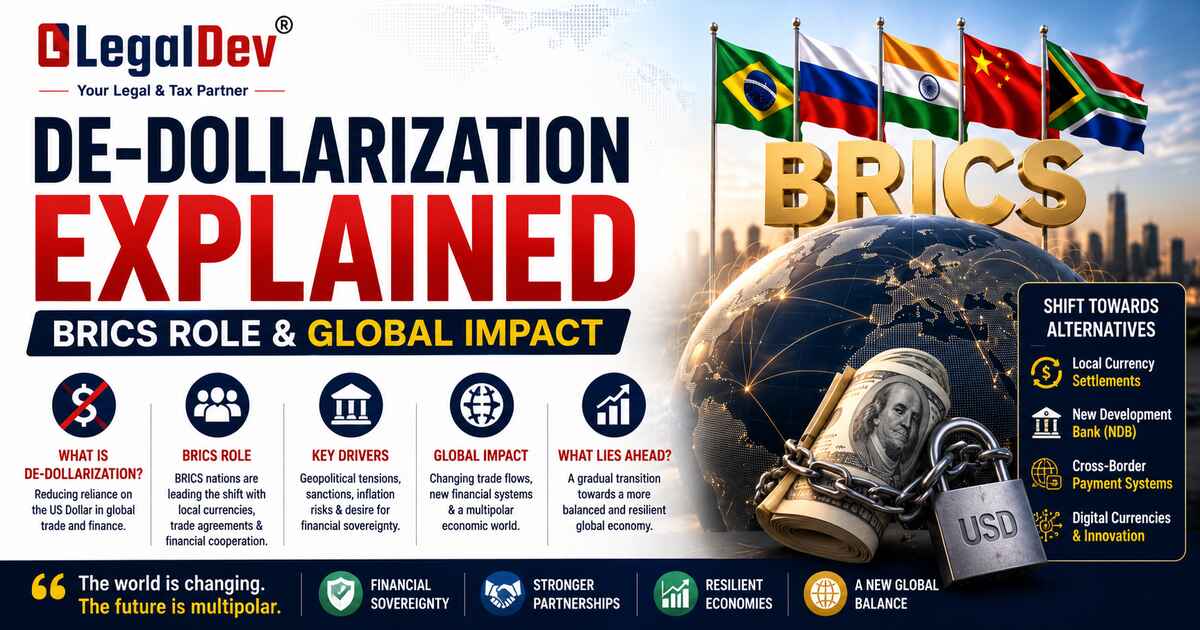
De-Dollarization: Meaning, BRICS Role, Countries & 2026 Global Impact
The US dollar has ruled global trade for over 75 years. But a quiet financial shift is underway — and its pace picked up sharply between 2022 and 2026. Countries are settling trade in local currencies, central banks are stockpiling gold instead of dollars, and alternative payment systems are moving from proposals to live infrastructure.
This guide breaks down what de-dollarization actually means, how it works, who is driving it, and what the latest data tells us about where the dollar really stands.
What is De-Dollarization?
De-dollarization is the process of reducing reliance on the US dollar in international trade, finance, and foreign exchange reserves. It is not an attempt to destroy the dollar — it is an attempt to stop being so dependent on it.
The US dollar is the world's primary reserve currency. Most global trade is invoiced in dollars. Oil is priced in dollars. Countries hold dollars to protect themselves during financial crises. That level of centrality gives the US enormous leverage — including the ability to cut countries off from the global financial system through sanctions.
The problem with dollar dominance is not efficiency. It is the concentration of risk, power, and vulnerability in a single country's currency.
De-dollarization is the effort to spread that concentration. And the countries most actively pushing it are the ones who have felt the consequences of dollar dependency most acutely.
How De-Dollarization Works
This is not a single policy decision. It is a set of economic shifts that happen in layers — each one reducing the dollar's role in a specific part of global finance.
Transaction Layer — Replace USD in Trade: Countries agree to settle bilateral trade in their own currencies rather than converting to dollars first. India and Russia trading in INR-Ruble is one example. Russia and Iran settling over 95% of their bilateral trade in rubles and rials — as reported by President Putin in January 2025 — is another.
Settlement Layer — Build Non-USD Payment Systems: Countries create alternatives to SWIFT (the Society for Worldwide Interbank Financial Telecommunication), which is deeply embedded in dollar-based settlement. Russia's SPFS, China's CIPS, and India's UPI — now being interlinked across borders — are the primary alternatives in active use.
Reserve Layer — Reduce USD Holdings: Central banks diversify out of dollar-denominated assets — US Treasuries primarily — into gold, euros, and other currencies. This reduces exposure to US monetary policy, sanctions, and fiscal decisions.
The full loop runs like this: Trade agreement → local-currency payment channel → diversified reserves → alternative infrastructure → policy push — and repeat, until the system no longer reflexively needs the dollar at every step.
The Three Dependencies De-Dollarization Targets
|
Layer
|
What It Replaces
|
|
Transaction
|
USD in trade invoicing
|
|
Settlement
|
SWIFT / dollar-based clearing
|
|
Reserve
|
US Treasury holdings
|
Why Is De-Dollarization Happening Now?
The timing is not random. Several specific triggers accelerated the shift.
Weaponisation of the Dollar Through Sanctions: When the US and its allies froze roughly $300 billion in Russian central bank assets and removed Russian banks from SWIFT following the 2022 Ukraine invasion, it sent a message to over 40 countries: the dollar is not just a currency, it is a foreign policy instrument. Countries that have any friction with Washington took notice.
Rise of Credible Alternatives: China's CIPS processed the equivalent of $245 trillion in yuan-denominated transactions in 2025 — real, operational infrastructure that provides a genuine settlement alternative. BRICS Pay is live. The BRICS "Unit" — a basket-backed, gold-collateralised settlement instrument — launched its pilot in October 2025. These are no longer proposals.
US Tariff Policy Accelerating BRICS Cohesion: President Trump's threats of 100-150% tariffs on BRICS nations attempting to reduce dollar usage, combined with actual tariffs imposed on multiple members in 2025, pushed countries that might have moved slowly to move faster. Brazil's President Lula stated directly: "BRICS+ is committed to ending US dollar dominance no matter what."
Whether that commitment holds across a bloc with deeply divergent interests is a different question — but the geopolitical pressure to find alternatives is real and growing.
De-Dollarization Countries — Who Is Doing What
BRICS+ Members
The expanded BRICS+ bloc now includes Brazil, Russia, India, China, South Africa, Iran, UAE, Egypt, Ethiopia, and Indonesia (which joined in early 2025). The 17th BRICS Summit in Rio de Janeiro in July 2025 added 11 new partner countries — Belarus, Bolivia, Kazakhstan, Cuba, Nigeria, Malaysia, Thailand, Vietnam, Uganda, and Uzbekistan. Combined, BRICS+ now accounts for roughly 47-48% of the global population and approximately 35-40% of global GDP by purchasing power parity.
Intra-BRICS trade in local currencies has surged. Russia-China bilateral trade is largely settled in yuan and rubles. Russia-Iran trade runs over 95% in local currencies.
India — Cautious but Active
India's position is more nuanced than other BRICS members. The RBI has expanded its network of Special Rupee Vostro Accounts — by 2025, 123 correspondent banks from 30 trading partner countries had opened 156 such accounts with 26 Indian banks, enabling rupee-settled bilateral trade. India has pushed for INR-Dirham settlements with the UAE and INR-Ruble settlements with Russia.
But India is explicitly not anti-dollar. External Affairs Minister S. Jaishankar stated in March 2025: "I don't think there's any policy on our part to replace the dollar. The dollar as the reserve currency is the source of global economic stability." India also broke ranks with BRICS peers in February 2026, signing a trade deal with the US that included halting purchases of Russian oil in exchange for reduced US tariffs.
ASEAN Members
Thailand, Philippines, Singapore, Malaysia, and Kazakhstan have been reducing dollar dependency in regional trade through QR payment linkages, digital payment systems, and bilateral currency agreements. ASEAN's regional payment connectivity is one of the quieter but more practical examples of de-dollarization in action.
Africa
The Pan-African Payment and Settlement System (PAPSS) processes cross-border African payments in local currencies, reducing the need for dollar intermediation within the continent.
The Role of BRICS in De-Dollarization
BRICS is the most organised collective force behind de-dollarization — though calling it a unified strategy would be overstating it. The bloc operates more through shared interest than through coordinated command.
Payment Infrastructure
BRICS Pay — A decentralised, blockchain-based payment messaging system designed to enable retail and wholesale transactions in local currencies across member countries. It links Russia's SPFS, China's CIPS, and India's UPI. In 2026, BRICS Pay expansion has reportedly reduced USD usage in intra-bloc trade significantly.
CIPS (Cross-Border Interbank Payment System) — China's alternative to SWIFT. As of January 2025, CIPS had 1,467 indirect participants across 119 countries, linking 4,800 banks in 185 countries. It processed $245 trillion in yuan-denominated transactions in 2025.
The BRICS Unit — Launched as a pilot on October 31, 2025. Structured as a basket-backed settlement instrument: 40% gold, 60% BRICS currencies. Not designed as everyday money — but as a mechanism for large international trade settlements that sidestep the dollar. The pilot processed transactions backed by over 6,000 tonnes of combined BRICS member gold reserves.
UPI (Unified Payments Interface) — India's payment system, now linked with UAE, Singapore, and other nations for direct cross-border transfers, reducing dollar-intermediate friction in retail settlements.
CBDCs (Central Bank Digital Currencies) — Russia, China, and India are actively developing digital ruble, digital yuan, and digital rupee respectively, with interoperability as a stated goal under the 2026 BRICS India presidency agenda.
Trade Shifts
BRICS members are increasingly invoicing commodity trade in non-dollar currencies. Russia has been pricing oil and gas sales to India and China in rubles and yuan. A BRICS Grain Exchange was announced at the 2025 Rio Summit to allow commodity trading in local currencies — a meaningful shift given that global commodity pricing has been dollar-denominated for decades.
Is the US Dollar Losing Its Dominance?
Here is where the picture gets more complicated — and more honest.
Reserve Share Is Declining: The IMF's COFER data shows the dollar's share of global foreign exchange reserves fell from 72% at its 2001 peak to 57.8% by Q4 2024, with the Q2 2025 COFER release showing further decline. Some metrics, after accounting for diversification and reserve revaluation, place the effective share even lower.
But Transaction Dominance Holds: The BIS 2025 Triennial Central Bank Survey found the US dollar on one side of 89.2% of all foreign exchange transactions in April 2025 — up from 88.4% in 2022. Global FX trading hit $9.6 trillion per day, and the dollar's share actually increased. No alternative comes close.
Foreign Treasury Ownership Is Falling: Foreign ownership of US Treasuries has declined from above 50% during the 2008 financial crisis to around 30% by early 2025, per J.P. Morgan data. Foreign official institutions have slowed their buying significantly.
Gold Is Replacing Dollars in Reserves: Central banks purchased 1,045 tonnes of gold in 2024 — the third consecutive year above 1,000 tonnes, and more than double the 473-tonne annual average from 2010 to 2021. BRICS+ central banks alone added nearly 800 metric tonnes in 2025. Combined BRICS gold reserves exceeded 6,000 tonnes. Gold prices surged past $4,400 per ounce in late 2025, with J.P. Morgan forecasting a climb toward $4,000–$4,500 by mid-2026.
The picture is not a dollar collapse. It is a dollar that remains dominant in transactions but is steadily losing its monopoly in reserves. The two trends can coexist — and right now, they are.
Impact of De-Dollarization on the Global Economy
Reduced US Influence via Sanctions: If countries can settle trade outside SWIFT and hold reserves outside US Treasuries, the sanctions tool loses some of its bite. This is the most direct geopolitical impact.
Weakening of USD Exchange Value: As global demand for dollars gradually declines — fewer countries needing to hold dollar reserves, fewer transactions requiring dollar conversion — downward pressure on the dollar's value builds over time. A weaker dollar makes US imports more expensive and can feed domestic inflation.
Higher US Borrowing Costs: The US benefits from global dollar demand through lower interest rates on its debt. As foreign demand for Treasuries softens, US borrowing costs face upward pressure. The US currently carries over $34 trillion in federal debt — any sustained rise in yields has significant fiscal consequences.
Fragmented Global Financial Systems: The rise of CIPS, SPFS, BRICS Pay, and regional payment networks creates a more fragmented global system. It is less efficient in some ways — more currency pairs, more settlement complexity — but for the countries involved, the tradeoff of reduced sanctions exposure is worth it.
De-Dollarization and Gold — Why Central Banks Are Buying
When a central bank moves away from dollars, it needs to answer one question: what do we hold instead?
Any replacement must satisfy three conditions: it must store value over time, it must be liquid enough to convert when needed, and it must be politically neutral — not controlled by any single government.
Alternatives like the euro or yuan fail the third test. They are still issued by specific countries, subject to those countries' policy decisions, and exposed to their geopolitical risks. The euro is credible; the yuan is not freely convertible due to China's capital controls.
Gold satisfies all three. It has no issuer. It cannot be sanctioned. Its supply cannot be printed. And its value has proven durable across centuries.
This is why the World Gold Council's 2025 survey found that 73% of global central bankers believe the dollar's reserve share will continue declining over the next five years — and why BRICS+ central banks have been buying gold at unprecedented rates. It is not speculation. It is a strategic hedge against the system they are trying to reduce their dependence on.
De-Dollarization and India — What It Means Specifically
India's position is genuinely interesting, and somewhat contradictory.
On one hand, India is actively promoting rupee trade settlement — 156 Special Rupee Vostro Accounts across 26 Indian banks with 30 trading partner countries. India's UPI is now linked with UAE, Singapore, Bhutan, Nepal, Sri Lanka, and others. These are real de-dollarisation steps.
On the other hand, India is cautious of any system dominated by China, wary of yuan-based settlement structures, and in February 2026 signed a bilateral trade deal with the US that directly conflicted with BRICS Russia oil purchasing agreements.
The honest assessment: India wants reduced dollar dependency on its own terms — through rupee internationalisation — not through BRICS collective action that might ultimately serve Chinese interests. That is a legitimate position, and it means India's de-dollarization story runs on a different track from Russia and China's.
Will the US Dollar Lose Its Reserve Currency Status?
Probably not in any near-term timeframe. But "no" and "unchanged" are two different answers.
The dollar remains backed by the world's deepest capital markets, the most liquid sovereign debt market, and decades of institutional trust. The yuan faces fundamental constraints — capital controls mean foreign investors cannot freely move money in and out of Chinese markets, which makes the yuan unsuitable as a global reserve currency at scale.
What is actually changing is the dollar's share of reserves, not its dominance in transactions. That distinction matters. A dollar that holds 57% of reserves instead of 72% is still the world's most important currency — just not a monopoly.
The IMF data, BRICS actions, gold buying, and payment system development all point in the same direction: a gradual, multi-decade erosion of dollar dominance rather than any sudden displacement. Analysts estimate the dollar's reserve share could reach 40-45% by 2040 under a gradual scenario. A political shock — loss of Federal Reserve credibility, enforced debt restructuring — could accelerate that timeline.
None of that is collapse. But it is change.
Quick Reference: Key De-Dollarization Terms
|
Term
|
What It Is
|
|
SWIFT
|
Dollar-based global interbank messaging system
|
|
CIPS
|
China's cross-border payment system — SWIFT alternative
|
|
SPFS
|
Russia's financial messaging system
|
|
BRICS Pay
|
Blockchain-based payment system linking BRICS local currencies
|
|
BRICS Unit
|
Gold + currency basket settlement instrument (pilot: Oct 2025)
|
|
CBDC
|
Central Bank Digital Currency — digital sovereign money
|
|
PAPSS
|
Pan-African Payment and Settlement System
|
|
SRVA
|
Special Rupee Vostro Account — enables rupee trade settlement
|
|
COFER
|
IMF database tracking global currency reserve composition
|
|
mBridge
|
BIS-led multi-CBDC platform (BIS withdrew in late 2024)
|
FAQs
Q: What is de-dollarization in simple terms?
A: De-dollarization is the process of reducing the world's dependence on the US dollar for international trade, financial settlements, and foreign exchange reserves. Countries are doing this by trading in local currencies, building alternative payment systems like CIPS and BRICS Pay, and buying gold instead of US Treasuries. It does not mean the dollar disappears — it means it becomes one important currency rather than the only one.
Q: Which countries are leading de-dollarization in 2026?
A: Russia and China are the most aggressive — Russia-China bilateral trade is largely settled in yuan and rubles, and China's CIPS processed $245 trillion in yuan transactions in 2025. BRICS+ members broadly are pushing local currency trade. India is pursuing rupee internationalisation through Special Vostro Accounts. ASEAN members like Thailand and Malaysia are reducing dollar use in regional trade. Saudi Arabia joined the mBridge CBDC platform in 2024, signalling movement on the petrodollar.
Q: Is the US dollar actually losing its reserve currency status?
A: Gradually, yes — but it remains dominant by a wide margin. The dollar's share of global foreign exchange reserves fell from 72% in 2001 to around 57-58% by 2025, per IMF COFER data. But in actual currency transactions, the BIS 2025 survey found the dollar involved in 89.2% of all FX trades. The dollar is losing ground in reserves but maintaining transaction dominance.
Q: What is BRICS Pay and how does it work?
A: BRICS Pay is a blockchain-based decentralised payment messaging system designed to enable cross-border transactions in local currencies among BRICS+ nations, bypassing SWIFT. It links Russia's SPFS, China's CIPS, and India's UPI. As of 2026, BRICS Pay expansion has reportedly reduced USD usage in intra-bloc trade significantly. It handles both retail and wholesale settlements.
Q: Why are central banks buying so much gold in 2025 and 2026?
A: Central banks — especially from emerging markets — are buying gold as a hedge against dollar dependency. Gold is politically neutral, cannot be sanctioned, and holds value over time. Central banks purchased 1,045 tonnes of gold in 2024, the third consecutive year above 1,000 tonnes. Gold prices exceeded $4,400 per ounce by late 2025. BRICS+ central banks alone added nearly 800 metric tonnes in 2025, bringing combined BRICS gold reserves past 6,000 tonnes.
Q: How does de-dollarization affect India?
A: India is actively promoting rupee settlement through Special Rupee Vostro Accounts — 156 accounts across 26 Indian banks with 30 trading partners as of 2025. India's UPI is linked internationally for cross-border payments. However, India is cautious about yuan-based systems and signed a bilateral trade deal with the US in February 2026, reflecting a pragmatic approach rather than full alignment with BRICS anti-dollar sentiment. India wants rupee internationalisation on its own terms.
Q: What is the BRICS Unit launched in 2025?
A: The BRICS Unit is a basket-backed settlement instrument piloted on October 31, 2025. It is structured as 40% gold and 60% BRICS member currencies. It is not designed as a daily-use currency but as a mechanism for large international trade settlements that bypass the dollar. The pilot leverages the combined 6,000+ tonnes of gold held by BRICS member central banks as collateral.
Q: Will de-dollarization increase gold prices?
A: The connection is real but not mechanical. Central bank gold buying — driven partly by de-dollarization motives — has been a significant price driver, pushing gold past $4,400 per ounce in 2025. J.P. Morgan forecasts further strength toward $4,000–$4,500 in mid-2026. But gold prices are also influenced by US interest rates, inflation expectations, and broader risk sentiment. De-dollarization supports higher gold prices structurally over time, but it does not control short-term movements.
Q: What is the difference between de-dollarization and dollar collapse?
A: They are very different things. De-dollarization is a gradual, deliberate structural shift — countries reducing dollar exposure over years and decades while maintaining functioning global trade. A dollar collapse would be a sudden, disorderly loss of confidence in the dollar's value. De-dollarization does not require or cause collapse. The dollar can remain the world's leading currency while simultaneously having a smaller share of reserves than it did in 2001.
Q: Can CIPS replace SWIFT?
A: Not fully, at least not yet. CIPS has 1,467 indirect participants across 119 countries as of January 2025, processing yuan-denominated transactions. SWIFT connects over 11,000 financial institutions across 200+ countries and remains the global standard for international payment messaging. CIPS is a credible alternative for yuan-settled transactions but lacks the universal connectivity, currency breadth, and institutional trust that SWIFT has built over decades. The more likely outcome is parallel systems operating simultaneously rather than one replacing the other.