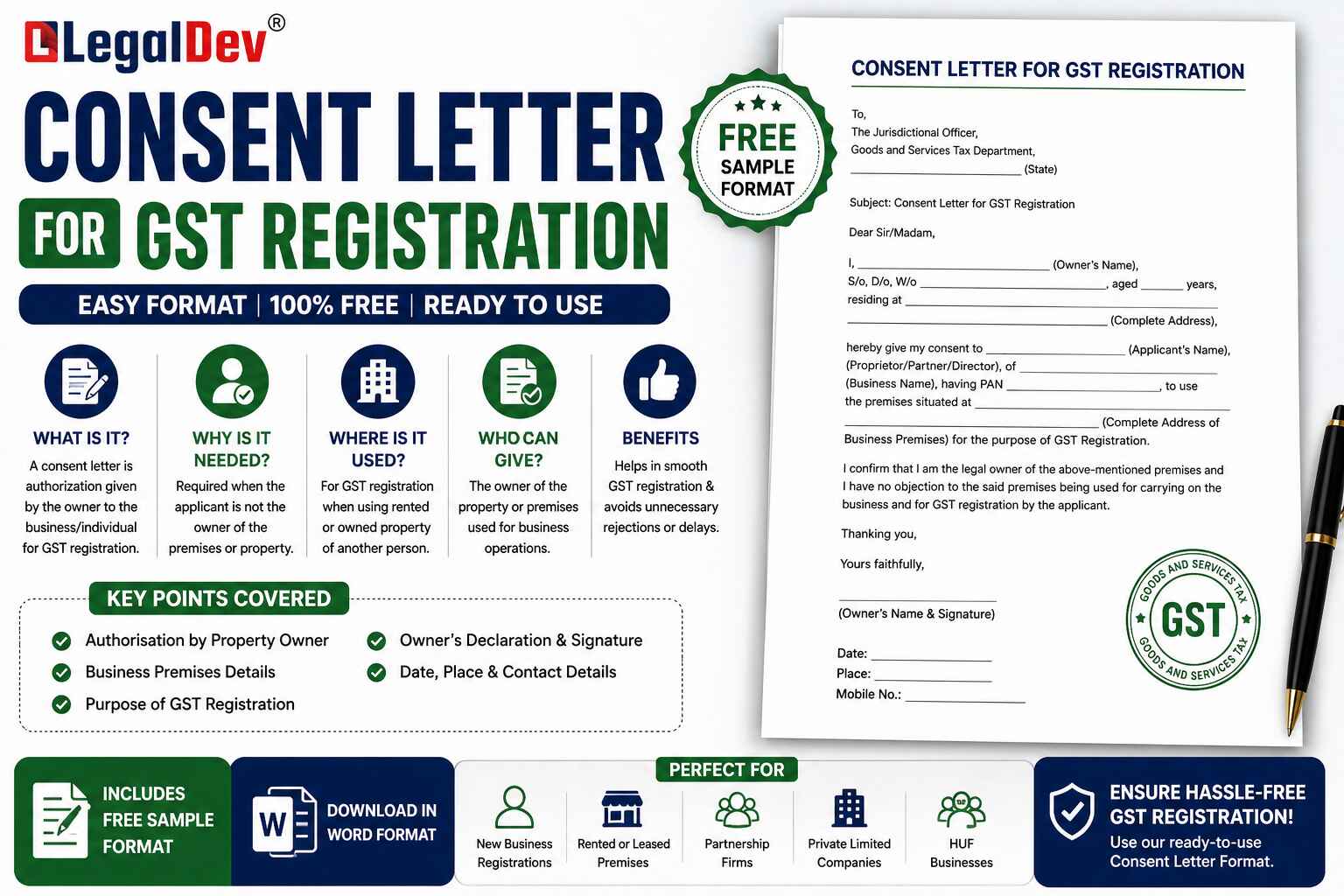
GST Consent Letter: Format, Who Signs It, Upload Steps & What Happens Without It
Renting your office space? Running your business from a leased property? Then there's one document standing between you and a completed GST registration — the consent letter for GST.
Miss it, and your application either stalls or gets rejected. Get it right the first time, and the whole registration process moves a lot smoother. Here's everything broken down — what it is, who signs it, the right format, how to upload it, and the consequences of skipping it.
What Is a GST Consent Letter and Why Is It Required?
A consent letter for GST is an official document that records the property owner's approval for a business to operate from their premises. It's required specifically for businesses that don't own the property they work from — rented offices, leased warehouses, shared commercial spaces — any of these situations call for one.
During GST registration, every business must submit proof of its operational address. When that address is a rented or leased property, the consent letter from the property owner is non-negotiable. There's no substitute document.
The consent letter serves three specific purposes:
-
Legal compliance — confirms the business has a valid, owner-approved address for GST registration purposes
-
Transparency — gives tax authorities a documented record of where the business actually operates
-
Protection for property owners — formally records their consent, so their premises don't end up registered under a business without their written knowledge
Straightforward in theory. But an incorrect format or missing supporting documents is enough to trigger a rejection.
Who Needs to Sign the GST Consent Letter?
The consent letter must be signed by the property owner or an authorised signatory. Who that is depends entirely on how the property is owned.
Company or Organisation-Owned Property
When the property belongs to a company or organisation, a director, manager, or officially authorised employee signs the consent letter. Their designation must be clearly stated in the document — that's what establishes their authority to sign.
Landlords of Rented or Leased Properties
For businesses running from rented spaces, the landlord signs. That signature confirms the landlord has no objection to the premises being used for a GST-registered business. No signature from the landlord, no valid consent letter.
Responsibilities of the Signatory
Whoever signs the document — property owner or authorised representative — takes on the responsibility of ensuring everything in the letter is accurate. Signing the consent letter is a formal declaration, not just a formality. The signatory is confirming they agree to the use of the premises for GST registration, and that all stated details are true.
Documents Required Along with the Consent Letter for GST Registration
The consent letter alone doesn't complete the application. Several supporting documents must accompany it.
Here's what's typically needed:
-
Proof of ownership — property tax receipts or electricity bills in the owner's name confirming they own the premises
-
Lease or rental agreement — a copy establishing the business's legal right to use the property
-
Identity proof of the authorised signatory — a government-issued ID such as Aadhaar, passport, or driver's licence
-
Bank account details — a cancelled cheque or recent bank statement to validate the business's bank account
-
Photograph of premises — to visually confirm the physical business location and its operational status
Missing any one of these alongside the consent letter is one of the most reliable ways to get an application sent back for resubmission.
How to Upload the Consent Letter on the GST Portal
Uploading is an online process — but each step needs to be followed correctly. A wrong file format or an incomplete form resets the entire effort.
Step 1: Log in to the GST Portal Visit the official GST portal and sign in using your registered credentials — username and password.
Step 2: Navigate to New Registration Go to Services > Registration > New Registration. Complete all required fields in the application form, including the nature of possession of the premises — whether owned, rented, or leased.
Step 3: Select 'Consent' as Nature of Possession In the nature of possession section, select the 'Consent' option. This signals to the system that a consent letter from the property owner will be attached to the application.
Step 4: Upload the Consent Letter Click the upload option, choose your signed consent letter from your device, and upload it. The file must be in PDF or JPEG format and cannot exceed 1 MB. Files larger than this will fail to submit.
Step 5: Attach All Supporting Documents Upload the remaining required documents alongside the consent letter — proof of ownership, the lease or rental agreement, and the identity proof of the authorised signatory.
Step 6: Review Before Submitting Go through every detail and every uploaded file carefully. Check for accuracy, completeness, and correct formatting. Once everything looks right, submit the application.
Step 7: Save Your ARN After submission, an Application Reference Number (ARN) is generated automatically. Save it — this is what you'll use to track the status of your GST registration application going forward.
Format of a Consent Letter for GST Registration
Use the template below as your base. Replace every bracketed field with actual details before signing and uploading.
CONSENT FOR RENT-FREE USE OF PREMISES FOR GST REGISTRATION
Date: ______________
I, [Owner Name], R/O [Owner's Address], [City], [State], [Postal Code], being the legal owner of the said premises, do hereby permit [Business Name], my [Relationship to Business, e.g., lessee] and [Additional Details] of [Business Address], to operate and conduct their business from the address mentioned above.
I hereby state that I have no objection to the said company/firm carrying on its business and profession from the said premises and getting registered under GST.
Through this letter, I am granting rent-free possession with immediate effect, in support of my ownership of the said premises.
Signature: ____________________ Name: ______________ Date: ______________ Place: ______________
This sample letter of permission works for most standard GST registration scenarios. If a formal lease is in place, attach the lease agreement alongside this letter when uploading.
Why Get a Professionally Drafted Consent Letter?
Downloading a random template and filling in the blanks might work. Or it might get rejected because a clause is missing, the format doesn't match what the GST officer expects, or the language is ambiguous. That risk is real — and the cost is time the business doesn't have while waiting to issue invoices or claim input tax credits.
A professionally drafted consent letter for GST removes that uncertainty. Here's what it actually delivers:
Compliance assurance. Legal professionals know exactly what GST authorities look for. Documents built to those standards clear technical review far more reliably than generic templates.
Accurate, customised documentation. A tailored consent letter accounts for your specific property arrangement, business type, and any state-level requirements that a generic format might miss entirely.
Peace of mind. Drafting legal documents without knowing the exact requirements is stressful. Getting it done correctly once is simpler — and cheaper — than fixing errors after a rejection.
Faster approvals. Compliant, properly formatted documentation moves through the GST portal faster. For a business ready to operate, that time difference matters.
Customised Consent Letter Services by legaldev Experts
legaldev handles consent letter drafting for businesses that want it done right without spending hours figuring out legal language.
-
Legal expertise — professionals with direct experience in GST compliance and consent letter requirements
-
Personalisation — the letter is drafted around your specific business structure, premises type, and registration needs
-
Compliance assurance — all required clauses and formats are included to prevent rejection on technical grounds
-
Time-saving — the drafting is handled entirely, freeing you to focus on running the business
What Happens If a GST Consent Letter Is Not Submitted?
Not submitting a consent letter — or submitting one that's incomplete — has consequences that go well beyond a minor inconvenience.
Registration delays. An application without a consent letter is treated as incomplete. Processing stops, waiting times stretch, and the business sits in limbo until the correct document is submitted.
Outright rejection. GST authorities can reject applications where the consent letter or address proof is missing. Starting the application from scratch costs time and delays everything downstream.
Operational disruptions. Without a completed GST registration, the business cannot issue GST invoices, claim input tax credits, or run tax-compliant operations. The direct revenue impact of that is hard to ignore.
Penalties and legal exposure. Operating without valid GST registration leaves the business exposed to penalties and fines. The longer it continues, the more that exposure compounds.
FAQs
Q: What is the correct format for a GST consent letter?
A: A valid consent letter for GST should include the property owner's full name and residential address, the business name and operational address, the nature of possession (rented, leased, or rent-free), and a clear declaration of no objection to GST registration. The owner or authorised signatory must sign and date it. The format in this guide follows the standard structure accepted by GST authorities.
Q: Is a consent letter mandatory for GST registration from a rented property?
A: Yes — the consent letter is mandatory when registering a business from a rented or leased property. There's no alternative document that replaces it in this scenario. If the business owns the property outright, a consent letter isn't required — ownership proof is submitted instead.
Q: Who should sign the GST consent letter — the property owner or the business owner?
A: The property owner or their authorised representative must sign. If the property belongs to a company, a director or authorised manager signs on the company's behalf. The business owner signs only if they also own the property being used for registration.
Q: Can a consent letter from parents work for GST registration at a home address?
A: Yes. A consent letter from parents is entirely acceptable when a business is being registered from the family home and the property is in the parents' names. It's treated the same as any other property owner consent — the parents sign as the legal property owners, with their address and relationship to the applicant clearly stated in the letter. This is a common scenario for home-based businesses and freelancers.
Q: What happens if the consent letter is rejected on the GST portal?
A: Check the rejection reason provided by the portal — common issues include missing details, unclear declarations, or file sizes exceeding 1 MB. Correct the document, confirm it's in PDF or JPEG format, and resubmit. If the format was the core problem, getting it professionally drafted at this stage avoids a second rejection.
Q: Can I use a sample letter of permission downloaded online for GST registration?
A: A sample letter of permission or downloaded template can serve as a starting point, but it must be filled out accurately with details specific to your property arrangement and business. Generic templates that skip required clauses — like the declaration of no objection or proof of ownership references — are a common reason for rejection. Customising it properly, or having it professionally drafted, reduces that risk considerably.
Q: What documents need to be attached along with the consent letter for GST?
A: Along with the signed consent letter, upload proof of ownership (property tax receipt or electricity bill), a copy of the lease or rental agreement if applicable, identity proof of the authorised signatory, bank account details, and a photograph of the premises. Missing any of these is one of the most common reasons GST applications are delayed.
Q: How long is a GST consent letter valid?
A: There's no fixed expiry period specified by GST law. The consent letter should reflect the current arrangement between the property owner and the business at the time of registration. If the property arrangement changes — a new lease, change of owner, or new premises — a fresh consent letter will be needed for any GST registration amendment.
Q: Does the consent letter need to be notarised for GST registration?
A: Notarisation is not mandatory. A signed, dated consent letter with the property owner's details is sufficient for most GST registration applications. That said, some specific situations or jurisdictions may have additional requirements — checking with a legal professional is a reasonable precaution if there's any uncertainty.
Q: Can one consent letter be used for multiple GST registrations at the same address?
A: No. Each GST registration requires its own separately signed consent letter specific to that business's name and details. If multiple businesses are being registered from the same address, each application needs its own letter. Submitting a single consent letter across multiple applications will result in rejection.