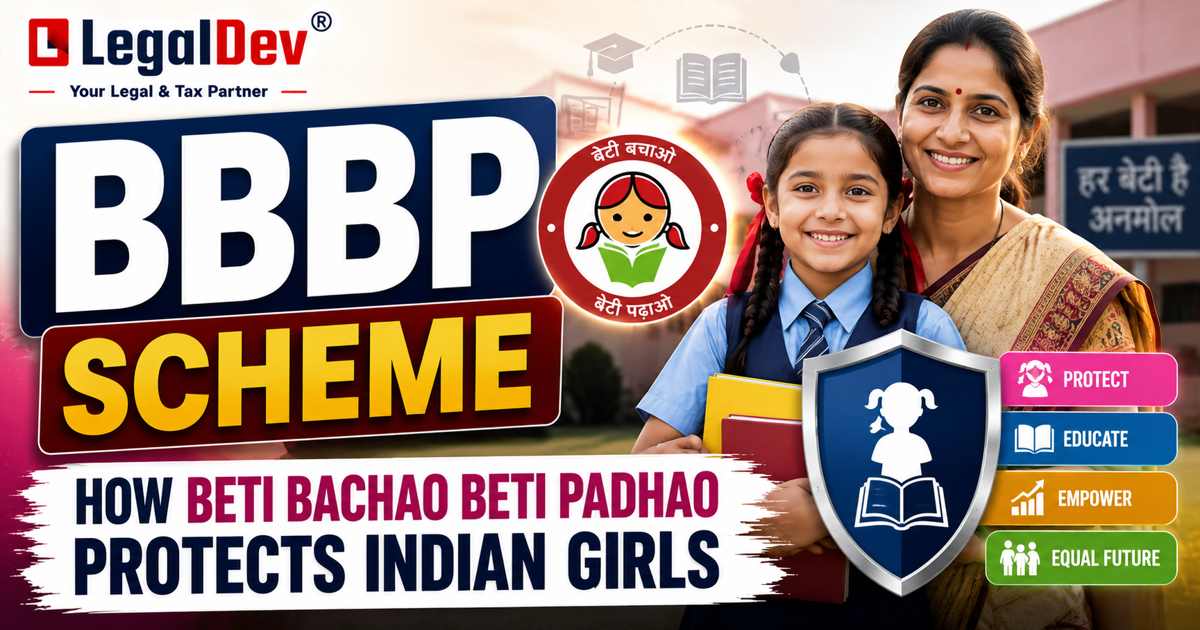
Beti Bachao Beti Padhao: What It Means for Your Daughter
India has always had a complicated relationship with its daughters. Celebrated in temples, undervalued in households — that contradiction is exactly what the Beti Bachao Beti Padhao scheme was designed to break.
Launched in January 2015 by Prime Minister Narendra Modi, this isn't just another government announcement. It's a nationwide push to fix something that data had been screaming about for years — a falling child sex ratio and shrinking opportunities for girls in education and beyond. Since then, it's grown, evolved, and in 2026, got a full upgrade.
Here's everything you need to know — from what the BBBP scheme actually does, to how to open the savings account connected to it, and what rights your daughter gets when she turns 18.
What Is Beti Bachao Beti Padhao?
The name says it plainly: Save the daughter, educate the daughter.
But the scheme goes further than the slogan. The core goal of the beti bachao beti padhao yojana is twofold — improve the child sex ratio at birth, which had been declining sharply in several Indian states, and push for better school enrollment among girls across the country.
Three central ministries run this jointly: the Ministry of Women and Child Development, the Ministry of Education, and the Ministry of Health and Family Welfare. That combination matters. A scheme touching only one ministry tends to get siloed. This one spans health, school systems, and welfare — which is why it's had more reach than most.
It applies across all states and union territories. No region is excluded.
Has It Actually Made a Difference?
Short answer — yes, though unevenly.
The sex ratio at birth has improved in several districts that were specifically targeted under the early phase of the bbbp scheme. School enrollment numbers for girls also moved in the right direction. Awareness campaigns — some controversial for their boldness, some quietly effective — shifted the conversation in communities where daughters were long seen as a financial burden.
That said, one scheme can't undo generations of bias overnight. Progress in some states was significant; in others, the numbers barely budged. Which is probably why the government didn't just leave it at Phase 1.
BBBP 2.0 — The 2026 Update
The updated phase of Beti Bachao Beti Padhao — launched in 2026 — addresses what the original missed.
The focus has shifted in four clear directions:
Digital monitoring. The first phase struggled with tracking impact on the ground. BBBP 2.0 uses better digital tools to measure what's actually changing in each district, not just what's being reported.
Skill development. Awareness alone doesn't create opportunity. The new phase links girls' education to actual career pathways — vocational training, technical skills, and employment-oriented programs are now part of the picture.
Education linked to jobs. This is the part that matters most to families deciding whether to keep a daughter in school past Class 10. When education visibly leads somewhere — to income, to independence — the calculation changes.
Community participation. Local involvement was always part of the plan. In 2.0, it's more structured. Gram panchayats, local schools, and community organizations play a formal role in pushing the scheme's goals.
Who Can Benefit? The Eligibility Question
Here's a clarification worth reading carefully.
Beti Bachao Beti Padhao is not a direct benefit scheme where families fill out a form and receive money. It's an awareness and policy initiative. There's no application process for the scheme itself.
The financial component — the part where your daughter's future actually gets secured in writing — runs through the Sukanya Samriddhi Yojana (SSY). And that does have specific eligibility rules.
Sukanya Samriddhi Account — Who Qualifies?
To open a Sukanya Samriddhi Account, these conditions must be met:
|
Criteria
|
Details
|
|
Account is in the name of
|
The girl child
|
|
Age of the girl
|
Must be below 10 years
|
|
Citizenship
|
Indian resident
|
|
Accounts per girl
|
Only one
|
|
Accounts per family
|
Maximum two (twins or triplets: exceptions apply)
|
|
Who opens the account
|
Parent or legal guardian
|
|
KYC
|
Mandatory — identity and address proof of guardian, plus the girl's birth certificate
|
One account per girl. Two per family. Simple rules, but worth knowing before you walk into a bank.
Documents You'll Need
Getting the paperwork right the first time saves a second trip. Here's what the bank or post office will ask for:
-
Official birth certificate of the girl child
-
Passport-size photographs of the child and parent/guardian
-
Address proof — Aadhaar card, utility bill, or rental agreement
-
Identity proof of the parent or legal guardian
Keep originals and photocopies both. Post offices especially tend to be strict about this.
How to Open the Account — Step by Step
The Sukanya Samriddhi Account can be opened at any authorized post office or at participating banks across India. The process is straightforward:
-
Visit the nearest post office or bank branch that offers the scheme
-
Collect and fill out the prescribed application form
-
Submit the form along with all required documents
-
Make the initial deposit (minimum deposit amounts apply as per current scheme guidelines)
-
After verification, the account is activated and a passbook is issued
That passbook is important — keep it safe. It's your record of every transaction, every interest credit, and the eventual maturity date.
Interest Rate — What Does Your Money Earn?
The Sukanya Samriddhi Account offers one of the better government-backed interest rates available for small savings in India. The rate is set by the Ministry of Finance and revised quarterly.
Interest is compounded annually — meaning the interest earned in Year 1 becomes part of the principal for Year 2. Over the long term (the account typically matures when the girl turns 21), that compounding adds up to a meaningful sum.
For the current applicable rate, check the official India Post website or your bank's SSY page — rates do change with government notifications and citing a number that may be outdated would be misleading here.
Withdrawal Rules — When Can You Access the Money?
This is the section families often misread. The rules are specific:
Partial withdrawal is permitted once the girl child turns 18, or after she clears Class 10 — whichever comes first. This partial amount is meant for higher education expenses. It's not a free withdrawal for any purpose.
Full withdrawal (the entire maturity amount) is available once the girl turns 21. That's the account's natural end point.
Premature closure is allowed only in specific circumstances — severe medical emergencies or other situations defined in the government's own guidelines. This isn't a loophole for general use.
The structure is intentional. The account is designed to stay locked until it actually serves the purpose it was opened for — the girl's education or her wedding, not day-to-day expenses.
Why This Matters Beyond the Numbers
There's a real-world impact that doesn't show up in policy documents.
When a family opens a Sukanya Samriddhi Account in a daughter's name, something shifts. The daughter becomes a named beneficiary. Her future becomes a line item in the household's financial planning. That's not a small thing in households where sons have historically been the ones with accounts in their names.
The beti bachao part of this scheme isn't just about preventing female infanticide — it's about changing the economic logic that makes daughters seem like a liability. A girl with an account growing interest for 21 years is a different proposition than a girl seen purely as dowry expense.
That's the real argument for the BBBP scheme, quietly built into the structure of a savings account.
Summary: Key Points
-
Launched January 2015 by PM Narendra Modi under the Beti Bachao Beti Padhao initiative
-
Jointly run by three central ministries — women & child development, education, health
-
BBBP 2.0 launched in 2026 — focuses on digital monitoring, skill development, and career-linked education
-
The financial instrument is the Sukanya Samriddhi Yojana — not a direct benefit, but a long-term savings scheme
-
Girl must be under 10 years at time of account opening
-
Interest compounded annually; maturity at age 21
-
Partial withdrawal permitted at 18 for education; full withdrawal at 21
FAQs
Q1: What is the difference between Beti Bachao Beti Padhao and Sukanya Samriddhi Yojana?
A: Beti Bachao Beti Padhao (BBBP) is a government awareness and policy campaign aimed at improving the child sex ratio and promoting girls' education across India. Sukanya Samriddhi Yojana (SSY) is the savings scheme launched alongside it — this is where families actually open bank accounts in a daughter's name. BBBP is the mission; SSY is one of its main financial tools.
Q2: Can I open a Sukanya Samriddhi Account if my daughter is already 10 years old?
A: No. The eligibility rule is clear — the girl child must be below 10 years of age at the time of account opening. If she has crossed that age, the SSY account cannot be opened under the current scheme guidelines. There are no exceptions to this age limit.
Q3: How much do I need to deposit to keep the Sukanya Samriddhi Account active each year?
A: A minimum annual deposit is required to keep the account active — this amount is specified in the current SSY scheme guidelines and is subject to revision. If the minimum deposit is missed in any financial year, the account can be revived by paying the outstanding amount along with a penalty fee. Check with your post office or bank for the exact current figures.
Q4: Can a girl have two Sukanya Samriddhi Accounts — one at a bank and one at a post office?
A: No. Only one SSY account is permitted per girl child, regardless of where it is opened. Having two accounts in one girl's name is not allowed under the scheme. If discovered, the second account is typically closed and the deposited amount returned without interest.
Q5: What happens to the Sukanya Samriddhi Account if the family moves to another city?
A: The account can be transferred from one authorized post office or bank branch to another anywhere in India. The transfer process involves a written request and submission of the passbook at the current branch. This is one of the advantages of an SSY account — it follows the account holder regardless of where the family relocates.
Q6: Is the money in the Sukanya Samriddhi Account tax-free?
A: Yes — under current Indian tax laws, the SSY account enjoys EEE status: the deposit is tax-deductible under Section 80C, the interest earned is tax-free, and the maturity amount is also tax-free. This makes it one of the more tax-efficient savings instruments available for Indian families. Tax laws do change, so it's worth confirming the current status with a tax professional.
Q7: Can the Sukanya Samriddhi Account be used for anything other than education and marriage?
A: Not easily. The scheme is specifically designed for the girl's higher education or marriage-related expenses. Partial withdrawals are permitted only for education after the girl turns 18. Full withdrawals are only at maturity (age 21). Premature closure for other reasons is only allowed in very specific circumstances, such as a medical emergency, as defined in official scheme guidelines.
Q8: What is BBBP 2.0 and how is it different from the original scheme?
A: BBBP 2.0, launched in 2026, is an upgraded phase of the original Beti Bachao Beti Padhao scheme. The original phase focused heavily on awareness and reducing sex-selective practices. The 2.0 version goes further — it includes skill development for girls, education programs linked to career outcomes, better digital monitoring of progress, and stronger community-level participation. The core mission remains the same; the delivery mechanism is now more structured and outcome-focused.
Q9: Which banks are authorized to open a Sukanya Samriddhi Account?
A: Most public sector banks and several major private sector banks are authorized to offer SSY accounts. State Bank of India, Bank of Baroda, Canara Bank, Punjab National Bank, and India Post are among the most commonly used. The complete list of authorized banks is available on the Reserve Bank of India's and India Post's official websites. It's always worth confirming with the branch before visiting.
Q10: Can a non-resident Indian (NRI) open a Sukanya Samriddhi Account for their daughter?
A: No. The scheme is currently available only to Indian resident citizens. If an SSY account holder later acquires NRI status, the account may need to be closed — interest in that period may not be applicable as per the original resident rate. Families with NRI status should seek updated guidance from their bank or a financial advisor, as rules around this have seen some revision over time.