Most people encounter the balance of payments only in economics textbooks. But its effects show up in places they notice every day — the price of petrol at the pump, the interest rate on their home loan, the rupee's slide against the dollar. That's what makes understanding this concept worthwhile beyond an exam.
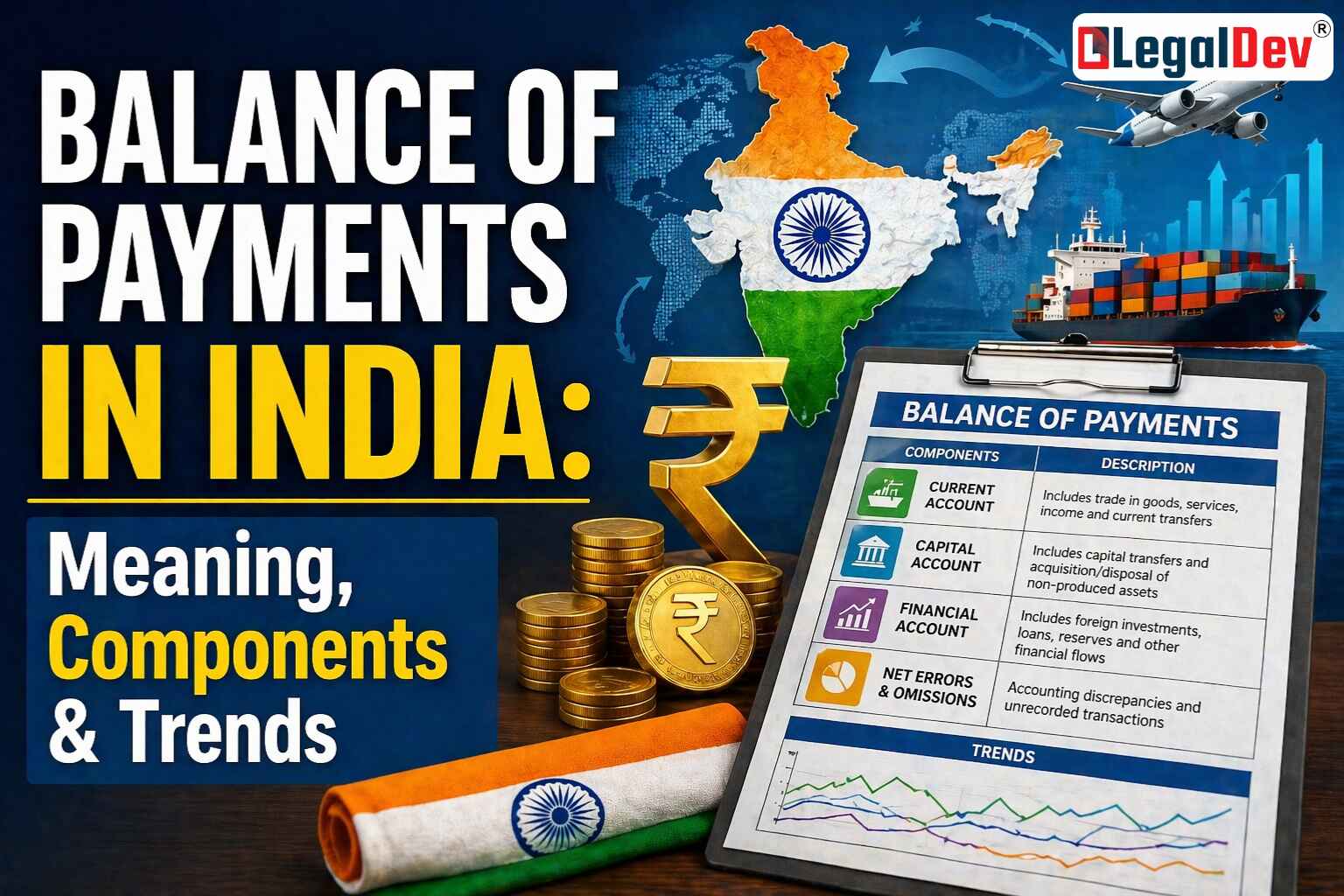
At its core, the balance of payments in India is a structured record of every financial transaction the country conducts with the rest of the world over a given period. Monthly, quarterly, or annual — the BoP period depends on what's being analysed. Think of it as the national equivalent of a household's income and expense ledger, applied to cross-border money flows.
Key numbers to anchor the picture:
-
India's Q2 FY2025-26 Current Account Deficit came in at $12.3 billion
-
That's down sharply from $20.8 billion in the same quarter a year earlier
-
FDI into equities climbed to $18.62 billion in Q1 FY26, up from $16.17 billion in Q1 FY25
-
FPI saw a net outflow of $9.5 billion across 2025 — against a net inflow of $20 billion in 2024
Balance of Payment in Economics: The Concept That Runs a Country's Finances
What balance of payment meaning actually covers
The balance of payment concept in economics captures both sides of a country's international ledger. Income flows in through exports, inward remittances, dividends on foreign investments, and capital coming into the country. Money flows out through imports, investment in overseas assets, and interest paid on foreign debt.
When income consistently outpaces outflow, the result is a BoP surplus. When outflow dominates, the country runs a deficit. Neither is inherently catastrophic — it's the scale, duration, and what's driving it that determines the real-world impact.
How BoP differs from just tracking trade
Balance of payment in international business covers far more than goods crossing a border. Services, financial instruments, remittances, and ownership changes in assets all count. This is what separates the BoP from a simpler balance of trade calculation, which only measures the merchandise gap. India's trade deficit looks alarming in isolation. The full BoP picture is more nuanced once services and capital flows enter the frame.
The Types of Balance of Payment India Uses — Current, Capital & Financial
The RBI breaks India's BoP into two primary accounts. Each one tracks a different dimension of the country's external financial position.
Current account and capital account: what each one tracks
The balance of payments current account captures three things: the flow of money from goods and services trading, income earned on foreign-held assets, and net transfers like NRI remittances. It's the closest thing to a national profit-and-loss statement in international terms. A current account surplus means the country is earning more from the world than it's spending. India's current account has run a deficit for most of the last two decades.
The balance of payments capital account — sometimes called the financial account BoP — tracks changes in ownership of assets across borders. This includes foreign direct investment, foreign portfolio investment into Indian equities and bonds, external commercial borrowings, and NRI deposits. Capital account surpluses have historically helped India fund its current account gap.
Balance of trade meaning within the current account
The balance of trade is the merchandise component of the current account — exports minus imports of physical goods. India's trade deficit is structurally large because crude oil and gold dominate the import side, and these aren't discretionary purchases. The balance of trade meaning here isn't just statistical; it's the reason India's external position is perpetually under some degree of pressure.
What India's BoP Data Actually Tells Us Right Now
Current account: the deficit that persists — and narrowed
India's Q2 FY2025-26 CAD stood at $12.3 billion. Year-on-year, that's a meaningful improvement from $20.8 billion in Q2 FY24-25. Two factors drove the narrowing: a slight drop in merchandise trade gap and stronger net services exports. Neither trend is guaranteed to hold, but both are meaningful.
India's energy import dependency is the single biggest structural drag. There's no diplomatic way to put it — as long as India imports 85% of its crude oil needs, some current account deficit is baked into the system. Even if global oil prices fall, a spike rebounds the deficit quickly.
Capital account: FDI up, FPI volatile
On the capital account balance side, the picture is mixed. FDI into equities grew from $16.17 billion in Q1 FY25 to $18.62 billion in Q1 FY26 — a sign that long-term investor confidence in India's growth story remains intact.
FPI flows are another story. They swung from net positive in Q1 FY26 to net negative in Q2. Across the full 2025 calendar year, FPI recorded a net outflow of $9.5 billion, compared to a net inflow of $20 billion in 2024. That's a $29.5 billion swing in a single year — a reminder of how quickly foreign portfolio sentiment can reverse.
Key trends summarised
-
Crude oil and gold imports remain the primary drivers of the merchandise deficit
-
IT and ITeS services exports have delivered consistent, strong results
-
NRI remittances continue to moderate the CAD's impact
-
FPI volatility, combined with a wide trade gap, has kept the rupee under intermittent pressure
Why India Runs a Persistent Current Account Deficit — And What Offsets It
Three structural reasons India's current account stays in deficit
Petroleum imports. India's industrial and transport systems run on imported crude oil. This isn't a policy choice that can be reversed quickly — it's decades of infrastructure built around fossil fuel dependence. Even when domestic renewables expand, the transition takes time. The monetary approach to balance of payment makes clear that a country's import mix matters as much as its volume of trade.
Gold consumption. India's private sector is among the largest gold consumers on earth. Cultural demand for gold at weddings, festivals, and as a store of value drives consistent and substantial import bills. That foreign exchange drains out without generating productive economic output in return.
Inelastic imports. Beyond oil and gold, India relies on imports for electronics, fertilisers, and edible oils. These don't shrink much when prices rise — the demand exists regardless. Each of these categories contributes to a stubbornly wide merchandise trade gap.
What keeps the overall BoP manageable
Despite the current account drag, India's bop balance holds up better than the trade deficit alone would suggest. Three sources provide the offset:
India's IT sector has been the standout performer. Services exports — particularly software, BPO, and business services — bring in substantial foreign exchange year after year. NRI remittances add another reliable inflow. Indians working abroad sent home tens of billions of dollars annually, making India one of the world's largest remittance recipients. And FDI — drawn by India's long-term growth story — provides a relatively stable capital inflow that doesn't evaporate with market sentiment the way FPI does.
The exception is FPI. Foreign portfolio investments are inherently short-term and sentiment-driven. In 2024, India received $20 billion in net FPI. In 2025, it recorded a $9.5 billion outflow. That kind of swing is exactly why BoP economists track the capital account balance separately from longer-term structural flows.
Summary: what drives each direction
|
Category |
Drives Deficit (Outflow) |
Drives Surplus (Inflow) |
|
Trade |
Crude oil, gold, electronics, fertilisers |
Engineering goods, pharma exports |
|
Services |
Payments to global consulting firms |
IT services, BPO, tourism |
|
Capital |
FPI outflows from equities and bonds |
FDI, NRI deposits (NRE/FCNR) |
|
People |
Indians studying or travelling abroad |
Remittances from Indian diaspora |
How BoP Movements Hit Your Wallet, the Rupee, and Interest Rates
Exchange rate and rupee depreciation
A negative BoP directly pressures the rupee. More rupees flow out than come in, which increases rupee supply in foreign exchange markets and drives its value down against currencies like the USD. That makes imports more expensive — and since India's import basket is heavily price-inelastic (petroleum, fertilisers, electronics), costlier imports worsen the BoP further. It's a feedback loop that's difficult to break quickly.
Commodity prices in domestic markets
When crude oil costs more in dollar terms — and the rupee is weaker to begin with — fuel prices rise. Fertiliser follows. And because fertiliser affects agricultural input costs, a broad range of food prices shifts upward too. The bop current account deficit isn't an abstract number; it's part of what determines whether food and fuel stay affordable.
Interest rates and RBI policy
Running a current account deficit means India needs foreign capital to fund the gap. Attracting that capital — particularly foreign debt — often requires offering higher interest rates. That's not a free choice; it feeds directly into the RBI's monetary policy decisions and, by extension, the cost of borrowing for Indian households and businesses. A wider deficit can constrain the RBI's ability to cut rates even when domestic conditions would otherwise justify it.
The Real Challenges Keeping India's BoP Under Pressure
India's BoP faces four persistent headwinds, and none of them have easy fixes.
Crude oil price volatility. India doesn't control global oil prices. A spike in Brent crude — whether from geopolitical tension or supply cuts — immediately widens the current account gap. There's limited policy buffer against this beyond strategic reserves.
Underwhelming goods export growth. India's merchandise export growth has lagged its import bill for years. While services exports have compensated, goods exports haven't kept pace with the ambitions set by trade policy goals.
Rising global protectionism. Developed economies are increasingly turning inward — higher tariffs, reshoring incentives, trade restrictions. That compresses India's export opportunities in key markets without a proportional reduction in imports.
FPI unpredictability. Honestly, nobody — not the RBI, not global fund managers, not economists — can reliably predict short-term FPI direction. Foreign portfolio investors react to US Federal Reserve decisions, global risk appetite, and geopolitical events that have nothing to do with India's fundamentals. A single Fed rate signal can trigger billions in outflows within days. That's a structural vulnerability in India's capital account that no domestic policy fully neutralises.
Frequently Asked Questions
What is the balance of payments in India and why does it matter?
India's balance of payments is a complete record of every cross-border financial transaction the country makes over a set period — exports, imports, remittances, foreign investment, and debt repayments. Think of it as a national-level cash flow statement. When outflows consistently exceed inflows, it puts pressure on the rupee and forces the RBI to respond. A BoP imbalance is often what triggers fuel price changes or interest rate shifts that ordinary citizens notice at home.
What is the difference between balance of trade and balance of payments?
Balance of trade meaning is narrower — it only covers the gap between merchandise exports and imports. Balance of payments is broader: it pulls in services, income flows, remittances, and capital movements too. India's trade deficit is large, but the overall BoP picture improves significantly once IT services exports and NRI remittances are added. The two are related but not interchangeable.
Why does India always have a current account deficit?
Two imports are mostly responsible: crude oil and gold. India imports roughly 85% of its crude oil requirements, and the annual bill runs into hundreds of billions of dollars. Gold is the second drain — India's private gold consumption is among the highest in the world. Both are price-inelastic, meaning demand holds even when prices climb. Until India meaningfully cuts its energy import dependence, some structural current account deficit is essentially unavoidable.
How does a BoP deficit affect the Indian rupee?
A persistent deficit means more rupees are flowing out than coming in. That increases rupee supply in foreign exchange markets and reduces demand — pushing the currency lower against the USD and others. A weaker rupee makes imports costlier, which for India's oil-and-electronics-heavy import basket feeds directly into inflation. The RBI manages this through forex reserves and rate decisions, but there's no clean solution when the structural imbalance runs deep.
What is India's current balance of payments status?
As of Q2 FY2025-26, India's Current Account Deficit stood at $12.3 billion — down from $20.8 billion in the same quarter a year before. The improvement came from stronger net services exports and a modest narrowing of the merchandise gap. On the capital side, FDI into equities rose to $18.62 billion in Q1 FY26, though FPI recorded net outflows of $9.5 billion across 2025. The overall position reflects managed pressure — not a crisis, but not a comfortable surplus either.