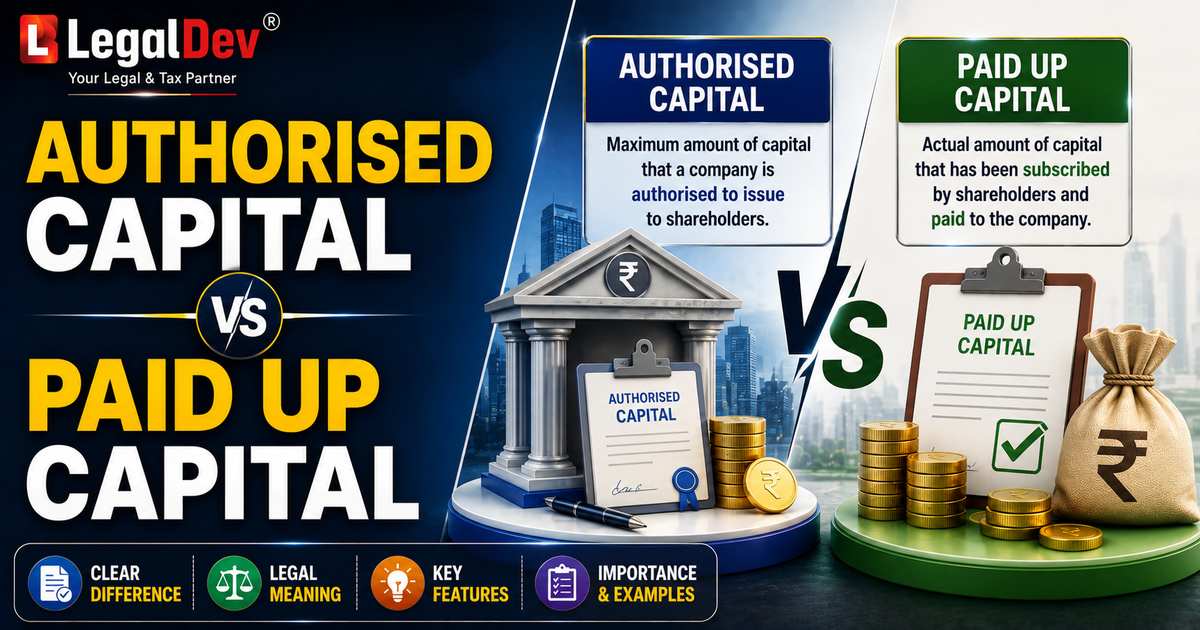
Every founder registering a company in India hits these two terms almost immediately — authorised capital and paid up capital. They sound similar. They are not the same thing. And confusing the two has real consequences: overpaying MCA fees at incorporation, hitting a fundraising wall mid-round, or unknowingly breaching the Companies Act, 2013.
The short version: authorised capital is the ceiling — the maximum your company is legally allowed to issue. Paid-up capital is the floor that matters — the actual money collected from shareholders. The gap between the two shapes everything from MOA structure to stamp duty to when you need to file Form SH-7.
This guide covers both in full — definitions, a complete capital hierarchy table, real numerical examples, MCA fee implications, and the exact steps to increase authorised capital when your business needs more room to grow.
What Is Authorised Capital?
Authorised capital — also called nominal capital or registered capital — is the maximum value of shares a company is legally permitted to issue. It is defined in the Capital Clause of the Memorandum of Association (MOA) before or at the time of incorporation. No shares can be issued beyond this limit unless the company formally increases it first.
Think of it as a legal boundary. The company does not have to fill it — and most do not, at least not in the early years. It simply defines how far the company can go when issuing shares at any point in its life, without triggering an MOA amendment.
Key Characteristics of Authorised Capital
-
Declared in the MOA under the Capital Clause — set before incorporation
-
Represents the maximum permissible share issuance, not what has actually been issued
-
Must be stated in multiples of the face value of each share
-
Determines the government filing fees payable to MCA at incorporation
-
Determines stamp duty payable on the MOA in most states
-
Can be increased at any time under the Companies Act, 2013 — but only after following the prescribed process
-
Does not factor into net worth calculation — only paid-up capital does
Example: XYZ Pvt Ltd has authorised capital of Rs. 20 Lakh. It has so far issued shares worth Rs. 12 Lakh to shareholders. The remaining Rs. 8 Lakh is unissued authorised capital — the company can issue more shares up to this amount without touching the MOA. If it wants to issue shares totalling Rs. 25 Lakh, it must first increase its authorised capital beyond Rs. 20 Lakh.
What Is Paid Up Capital?
Paid-up capital is the actual amount a company has received from its shareholders in exchange for shares that have been both issued and fully paid. It is the real financial contribution sitting in the company's equity base — not a ceiling, not a promise, but money already in.
Paid-up capital is always less than or equal to authorised capital. It can never exceed it. That is not a technicality — it is a hard legal limit under the Companies Act, 2013.
Since the Companies Amendment Act, 2015, there is no minimum paid-up capital requirement for incorporating a company in India. A private limited company can be incorporated with Rs. 1,000 as paid-up capital. The amount is entirely at the founders' discretion. What still remains mandatory is declaring an authorised capital in the MOA.
Key Characteristics of Paid-Up Capital
-
Represents actual funds received from shareholders — not subscribed or merely promised
-
Always less than or equal to authorised capital — no exceptions
-
Directly used in net worth calculation of the company
-
Must also be less than or equal to issued capital and subscribed capital in the capital hierarchy
-
No minimum requirement post the 2015 Amendment — any amount works
-
Can be increased by issuing new shares, but only within the authorised capital limit
-
Routes for increase: rights issues, private placements, preferential allotments
Example: ABC Pvt Ltd has authorised capital of Rs. 10 Lakh. It offers shares worth Rs. 8 Lakh to investors (issued capital). All investors apply for and receive those shares (subscribed capital = Rs. 8 Lakh). All pay the full amount upfront (paid-up capital = Rs. 8 Lakh). The remaining Rs. 2 Lakh sits as unissued authorised capital — available for future share issuances without amending the MOA.
The Complete Share Capital Hierarchy
Authorised and paid-up capital do not exist in isolation. They sit within a broader capital structure — and understanding all four types clarifies how any company's financials are actually constructed.
|
Capital Type
|
Definition
|
Relationship
|
|
Authorised Capital
|
Maximum share capital permitted — defined in MOA
|
Ceiling — cannot be exceeded without MOA amendment
|
|
Issued Capital
|
Portion of authorised capital actually offered to shareholders
|
Issued ≤ Authorised
|
|
Subscribed Capital
|
Portion of issued capital that shareholders have applied for and received
|
Subscribed ≤ Issued
|
|
Called-up Capital
|
Portion of subscribed capital the company has asked shareholders to pay
|
Called-up ≤ Subscribed
|
|
Paid-up Capital
|
Portion of called-up capital shareholders have actually paid
|
Paid-up ≤ Called-up
|
|
Uncalled Capital
|
Remaining amount on subscribed shares not yet demanded
|
Subscribed minus Called-up
|
|
Reserve Capital
|
Portion of uncalled capital reserved only for winding-up situations
|
Subset of uncalled capital
|
In most private limited companies today — especially startups — issued, subscribed, and paid-up capital are typically identical. Founders and investors pay the full share price upfront at allotment, which collapses the distinction between called-up and paid-up. The more granular differences between these layers matter mainly in larger public companies with complex, multi-tranche capital structures.
Authorised Share Capital vs Paid Up Capital — Full Comparison
|
Parameter
|
Authorised Capital
|
Paid Up Capital
|
|
Definition
|
Maximum share capital permitted to be issued
|
Actual capital received from shareholders
|
|
Where Defined
|
Capital Clause of the MOA
|
Share allotment and payment records
|
|
Nature
|
Ceiling / upper limit
|
Actual amount collected
|
|
Must Equal
|
Does not need to be fully issued
|
Must always be ≤ authorised capital
|
|
Minimum Requirement
|
Must be declared at incorporation
|
No minimum after Companies Amendment Act, 2015
|
|
Net Worth Impact
|
Does not factor into net worth
|
Directly factors into net worth
|
|
ROC Filing
|
Form SH-7 required when increasing
|
No separate filing — reflected in annual accounts
|
|
Stamp Duty
|
Stamp duty paid on authorised capital (state-dependent)
|
No separate stamp duty on paid-up capital
|
|
MCA Fees
|
Incorporation fees based on authorised capital
|
Not directly linked to MCA incorporation fees
|
|
Flexibility
|
Increased by amending MOA
|
Increased by issuing new shares within authorised limit
|
|
Investor Signal
|
Shows maximum growth potential
|
Shows actual capital deployed in the business
|
Numerical Example: Authorised vs Paid Up Capital
Numbers clarify this faster than any definition. Here is a practical illustration using a company's full capital structure at a point in time.
|
Capital Type
|
Amount
|
Explanation
|
|
Authorised Capital
|
Rs. 50,00,000 (50 Lakh)
|
Declared in MOA — this is the legal ceiling
|
|
Issued Capital
|
Rs. 30,00,000 (30 Lakh)
|
Shares offered to founders and investors
|
|
Subscribed Capital
|
Rs. 30,00,000 (30 Lakh)
|
All offered shares were taken up
|
|
Called-up Capital
|
Rs. 30,00,000 (30 Lakh)
|
Full payment demanded from all shareholders
|
|
Paid-up Capital
|
Rs. 28,00,000 (28 Lakh)
|
All paid except one shareholder (Rs. 2L outstanding)
|
|
Calls in Arrear
|
Rs. 2,00,000 (2 Lakh)
|
One shareholder has not yet paid
|
|
Unissued Authorised
|
Rs. 20,00,000 (20 Lakh)
|
Remaining headroom — no MOA amendment needed
|
This company has Rs. 20 Lakh of unissued headroom sitting inside its authorised capital. It can bring in new investors or issue additional shares up to that amount without filing anything to amend the MOA. The moment it wants to raise equity beyond Rs. 50 Lakh total, it must go through the process of increasing authorised capital — and that means Form SH-7, shareholder approval, and paying additional MCA fees.
Impact on MCA Fees and Stamp Duty
Here is something founders often discover too late: the government fees payable to the MCA at incorporation are calculated on authorised capital — not on what you actually raise.
The FiLLiP form filing fee follows this slab structure:
|
Authorised Capital Slab
|
MCA Filing Fee (FiLLiP)
|
Notes
|
|
Up to Rs. 1 Lakh
|
Rs. 200
|
Minimum fee
|
|
Rs. 1 Lakh to Rs. 5 Lakh
|
Rs. 2,000
|
Most micro-businesses
|
|
Rs. 5 Lakh to Rs. 10 Lakh
|
Rs. 4,000
|
—
|
|
Rs. 10 Lakh to Rs. 25 Lakh
|
Rs. 5,000
|
Common for startups
|
|
Above Rs. 25 Lakh
|
Rs. 5,000 + additional slabs
|
Capped slab structure
|
Stamp duty on the MOA and AOA is also calculated on authorised capital in most states — not on paid-up capital. Declaring an unnecessarily high authorised capital at incorporation therefore increases your upfront costs with no corresponding benefit.
Most founders keep authorised capital at Rs. 10 Lakh to Rs. 25 Lakh at the time of incorporation. That is usually enough headroom for early-stage operations. When a funding round approaches and more shares need to be issued, they file to increase authorised capital at that point.
How to Increase Authorised Capital
Growing companies — especially those approaching a funding round or planning ESOP issuances — regularly need to increase authorised capital to create room for new shares. The process under the Companies Act, 2013 runs in six steps.
Step 1 — Check the AOA Confirm that the Articles of Association permit an increase in authorised capital. If they do not, the AOA must be amended first under Section 14 before proceeding.
Step 2 — Board Resolution Hold a Board of Directors meeting. Pass a resolution approving the proposed increase and recommending it to shareholders for approval.
Step 3 — Shareholder Approval Convene an Extraordinary General Meeting (EGM) or pass the resolution through postal ballot. Shareholders must approve the increase before any MOA amendment takes effect.
Step 4 — File Form SH-7 File Form SH-7 with the MCA within 30 days of the shareholder resolution, along with a copy of the altered MOA and payment of additional government fees. Missing this window creates compliance exposure.
Step 5 — Pay Additional Stamp Duty Pay stamp duty on the increased portion of authorised capital, as applicable in your state.
Step 6 — Update the MOA The Capital Clause of the MOA is formally amended to reflect the new, higher authorised capital figure.
When Should You Actually Increase Authorised Capital?
-
Before a funding round — to create issuance room for investor shares
-
Before launching an ESOP scheme for employees
-
When issued capital is approaching the authorised limit and future growth flexibility is needed
Waiting until you are mid-deal to discover the headroom is gone is an avoidable problem. Building this into pre-round due diligence is standard practice.
Companies Amendment Act 2015 — What Changed for Paid Up Capital
Before the Companies Amendment Act, 2015, every private limited company needed a minimum paid-up capital of Rs. 1 Lakh at incorporation. Public limited companies required Rs. 5 Lakh. This was a meaningful barrier for small businesses and early-stage founders who did not need — and could not always afford — to lock capital in from day one.
The 2015 amendment removed this entirely.
|
Requirement
|
Before 2015 Amendment
|
After 2015 Amendment
|
|
Minimum Paid-up Capital (Pvt Ltd)
|
Rs. 1 Lakh
|
No minimum — any amount
|
|
Minimum Paid-up Capital (Public Ltd)
|
Rs. 5 Lakh
|
No minimum — any amount
|
|
Authorised Capital Requirement
|
Mandatory
|
Still mandatory
|
|
Practical Impact
|
Barrier for small startups and solo founders
|
Any founder can now incorporate at minimal cost
|
The authorised capital requirement did not change — it still must be declared in the MOA before or at incorporation. What changed is that the amount you actually collect from shareholders at the start is entirely your call.
Why This Distinction Matters for Founders
Getting the authorised vs paid-up capital structure right from day one avoids three expensive problems later.
First, setting authorised capital too high at incorporation means paying more in MCA fees and stamp duty upfront — money that adds nothing to the business.
Second, setting it too low means hitting a ceiling mid-funding round — which requires an emergency Form SH-7 filing, shareholder approvals, and additional fees, all under time pressure.
Third, confusing authorised capital with paid-up capital leads to invoicing, valuation, and compliance errors that surface during due diligence — not a position you want to be in when an investor is already at the table.
The math here is straightforward. The compliance path is well-defined. Getting both right at the start is far easier than correcting them later.
Why Choose Legaldev
Whether you are incorporating and need to declare the right authorised capital from the start, or your company is approaching a funding round and needs to increase authorised capital quickly and correctly, Legaldev provides complete end-to-end support.
From MOA drafting and SPICe+ filing to Form SH-7 preparation, shareholder resolution documentation, and post-incorporation compliance, Legaldev's Company Secretaries handle every capital-related obligation accurately and on time. No missed deadlines. No misclassified capital structures. Just the right compliance, done right.
FAQs
Q1: What is the main difference between authorised capital and paid up capital?
A: Authorised capital is the maximum share capital a company is legally allowed to issue, as stated in the Memorandum of Association — it is a ceiling, not an actual collection. Paid-up capital is the actual money received from shareholders for shares that have been issued and fully paid. Paid-up capital is always less than or equal to authorised capital — that relationship is non-negotiable under the Companies Act, 2013.
Q2: Can paid up capital ever exceed authorised capital?
A: No — and this is absolute. Issuing shares that would push paid-up capital beyond the authorised limit is not permitted under the Companies Act, 2013, and any such issuance would be legally invalid. If a company wants to raise more equity than its current authorised capital allows, it must first increase the authorised capital through shareholder approval, Form SH-7 filing with the MCA, and MOA amendment — in that order.
Q3: What is the minimum paid up capital required to register a company in India?
A: There is no minimum paid-up capital requirement in India after the Companies Amendment Act, 2015. A Private Limited Company can be incorporated with as little as Rs. 1,000 — or any other amount — as paid-up capital. The authorised capital, however, still must be declared in the MOA before or at incorporation. This change made incorporation significantly more accessible for small businesses and early-stage founders.
Q4: How do I increase authorised capital, and what is the Form SH-7 process?
A: To increase authorised capital, a company must: check that the AOA permits the increase, pass a Board resolution recommending it, obtain shareholder approval at an EGM or through postal ballot, file Form SH-7 with the MCA within 30 days of shareholder approval, pay additional government fees and applicable stamp duty, and formally amend the Capital Clause of the MOA. The entire process — when documents are in order — typically takes two to four weeks.
Q5: Does a higher authorised capital increase MCA registration fees?
A: Yes, directly. The government fees payable through the FiLLiP form at incorporation are calculated on declared authorised capital — not on actual paid-up capital. Fees range from Rs. 200 for up to Rs. 1 Lakh in authorised capital to higher slabs for larger amounts. Stamp duty on the MOA is also typically calculated on authorised capital in most states. This is why most founders declare a modest authorised capital at incorporation — usually Rs. 10 Lakh to Rs. 25 Lakh — and increase it later when the business actually needs the headroom.
Q6: What is unissued authorised capital and how does it work?
A: Unissued authorised capital is the portion of authorised capital that has not yet been offered to shareholders — it is the gap between total authorised capital and issued capital. A company with Rs. 50 Lakh in authorised capital and Rs. 30 Lakh in issued capital has Rs. 20 Lakh of unissued headroom. It can issue additional shares up to that Rs. 20 Lakh through rights issues, private placements, or ESOPs without needing to amend the MOA or file Form SH-7. That flexibility is exactly why maintaining adequate unissued authorised capital matters before a funding round.
Q7: Does paid up capital affect a company's valuation?
A: Paid-up capital is one component of shareholders' equity and directly factors into net worth calculation. However, company valuation in practice — particularly for startups — is driven by revenue, growth trajectory, and future earning potential far more than by paid-up capital figures. Authorised capital has no bearing on valuation at all. Investors look at paid-up capital as part of the equity structure, not as the primary valuation driver.
Q8: What is the difference between authorised capital and issued capital?
A: Authorised capital is the total maximum the company can ever issue — the legal ceiling set in the MOA. Issued capital is the portion of that maximum that has actually been offered and allotted to shareholders. A company does not have to issue all of its authorised capital — it can keep a portion unissued as headroom for future rounds, ESOPs, or other equity needs. The unissued portion requires no separate filing and carries no cost.
Q9: What is the relationship between authorised capital and stamp duty on the MOA?
A: Stamp duty on the Memorandum of Association is calculated on authorised capital in most Indian states — not on paid-up capital. This means declaring a high authorised capital at incorporation increases stamp duty payable upfront. The exact rate varies by state. Most founders keep authorised capital moderate at incorporation specifically to manage this cost, then file to increase authorised capital when the business approaches a funding round and needs more issuance room.
Q10: What happens if a company tries to issue shares beyond its authorised capital?
A: It is not permitted, and any attempt to do so would make those share allotments legally invalid. The Companies Act, 2013 strictly caps share issuances at the authorised capital limit. Directors of a company that issues shares beyond this limit could face penalties and personal legal liability. The correct approach is always to increase authorised capital first — through shareholder approval, Form SH-7 filing, and MOA amendment — and only then proceed with the new share issuance.