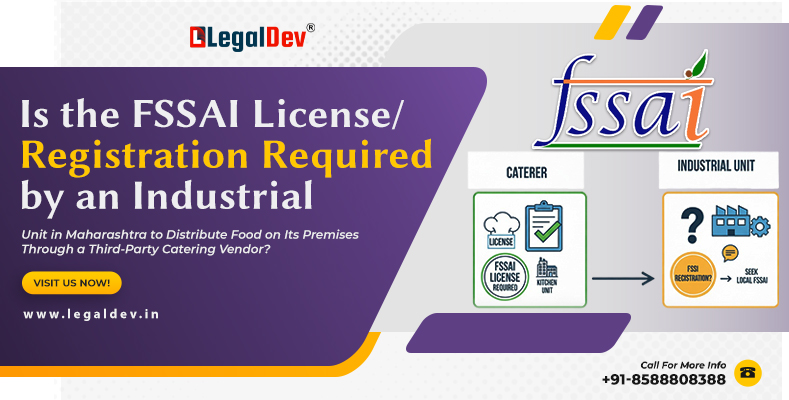
As a result of the Importance of the Food Safety Compliance for business including food, corporation/business/offices, and Industrial unit, every Food business as well as microwaves, corporations, and Industrial units must comply with the food safety act and any laws pertaining to food compliance to be considered a legal business. Many Industrial units in Maharashtra have third-party catering vendors providing their employees with either hot or prepared meals and packaged or prepared food. One question that many Industrial units have is: Does an Industrial unit need an FSSAI registration or FSSAI license even if the food is being purchased from a third-party catering vendor? This comprehensive edition of the Food Safety Compliance Guide was written to answer that question and to help better understand your obligations to comply as outlined in the Food Safety and Standards Act, 2006 regarding Food License Registration, compliance, and the services associated with Food License Registration.
Understanding the Regulatory Framework: FSSAI and Its Mandatory Scope
FSSAI's regulations and monitoring promote 'food safety' throughout the country. FSSAI Compliance needs to be adhered to in manufacturing, storage, transportation, distribution, and consumption of all food items. Essentially, if your company interacts with food in any way, either directly or indirectly, you must comply with FSSAI compliance regulations.
The following classes of businesses as identified by the FSSAI require either a license or registration:
1. Food Manufacturing
2. Food Distribution
3. Retail Food Distribution
4. Canteens & Cafeterias (including Industrial Canteens)
5. Catering Businesses
6. Corporate Kitchens
7. Transport & Storage Facilities
8. Institutions Disseminating Food to Their Employees
It is possible for your company to be classified as a Food Distributor or a Canteen Operator by the manner by which you serve food on or within the confines of your premises, even if you do not cook the food.
Why Industrial Units Provide Food and How FSSAI Rules Apply
Industrial employees often operate under long hours, work with heavy equipment and machinery, and must deal with minimal access to food within a large factory setting. Companies do it in a variety of ways to foster the safety, convenience and productivity of their workforce, including:
• Providing meals through company canteens
•Providing pre-cooked/ready to eat meals from professional catering services
•Providing pre-packaged meals for employees to pick up on their way home
•Providing subsidized meals on site to employees
There is an important distinction in the way that the company provides food, and that is that even though it does not prepare the food itself, it participates in some level of providing, distributing or handling food for employees. FSSAI considers the company as part of the food chain.
Does the Industrial Unit Need an FSSAI License in This Scenario?
Let’s answer the main question:
If an industrial unit in Maharashtra distributes food on its premises that is prepared and delivered by a third-party catering vendor, does it need FSSAI registration?
YES — if the company stores, distributes, or handles food in any form.
YES — if the company operates a canteen or cafeteria (even if outsourced).
YES — if the company subsidizes meals or collects payments.
YES — if the company manages food distribution for employees.
NO — ONLY when the company is NOT involved in any activity related to storage, distribution, or administration of food.
Example:
If the catering vendor delivers food directly to employees outside the company premises, without storing or distributing it inside the unit, then the industrial unit may not require an FSSAI registration.
Is an FSSAI License Required for Industrial Units in Maharashtra Using Third-Party Caterers?
The answer is simple; in most cases, an FSSAI license or registration is necessary to operate as a food distributor/caterer, even if the food was cooked off-site by a vendor.
To understand how this works, consider the following:
1.An Industrial Unit Can Also Be a Food Business Operator.
If a third-party catering company delivers food to an Industrial Facility, that facility is still responsible for distributing it.
Under FSSAI regulations, if you:
• Have a dining area,
• Serve or handle food in any way,
• Store food before serving it,
• Operate an in-house canteen,
• Allow the public to eat their meal on your property,
Then, you are operating as a Food Business Operator and must register with FSSAI.
2. You Cannot Outsource Responsibility.
Many companies believe that if they use a third-party catering service, they are not responsible for the food served, rather that responsibility lies with the vendor.
However, according to FSSAI Guidelines, "Food must meet all food safety standards on premises where food is served, irrespective of the origin of the food".
In essence, the caterer is required to have an FSSAI License and the Industrial Facility must also possess FSSAI Registration as a food distributor or excepted canteen operator.
3. Both Sellers & Subscribers Have a Food Safety Responsibility
Maharashtra FDA inspects:
-
industrial kitchens
-
dining rooms
-
points of food distribution
-
food storage refrigeration units (i.e., racks)
If the seller serves food on their premises, they are responsible to ensure:
-
cleanliness of food
-
food is stored at the appropriate temperature
-
clean & safe handling of food
The above items take place in an industrial unit, so compliance with the Food Safety & Standards Authority of India (FSSAI) applies directly to these functions.
4. Under the FSSAI, Accommodation Facilities for Employees
As per the standards set by the Factory Act, employers are required to provide hygienic areas for employees. When an employer provides food to employees through an employer provided canteen, that food must fall under FSSAI guidelines.
As a result, any company that distributes food or serves food on their premises (directly or indirectly) must obtain a Food License Registration in India.
5. Responsibilities of the Third-Party Vendor
When preparing and delivering cooked meals, the third-party vendor must:
-
possess a valid FSSAI License (depends on turnover)
-
operate from a hygienic kitchen
-
complete timely food safety inspections
-
comply with regulations regarding transportation of food
However, compliance by the third-party vendor does not remove the need for compliance of the industrial unit.
Types of FSSAI Registration Required by Industrial Units
Depending on how much business you’re doing, the type of food business you run in Maharashtra will determine which of the three possible registration options you’ll need to have registered with FSSAI (Food Safety and Standards Authority of India):
Option 1: Basic Registration – For food businesses with an annual turnover that doesn’t exceed Rs. 12 lakhs.
Option 2: State License – For food service companies (restaurants) or large businesses that serve food through a cafeteria, canteen or large commercial unit with an annual turnover between Rs. 12 lakh and Rs. 20 crores.
Option 3: Central License – For large multi-state businesses that serve food throughout India and require licensing from FSSAI to operate.
Most industrial units require either Basic Registration or a State License depending on internal food distribution scale.
Why Industrial Units Must Have Their Own FSSAI Registration
Important reasons for food safety compliance and why you should consider the implications to your food-related business include:
1. Employee Health and Safety Regulation – Ensuring that employees receive a safe and hygienic meal.
2. Legal Compliance with FDA Inspections – Food businesses that do not register with the FSSAI may be subject to one of several consequences:
• Penalties from the FSSAI.
• Legal notice from the FSSAI.
• Operational halt to the canteen/presentation area until FSSAI compliance is achieved.
3. Shared Responsibility Under the Food Safety Act – Even if you are served food by a licensed caterer, the point of service must be compliant with the Food Safety Act.
4. Risk Protection – Food businesses face potential liability in cases of:
• Food poisoning.
• Food contamination.
• Food allergy reactions from customers or employees.
5. Corporate Governance Standards – Safe food and safety audits for food businesses are now part of the corporate governance and sustainability process.
Documentation Required for FSSAI Registration of Industrial Units
Industrial units need to provide:
-
PAN card of the business
-
GST certificate
-
Address proof of the premises
-
Canteen layout (optional in State License)
-
Details of the catering vendor
-
Food safety management plan
-
Photo ID and passport-size photo of the applicant
If you use a Food License Registration Service, these documents are smoothly handled by experts.
How to Get FSSAI Registration in India for Industrial Units
Obtaining FSSAI registration involves:
Step 1: Determining the Category
Identify whether you need Basic, State, or Central License.
Step 2: Preparing Documentation
Common documents include:
-
Identity proof of responsible person
-
Address proof of industrial unit
-
Layout of food distribution area
-
Details of food handling staff
-
NOC from building owner (if applicable)
-
Agreement with catering vendor
Step 3: Filing the Application Online
Applications are submitted via the FoSCoS portal, the official platform for Food License Registration in India.
Step 4: Food Safety Inspection
In many cases, the Maharashtra FDA will inspect the premises before issuing a license.
Step 5: Approval and Issuance of Certificate
Once verified, the FSSAI registration Certificate is issued.
It must be:
-
displayed visibly, and
-
renewed on time every 1–5 years
For hassle-free processing, many industrial units use a professional Food License Registration Service to avoid delays or mistakes.
Why Industrial Units Should Ensure Compliance
Though Food License Registration is not a requirement for Industrial Units, they should:
• Confirm that their vendors have a valid FSSAI License
• Conduct hygiene audits
• Maintain records of compliance with regulations
• Maintain safe storage conditions where applicable
• Follow FDA Food Safety Regulations established by Maharashtra State
Food Safety Issues could result in:
• Health complaints from Employees
• Legal Action
• Loss of Operation Credibility
• Fines from FSSAI
Being aware of the Compliance Issues will allow Industrial Unit Owners to avoid potential Legal Risks and keep their Employees Healthy.
FSSAI Compliance Checklist for Industrial Units (Maharashtra)
Industrial Units are encouraged to compile the following Checklist to assist in identifying and addressing Food Safety Compliance Issues:
• Verify that Caterers maintain a valid FSSAI License
• Ensure Food Safety Management Practices are maintained in both Serving and Dining Areas
• Conduct regular Hygiene Audits of Food Preparation areas and Serving areas
• Organize and maintain clean Food Storage areas
• Maintain records for Employee Meals
• Post FSSAI Registration Numbers at Cafeteria Points
• Require Food Handlers to adhere to good hygiene practices
• Monitor Food Temperature, Storage and Expiration Date compliance
Common Misconceptions About FSSAI License for Industrial Units
1.I do not cook any food, so I do not need an FSSAI license.
Correct Response: Even if a sold item is only distributed, it still needs to meet FSSAI standards.
2.Only the party preparing the food needs a Food License.
Correct Response: Both the company providing the food and the caterer must be licensed.
3.We only keep cooked food in our pantry; we do not serve any prepared food.
Correct Response: Even if you are only storing cut and cooked food to serve, you need to register with FSSAI.
4.We only deliver meals to employees of this company, not to the general public.
Correct Response: All food delivered to employees must still comply with FSSAI guidelines.
Impact of Not Having an FSSAI License for Industrial Units
Failure to have a Food License Registration can lead to the following negative consequences:
1.Legal Penalties
Food distributors can be liable for the following penalties:
• Fines of up to ₹5 lakh
• Closure of all food distributor operations
• Penalties under FSSA, 2006
2. Employee Health Risk
Providing unregulated food can expose employees to the following health risks:
• Foodborne illness (food Poisoning)
• Unsanitary conditions
• Contamination
The above risks will affect both the company’s image and employee productivity.
3. Lack of Vendor Responsibility
Without proper food licensing, a company does not have:
• Legal means to enforce safety on caterers
• Documentation of compliance history
4. Lost Trust from Employees
Employees expect to receive safe food. When food is improperly purchased or receives food poisoning, employee morale and satisfaction will decline.
5. Decreased Insurance and Compliance Opportunities
An organization can be denied insurance claims and finding during government inspections can be attributed to non-compliance with FSSAI Regulations.
Benefits of Obtaining FSSAI Registration for Industrial Units
Having a Food License Registration is more than just fulfilling the law; it can also offer businesses practical benefits.
1.Employee Health & Safety
Most industrial employees rely on snacks and meals from the canteen (or other dispersed locations). Establishing a document that ensures food safety generates trust and mitigates the potential for health incidents.
2. Prevents Liability Penalties
By obtaining an FSSAI registration Certificate, you'll be able to prove to anyone that your facility is fully compliant according to Maharashtra FDA regulations.
3. Improves Brand Credibility
A facility in compliance with the law demonstrates responsibility and professionalism.
4. Strengthens Vendor Relations
When you obtain an FSSAI Certificate, you will be able to enforce the same standards of compliance with your food supply vendors.
5. Streamlines Food Audits
Food Safety Audits by corporate clients, governmental organizations, or internal compliance officers will be made simpler with FSSAI certification.
Common Mistakes Industrial Units Should Avoid
Many large industrial businesses are guilty of making compliance mistakes. The most common mistakes made include:
1. Assuming Vendor’s License Covers the Industry
Many businesses wrongly believe that if the caterer has a Food License Registration Certificate, the industrial unit doesn’t need one.
This is incorrect. Both need separate licenses.
2. Not Verifying Caterer’s License Validity
Industrial Units often do not verify the following:
-
Expiration date of the license
-
License Category
-
Food business type allowed to operate under the license
3. Not being present at the time of the on-site delivery.
if prepared food arrives, improper handling after arrival can lead to contamination of food.
4. Improper Storage of Food.
It is common for bacteria to develop when food is stored incorrectly after a period of time or due to poor handling of food.
5. Lack of Standard Operating Procedures for Food Distribution.
Industries should have internal standard operating procedures for the following:
-
Receiving Food
-
Checking Taste and Smell
-
Temperature Managing
-
Maintaining Clean Serving Areas
6. Not renewing the License in a timely manner.
Individuals working in industrial settings frequently fail to remember the deadline for renewing a food service license and are ultimately operating their businesses illegally after failing to renew their license.
Conclusion
Maharashtra businesses that distribute food through their premises (either made by the company or delivered by a third-party caterer) must have a valid FSSAI registration license to meet all legal obligations, keep employees healthy, establish accountability among workers, and avoid possible fines or penalties. It is important for any catering partner to also have their own food license but it is just as important for the industrial unit to obtain a valid food license and make sure that they are complying with food safety regulations, maintaining high levels of hygiene and properly monitoring how food is handled. By preventing the same mistakes and being aware of what can happen if they do not comply with regulations, companies will create a more safe and legally protected environment and give their employees an enjoyable workplace while performing their duties of distributing food.
FAQs
1. If the food is prepared by a vendor outside, why does the industrial unit need an FSSAI license?
Because the act of distributing or serving food on the premises makes the industrial unit a Food Business Operator.
2. Is the FSSAI license mandatory for employee canteens?
Yes. Employee canteens—whether outsourced or in-house—must have FSSAI registration.
3. Will the caterer’s license cover the industrial unit?
No. Each entity must have its own FSSAI compliance.
4. What if the industrial unit only keeps packaged snacks?
Even storage and distribution of packaged food require FSSAI registration.
5. Does Maharashtra FDA conduct inspections?
Yes. Industrial canteens and food distribution points are routinely inspected.
6. What is the easiest way to apply for FSSAI registration?
Using a professional Food License Registration Service ensures fast, error-free documentation and approval.